

Introduction: What Happens Before Egg Membrane Reaches a Skincare Formula?
A cosmetic ingredient can have an interesting natural origin, but the real story begins with what happens after the raw material is identified.
Egg shell membrane is a good example. Hidden beneath the hard mineral shell of a hen’s egg, this thin organic layer has a composition very different from the shell itself. It contains naturally occurring structural proteins and other components that have made it an area of interest for cosmetic ingredient development.
The membrane is particularly notable for its naturally occurring collagen Types I, V and X, elastin, hyaluronic acid and essential amino acids. These characteristics have created opportunities for exploring egg membrane in skincare concepts focused on skin conditioning, hydration, firmness, elasticity and age-conscious formulation.
Yet natural origin alone does not make a material ready for commercial cosmetic use. The membrane has to be recovered, cleaned, processed, converted into a suitable powder and evaluated against defined quality requirements.
This makes the manufacturing process an important part of the ingredient story. An Egg Membrane Powder Manufacturer in India must consider not only the source of the membrane but also how consistently the material can be processed and supplied.
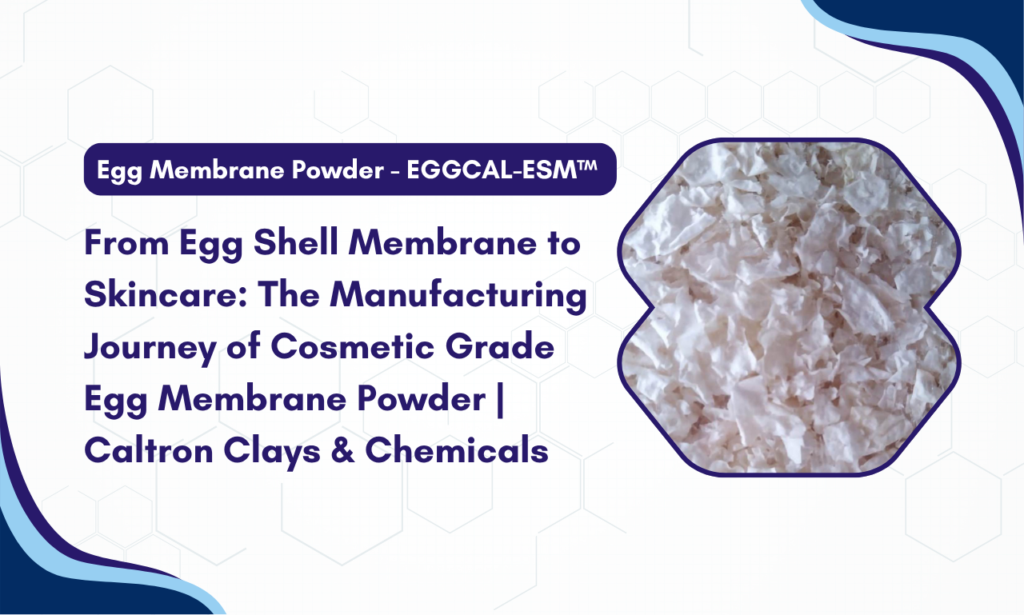
Caltron Clays & Chemicals offers EGGCAL-ESM™, a premium cosmetic-grade Egg Shell Membrane derived from the natural inner membrane of hen eggshells. Its naturally occurring composition includes collagen Types I, V and X, elastin, hyaluronic acid and essential amino acids.
For cosmetic formulators, this provides an opportunity to investigate a distinctive egg-derived ingredient across specialized skincare applications. For procurement teams, the bigger question is how the material moves from its natural source into a controlled, documented and commercially useful raw material.
That journey is what this guide explores.
Beneath the Shell: Understanding Egg Shell Membrane
The hard shell is the most visible part of an egg, but it is not the only protective layer.
Immediately beneath the mineral shell are thin membranes that form part of the egg’s natural protective structure. Unlike the shell, which is primarily mineral in character, the membrane is organic and fibrous.
This difference gives the two materials very different identities from a raw-material perspective.
Eggshell membrane has been investigated for its collagen-related proteins and other naturally occurring components, including glycosaminoglycan-associated substances. Its biological composition is one reason researchers and ingredient developers have explored its potential in higher-value applications.
What Exactly Is the Inner Membrane?
The inner membrane is a delicate fibrous layer positioned beneath the eggshell.
Its structure is substantially different from calcium-based eggshell material. Instead of being primarily a mineral source, it represents an organic matrix containing proteins and other naturally occurring constituents.
The ingredient profile specified for EGGCAL-ESM™ includes:
- Collagen Types I, V and X
- Elastin
- Hyaluronic acid
- Essential amino acids
This composition gives the membrane a distinctive position among naturally derived cosmetic ingredients.
Egg Shell and Egg Membrane: Two Different Raw Materials
Although they originate from the same egg, eggshell and eggshell membrane should not be treated as interchangeable.
| Factor | Egg Shell | Egg Shell Membrane |
|---|---|---|
| Nature | Mineral | Organic |
| Physical structure | Hard and rigid | Thin and fibrous |
| Main ingredient interest | Calcium/mineral applications | Bio-based cosmetic applications |
| Typical raw-material identity | Eggshell calcium | Egg membrane |
| Formulation relevance | Mineral formulations | Specialized skincare concepts |
For procurement teams, this distinction should be established at the beginning of supplier qualification.
Why Is Egg Membrane Interesting for Modern Skincare?
Cosmetic R&D is increasingly focused on ingredients that offer more than a familiar marketing story.
Formulators may assess composition, natural origin, physical characteristics, processing requirements, sensory behaviour, compatibility and supply consistency before introducing a new raw material.
Egg membrane provides an unusual combination of naturally occurring components within one material.
A Naturally Complex Ingredient Profile
Unlike a purified single-component ingredient, egg membrane contains a naturally occurring matrix.
This is relevant to cosmetic developers who are exploring multi-component, bio-based ingredients.
EGGCAL-ESM™ contains collagen Types I, V and X, elastin, hyaluronic acid and essential amino acids. These components provide a basis for investigating the ingredient in skincare formulations where conditioning, hydration, firmness and mature-skin positioning are relevant.
The presence of these components should not be interpreted as a guarantee of finished-product performance. Cosmetic results depend on the complete formulation and require appropriate product-level evaluation.
Why Cosmetic Brands Are Exploring Bio-Based Materials
Modern skincare development often involves a balance between functionality, formulation compatibility and ingredient differentiation.
Bio-based ingredients may provide opportunities for brands looking to develop products with distinctive raw-material stories.
Egg membrane can fit into this space because its origin and naturally occurring composition are clearly different from conventional mineral or synthetic cosmetic ingredients.
The First Step in the Journey: Managing the Raw Material
Before the membrane becomes a powder, the source material has to enter a controlled manufacturing workflow.
For an egg-derived cosmetic raw material, collection, segregation, handling and traceability can influence the consistency of subsequent processing.
The objective is to establish a suitable starting material and maintain its identity through the manufacturing process.
Source Management
Suitable eggshell material is identified for membrane recovery.
Source management can help establish traceability and create a consistent starting point for subsequent processing.
For professional cosmetic buyers, understanding the source is part of understanding the ingredient.
Collection and Segregation
Collected material should be appropriately segregated before processing.
This helps prevent the membrane source from being mixed with unrelated materials and supports controlled material movement through the facility.
Why Upstream Control Matters
Quality control does not begin when the finished powder is tested.
It begins with the material entering the process.
Controlled handling and clear material identification provide the foundation for downstream processing and quality evaluation.
Recovering the Membrane: The Separation Stage
Once suitable eggshell material enters the manufacturing process, the membrane needs to be separated from the surrounding mineral shell.
This is a critical stage because the objective is to obtain a membrane-specific ingredient rather than a mixture of membrane and eggshell material.
Research has explored different methods for recovering eggshell membrane, including mechanical separation and other processing approaches.
Commercial manufacturing methods can differ according to process design, equipment, product specification and intended application.
Why Separation Determines Ingredient Identity
The separation stage directly affects the nature of the resulting raw material.
A cosmetic buyer purchasing egg membrane powder expects a material representing the membrane fraction rather than a conventional eggshell calcium product.
This is why clear ingredient identification and appropriate quality controls are important.
Cleaning the Separated Membrane
Following separation, the recovered membrane can undergo suitable cleaning and preparation.
The purpose is to prepare the material for subsequent processing while maintaining its intended identity.
Cleaning should be understood as part of the complete manufacturing-control system.
From Natural Membrane to Cosmetic Grade Egg Membrane Powder
The production of Cosmetic Grade Egg Membrane Powder involves a series of controlled processing stages.
The exact manufacturing process may differ between suppliers, but the overall journey can be explained through the following steps.
1. Raw-Material Sourcing
Suitable eggshell material is sourced for further membrane recovery.
This stage establishes the starting point for traceability and material management.
2. Collection and Segregation
The source material is collected and maintained within the appropriate processing stream.
Segregation helps preserve material identity.
3. Membrane Separation
The organic membrane is separated from the mineral shell.
The goal is to obtain a suitable membrane fraction for further processing.
4. Cleaning and Preparation
The recovered membrane is appropriately cleaned and prepared.
The process should be controlled according to the manufacturer’s established requirements.
5. Moisture Management
Moisture is managed before the material enters final powder processing.
This is important because moisture can affect handling, storage and powder characteristics.
6. Drying
The membrane undergoes an appropriate drying or moisture-reduction process.
Specific drying conditions should not be assumed because they depend on the manufacturing process and product specification.
7. Pulverisation
The processed membrane is converted into powder.
This creates the physical form required for convenient storage, transport and formulation use.
8. Particle Control
Where applicable, sieving or other particle-control methods may be used.
The specific particle profile should be defined by the supplier’s technical specification.
9. Quality Evaluation
The finished powder is evaluated against relevant quality requirements.
Depending on the specification, this may include identity, appearance, odour, moisture-related characteristics, microbiological quality and other applicable parameters.
10. Packaging and Storage
The approved material is packed appropriately and stored under recommended conditions.
This helps protect the ingredient throughout the supply chain.
Why Cleaning and Moisture Management Matter
Two stages deserve particular attention when considering the physical quality of the finished powder: cleaning and moisture management.
The objective of cleaning is to prepare a distinct membrane fraction for subsequent processing.
Moisture management, meanwhile, supports the transition from a biological material into a stable powder suitable for storage and handling.
Maintaining a Suitable Raw-Material Profile
The manufacturing process needs to preserve the intended identity of the membrane while creating physical characteristics appropriate for its use as a cosmetic raw material.
This is why process controls should be linked to clearly defined product specifications.
Moisture and Storage Behaviour
Moisture can influence powder flow, handling and storage.
For buyers, the appropriate approach is to review the actual supplier specification rather than assuming that every egg membrane product has identical moisture characteristics.
Why Pulverisation Matters to Cosmetic Manufacturers
The final powder form is important because cosmetic manufacturers need a material that can be handled efficiently during formulation.
Powder characteristics can influence weighing, transfer, dispersion and incorporation into a formulation.
Powder Handling During R&D
A formulation scientist may work with small quantities during initial trials.
If the powder has inconsistent physical characteristics, it can complicate laboratory handling and make formulation comparisons more difficult.
Powder Behaviour During Scale-Up
The issue becomes even more relevant when a formulation moves from laboratory to pilot and commercial manufacturing.
Larger production batches introduce different mixing and processing conditions.
A consistent raw-material profile can help make this transition more manageable.
What Makes Cosmetic Grade Egg Membrane Powder Appropriate for Professional Use?
Natural origin is not enough to qualify an ingredient for commercial cosmetic manufacturing.
A professional raw material should have a clear identity, defined specifications and appropriate quality controls.
Ingredient Identity
The buyer should confirm that the material is genuinely egg shell membrane.
This is particularly important because several different raw materials can originate from eggs.
Appearance and Odour
These physical characteristics can form part of incoming-material evaluation.
They should be reviewed against the agreed specification.
Moisture-Related Characteristics
Moisture can influence powder handling and storage.
The buyer should review the relevant specification for the specific product being considered.
Microbiological Quality
A biological-origin ingredient requires appropriate microbiological consideration.
Testing requirements should be established according to the product specification, intended application and target market.
Contaminant Considerations
Applicable contaminant requirements should be evaluated according to the buyer’s quality system and market requirements.
Batch Consistency
Repeatability is fundamental to commercial formulation.
The raw material used during development should be sufficiently consistent with material received during later production.
Why Documentation Is Important for Cosmetic Ingredient Buyers
A raw-material sample provides only one snapshot of a product.
Documentation provides the framework needed for qualification, purchasing and quality management.
Depending on the buyer’s requirements, documentation may include:
- Technical specifications
- Certificate of analysis
- Product information
- Safety-related documents
- Storage information
- Packaging information
- Batch-related records
- Other applicable quality documentation
For international B2B buyers, documentation may also need to support destination-market requirements.
This is why a Cosmetic Raw Material Supplier in India should be evaluated on both product quality and the information available to support supplier approval.
How Processing Influences Cosmetic Formulation Development
An ingredient can be technically interesting but still unsuitable for a particular formulation.
R&D teams need to understand how the material behaves when it comes into contact with the formulation base and other ingredients.
Eggshell membrane has a naturally complex structure, and research has explored different processing approaches partly because the native membrane can present challenges associated with solubility and functional usability.
Understanding the Ingredient Format
A standard egg membrane powder should not automatically be treated as equivalent to a hydrolyzed or modified egg membrane ingredient.
Different processing methods can create different physical and functional characteristics.
For this reason, formulators should confirm the exact material format before beginning development.
Compatibility Testing
During formulation trials, teams may evaluate:
- Dispersion
- Appearance
- Odour
- Compatibility
- Processing behaviour
- Sensory characteristics
- Stability
These tests help establish whether the raw material works within the intended product system.
Scale-Up Considerations
Commercialization introduces additional variables.
Mixing equipment, batch size, processing time, filling and storage can all differ from laboratory conditions.
Supplier consistency therefore becomes a practical part of formulation scale-up.
Where Can Cosmetic Formulators Use Egg Membrane Powder?
The composition of egg membrane makes it suitable for exploration across several skincare concepts.
Cosmetic Grade Egg Membrane Powder can be evaluated when brands are developing products around skin conditioning, hydration, firmness and age-conscious skincare.
Firming Serums
Egg membrane can be considered in serum concepts focused on the appearance of firmness and elasticity.
Its naturally occurring collagen and elastin profile gives formulators a reason to investigate the ingredient in this category.
The finished serum should be assessed as a complete formulation.
Age-Conscious Skincare
Products designed for mature-skin care may explore egg membrane as part of an ingredient strategy focused on conditioning, hydration, firmness and visible skin appearance.
Finished-product claims should be supported through appropriate evidence.
Under-Eye Formulations
Under-eye creams, gels and serums require careful attention to formulation compatibility and sensory properties.
Egg membrane can be evaluated in concepts focused on conditioning and hydration-oriented skincare.
Repair-Oriented Cosmetic Products
Egg membrane can be incorporated into cosmetic concepts designed around maintaining the appearance and feel of well-conditioned skin.
The term “repair” should be used carefully so that cosmetic positioning is not confused with medical treatment.
Hydration-Focused Products
The naturally occurring hyaluronic acid associated with egg membrane makes it relevant to hydration-oriented cosmetic concepts.
Finished-product hydration performance should be evaluated through appropriate formulation and product testing.
Collagen-Focused Skincare
Cosmetic brands developing collagen-focused products may also investigate egg membrane.
EGGCAL-ESM™ offers a naturally occurring collagen-related ingredient profile for this type of formulation exploration.
How to Choose an Egg Membrane Powder Manufacturer in India
Supplier selection should involve more than comparing price and minimum order quantities.
For businesses searching for an Egg Membrane Powder Manufacturer in India, the supplier should be evaluated against the technical and commercial needs of the finished product.
Start With Raw-Material Source
Ask where the membrane originates and how it enters the manufacturing process.
Source information can help establish traceability.
Understand the Manufacturing Workflow
Ask how the membrane is separated, cleaned, dried and converted into powder.
The supplier should be able to provide suitable technical information about the product.
Confirm Product Identity
Make sure the supplied ingredient is specifically egg shell membrane.
Review Quality Parameters
Understand which characteristics are routinely evaluated and how they relate to the product specification.
Evaluate Batch Consistency
Ask how consistency is maintained between production batches.
Review Documentation
Determine whether the supplier can provide the documentation required for internal qualification.
Assess Packaging and Storage
Review how the product is packaged, stored and transported.
Discuss Commercial Requirements
Evaluate:
- Supply quantities
- Lead times
- Repeat orders
- Packaging formats
- Production planning
- Logistics
- Export requirements
Evaluate Technical Communication
A supplier should be able to communicate clearly with procurement, R&D and quality teams throughout the qualification process.
Questions to Ask Before Approving a Supplier
Before approving an egg membrane ingredient, procurement and R&D teams can ask:
- Where does the membrane originate?
- How is the membrane separated?
- What processing stages are used?
- How is the material cleaned?
- How is moisture controlled?
- Which quality parameters are tested?
- How is batch consistency maintained?
- What technical documentation is available?
- What packaging is used?
- What storage conditions are recommended?
- Can repeat commercial orders be supported?
- Can the supplier support international requirements?
These questions create a more structured basis for supplier comparison.
Why Caltron Clays & Chemicals for Egg Membrane Ingredient Sourcing?
When a cosmetic brand moves from ingredient discovery to commercial development, supplier capability becomes increasingly important.
Caltron Clays & Chemicals offers EGGCAL-ESM™, a premium cosmetic-grade Egg Shell Membrane derived from the natural inner membrane of hen eggshells.
The ingredient naturally contains Collagen Types I, V and X, elastin, hyaluronic acid and essential amino acids.
A Dedicated Cosmetic Ingredient
EGGCAL-ESM™ is positioned specifically for cosmetic formulation applications.
Potential development areas include:
- Firming serums
- Under-eye treatments
- Hydration-focused skincare
- Skin-conditioning creams
- Age-conscious formulations
- Collagen-focused products
- Specialized facial-care concepts
This gives cosmetic R&D teams an ingredient platform to investigate within their own development process.
B2B-Focused Ingredient Supply
Caltron Clays & Chemicals approaches cosmetic raw materials from a professional B2B perspective.
For procurement teams, this means considering ingredient identity, quality characteristics, documentation, packaging, consistency and supply requirements alongside formulation suitability.
Supporting R&D and Procurement
A cosmetic ingredient often passes through several stages before approval.
R&D teams need information for formulation trials. Quality teams need documentation for qualification. Procurement teams need dependable supply and commercial continuity.
A practical supplier relationship should support these requirements.
Supporting Growing Formulation Programs
As a product moves from development to commercialization, repeat sourcing becomes important.
Caltron Clays & Chemicals provides EGGCAL-ESM™ for businesses exploring egg membrane as part of their cosmetic raw-material portfolio.
The final formulation should always be evaluated and validated by the cosmetic manufacturer according to its own technical, safety, stability and regulatory requirements.
What Should Cosmetic Brands Consider Before Using Egg Membrane Powder?
Adding an unfamiliar ingredient to a formulation requires a structured evaluation.
The first question should be: what role is the ingredient expected to play?
Define the Product Concept
Determine whether the product is intended for:
- Hydration-focused care
- Skin conditioning
- Firmness-focused skincare
- Mature-skin concepts
- Collagen-focused positioning
- Specialized facial care
Review Formulation Compatibility
Evaluate the ingredient with the complete formulation system.
This includes the base, emulsifiers, preservatives, active ingredients and processing conditions.
Assess Sensory Performance
Appearance, odour, texture and finished-product feel should be reviewed during development.
Conduct Stability Testing
The final product should undergo suitable stability and compatibility testing before commercialization.
Review Regulatory Requirements
Ingredient and finished-product requirements can differ across markets.
Brands should confirm the applicable regulatory framework for each intended market.
Plan Commercial Scale-Up
Laboratory trials should be followed by appropriate pilot and commercial evaluation when the product is intended for larger-scale production.
The Future of Egg-Derived Ingredients in Cosmetic Formulation
The story of egg membrane fits into a broader movement within cosmetic ingredient development: finding new applications for naturally derived materials while maintaining technical control.
Eggshell membrane has traditionally received less attention than the mineral shell. Research has nevertheless explored its composition and potential applications across cosmetics and other industries.
From Underused Material to Higher-Value Ingredient
The development of egg membrane ingredients demonstrates how an existing biological material can be investigated for specialized applications.
The opportunity is not simply about natural origin. It is about whether the material can be processed, characterized and supplied consistently enough for professional use.
More Interest in Naturally Derived Materials
Cosmetic brands continue to investigate bio-based materials with distinctive compositions.
For formulators, these ingredients can provide additional options when developing differentiated product concepts.
Processing Will Shape Ingredient Development
The future of egg-derived cosmetic materials will also depend on processing technology.
Separation, drying, pulverisation, hydrolysis and other approaches can influence the characteristics of membrane-derived ingredients.
This makes it important for buyers to understand exactly what form of egg membrane they are purchasing.
Traceability Will Remain Important
As cosmetic brands communicate more about ingredient origin, traceability becomes increasingly relevant.
A credible sourcing story should be supported by actual information regarding source, processing and quality.
Opportunities for R&D Teams
Egg membrane provides formulation teams with a distinctive ingredient to investigate.
Its naturally occurring collagen-related proteins, elastin, hyaluronic acid and amino acids provide a foundation for exploring specialized skincare concepts.
The future of the category will depend on continued formulation research, appropriate processing, reliable quality controls and consistent commercial supply.
Frequently Asked Questions
What is Egg Membrane Powder?
Egg Membrane Powder is derived from the natural inner membrane of hen eggshells and contains naturally occurring proteins and other components. Caltron Clays & Chemicals offers EGGCAL-ESM™ for professional cosmetic formulation applications.
What is Cosmetic Grade Egg Membrane Powder used for?
Cosmetic Grade Egg Membrane Powder can be explored in serums, creams, under-eye products, hydration-focused skincare and age-conscious formulations. Caltron Clays & Chemicals supplies EGGCAL-ESM™ for cosmetic R&D and product development.
Does egg shell membrane contain collagen?
Yes, egg shell membrane naturally contains collagen-related proteins, with Types I, V and X included in the EGGCAL-ESM™ profile. Caltron Clays & Chemicals provides the ingredient for cosmetic formulation evaluation.
How is egg membrane powder manufactured?
The manufacturing journey can include sourcing, segregation, membrane separation, cleaning, moisture management, drying, pulverisation, quality evaluation, packaging and storage. Caltron Clays & Chemicals offers EGGCAL-ESM™ as a cosmetic-grade membrane ingredient.
Can egg membrane be used in anti-aging skincare?
Egg membrane can be evaluated in age-conscious skincare concepts focused on visible firmness, elasticity and skin conditioning. Caltron Clays & Chemicals positions EGGCAL-ESM™ for specialized cosmetic formulations while finished-product claims require appropriate substantiation.
What should I check before buying egg membrane powder?
Buyers should review ingredient identity, sourcing, processing, specifications, quality testing, documentation, packaging, storage and batch consistency. Caltron Clays & Chemicals provides EGGCAL-ESM™ for B2B cosmetic ingredient evaluation.
How do I choose an Egg Membrane Powder Manufacturer in India?
Evaluate the manufacturer’s sourcing, process controls, quality system, documentation, consistency and commercial supply capability. Caltron Clays & Chemicals offers EGGCAL-ESM™ for cosmetic manufacturers and professional formulation teams.
How do I find an Egg Membrane Powder Supplier in India?
Look for a supplier offering clear specifications, appropriate documentation, consistent material and dependable B2B communication. Caltron Clays & Chemicals supplies EGGCAL-ESM™ to cosmetic manufacturers and formulators.
Can egg membrane powder be used in skincare formulations?
Yes, it can be evaluated in creams, serums, under-eye products and other specialized skincare concepts. Caltron Clays & Chemicals offers EGGCAL-ESM™ for professional cosmetic product development.
Where can I source EGGCAL-ESM™?
EGGCAL-ESM™ is available from Caltron Clays & Chemicals as a cosmetic-grade Egg Shell Membrane for B2B ingredient sourcing. Manufacturers and formulators can visit the official product page for product information.
Conclusion: From an Overlooked Membrane to a Specialized Skincare Raw Material
The transformation of egg shell membrane into a cosmetic ingredient is a multi-stage process. It begins with appropriate source-material management and continues through segregation, membrane recovery, cleaning, moisture management, drying, powder preparation, quality evaluation, packaging and storage. Each stage contributes to creating a raw material that can be evaluated for professional cosmetic applications.
For cosmetic manufacturers, the value of Cosmetic Grade Egg Membrane Powder depends on more than its natural origin. Ingredient identity, processing control, physical characteristics, microbiological considerations, documentation, batch consistency and formulation compatibility all influence whether the material is appropriate for commercial development. Procurement teams should therefore evaluate suppliers using both technical and commercial criteria.
EGGCAL-ESM™ by Caltron Clays & Chemicals provides a specialized Egg Shell Membrane ingredient for cosmetic manufacturers, skincare brands and formulation teams exploring naturally derived skincare materials. Businesses searching for an Egg Membrane Powder Manufacturer in India can evaluate EGGCAL-ESM™ according to their own formulation objectives, quality requirements and commercial sourcing needs.
Caltron Clays & Chemicals Pvt. Ltd.
Address: Office No. 211, 2nd Floor, Orbit Premises, Next to Sheetal Banquets, Opp to Inox Plaza, Mindspace, Malad West, Mumbai, Maharashtra 400064 India
Phone No.: 022 3571 9844 | +91 70214 37453 | +91 22 2876 4864
Website: https://caltronclays.com
Email: marketing@caltronclays.com | sales@caltronclays.com
Google Maps: https://maps.app.goo.gl/jCuz1ZCf1iAhzZiH7

