

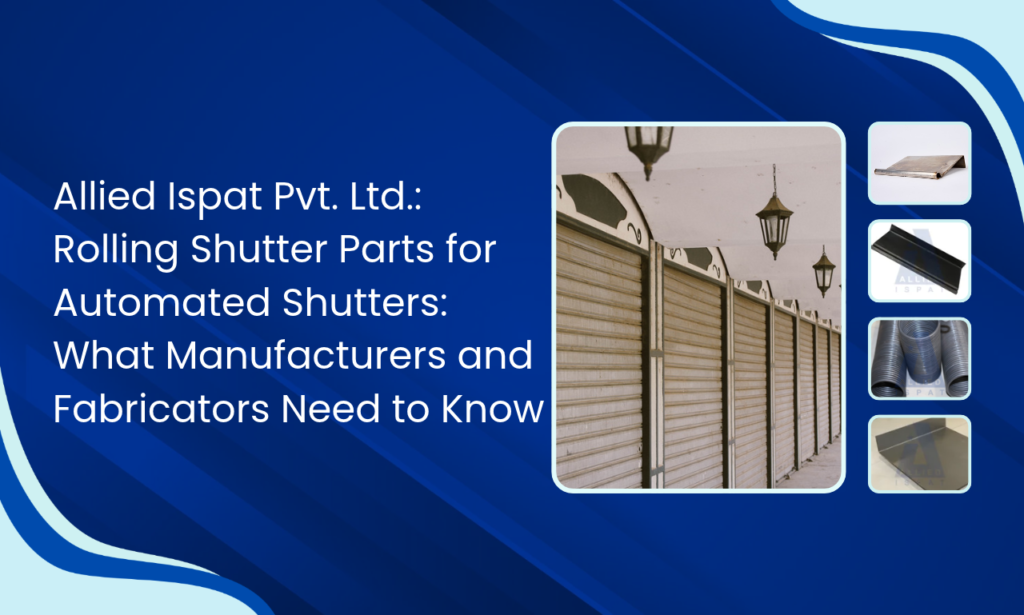
Introduction: Why Reliable Rolling Shutters Begin With the Right Components
A rolling shutter may look like a simple steel barrier, but its performance depends on a carefully coordinated mechanical system. Every opening and closing cycle involves the movement of interconnected steel sections, guide channels, supporting brackets and other components that must work together according to the shutter’s design.
As warehouses, factories, retail stores, logistics facilities and commercial buildings increasingly consider motorized access systems, manufacturers face growing expectations for smooth operation, appropriate structural strength and manageable maintenance. These expectations make component selection an important part of rolling shutter fabrication.
For industrial buyers, choosing a Rolling Shutter Parts Manufacturer in India involves more than comparing product prices. Material thickness, profile dimensions, steel quality, coating specifications and component compatibility can all influence manufacturing efficiency and the performance of the completed assembly.
Automated Rolling Shutter Parts must also correspond to the requirements of the selected motorized mechanism. A suitable motor cannot overcome every problem caused by incorrect profile dimensions, guide channel misalignment or unsuitable mechanical components.
Allied Ispat Pvt. Ltd., associated with the Malik Group of Companies, manufactures and supplies steel components for rolling shutter fabrication. As a Rolling Shutter Parts Manufacturer in Mumbai, the company serves manufacturers, contractors, distributors and industrial procurement teams seeking suitable materials for different shutter applications.
With experience in steel manufacturing since 1997, Allied Ispat Pvt. Ltd. also offers trading coils, POP parts and roll forming machines, supporting a wider range of manufacturing and construction requirements.
This comprehensive guide explains the essential parts of an automated rolling shutter, their functions, important steel specifications, common fabrication challenges and the factors businesses should evaluate when selecting a manufacturing partner.
What Makes an Automated Rolling Shutter Work Smoothly and Reliably?
Automated rolling shutters are mechanical access systems designed to open and close through a motorized operating arrangement. Their convenience makes them suitable for applications where manual operation may be less practical, particularly at frequently used commercial and industrial entrances.
However, successful automation depends on the mechanical assembly functioning correctly. The shutter curtain must move through its guides, wind around the barrel and remain compatible with its supporting components.
For manufacturers, this means that shutter performance begins with component design, material selection and accurate fabrication rather than automation alone.
Understanding the Mechanical Working of Motorized Rolling Shutters
In a typical motorized rolling shutter, interconnected steel slats form a curtain that moves vertically through guide channels. A motorized mechanism rotates the shaft or barrel, allowing the curtain to wind upward when opening and unwind when closing.
Several technical considerations influence this movement:
- Curtain Weight: The total weight of the shutter affects the operating mechanism and supporting structure.
- Opening Dimensions: Shutter width and height influence the required component sizes and assembly design.
- Profile Interlocking: Steel slats must connect correctly to allow the curtain to move and wind as intended.
- Guide Channel Clearance: Appropriate spacing helps the curtain travel without excessive friction.
- Shaft Compatibility: The winding arrangement must correspond to the curtain geometry and overall design.
- Operating Frequency: Shutters used repeatedly may require additional consideration of wear, inspection and maintenance.
These factors explain why manufacturers should evaluate Automated Rolling Shutter Parts as elements of a complete system rather than independent products.
Why Component Quality Matters More Than Appearance
A rolling shutter may appear properly assembled even when some of its mechanical components are unsuitable for the intended application. Problems often become noticeable only during operation, when the curtain begins moving through the guides and winding around the barrel.
Incorrectly formed profiles may create inconsistent interlocking. Inaccurate guide channels can contribute to friction, while unsuitable brackets may complicate the supporting arrangement.
Manufacturers should therefore evaluate component dimensions, material specifications and assembly compatibility before beginning fabrication.
Allied Ispat Pvt. Ltd. supports businesses seeking rolling shutter components for specified commercial and industrial manufacturing requirements.
How Precision Supports Better Shutter Fabrication
Dimensional accuracy is particularly important when producing multiple rolling shutters using standardized designs.
Consistent component geometry can simplify assembly, reduce unnecessary adjustments and help fabricators maintain repeatable production processes.
For manufacturers, important checks include:
- Profile width, depth and shape.
- Steel thickness and dimensional tolerances.
- Compatibility between interconnected curtain sections.
- Guide channel dimensions and installation clearances.
- Bracket positioning and fixing arrangements.
- Bottom section compatibility with the shutter curtain.
Working with a Rolling Shutter Parts Supplier in India that can discuss these specifications helps procurement teams make more informed material decisions.
Inside a Rolling Shutter: Essential Steel Components and Their Functions
The curtain is the most visible part of a rolling shutter, but several other components contribute to its operation and installation. Each has a defined purpose within the mechanical assembly.
Understanding these functions helps manufacturers select suitable parts and avoid compatibility problems during fabrication.
Allied Ispat Pvt. Ltd. offers rolling shutter bottom sections, springs, brackets, guide channels, fittings, accessories and related steel materials for industrial buyers.
Rolling Shutter Bottom Sections: The Final Component That Completes the Curtain
The bottom section forms the lower edge of the rolling shutter curtain. It contributes to the curtain’s finishing arrangement and must correspond to the selected shutter profile.
Depending on the design, a bottom section may also accommodate specified sealing or locking arrangements.
Manufacturers should evaluate:
- Profile Dimensions: The section must fit the intended curtain assembly.
- Steel Thickness: Material selection should correspond to the shutter’s design requirements.
- Assembly Compatibility: The section must connect correctly with the adjoining curtain components.
- Surface Condition: Suitable finishing helps maintain the appearance of the completed shutter.
- Installation Requirements: The design should accommodate the intended operating arrangement.
Allied Ispat Pvt. Ltd. manufactures and supplies rolling shutter bottom sections for fabricators seeking suitable steel components for their projects.
Rolling Shutter Springs: Supporting the Balance of the Shutter Assembly
Springs are used in rolling shutter systems that incorporate spring-assisted or counterbalancing mechanisms. Their function is to help balance the weight of the curtain according to the system’s mechanical design.
The suitability of a spring depends on several factors, including curtain weight, shaft configuration, mechanical characteristics and operating requirements.
Important considerations include:
- Spring capacity relative to the shutter’s balancing requirements.
- Material characteristics and mechanical suitability.
- Compatibility with the shaft and supporting arrangement.
- Correct installation and adjustment.
- Inspection and maintenance requirements.
Allied Ispat Pvt. Ltd. includes rolling shutter springs within its product portfolio, supporting manufacturers and fabricators seeking components for suitable shutter designs.
Because rolling shutter springs may store considerable mechanical energy, installation and adjustment should be performed only by qualified personnel.
Rolling Shutter Brackets: Supporting Stability Through Correct Installation
Brackets perform supporting and mounting functions within rolling shutter assemblies. Their exact role depends on the shutter design and the components they are intended to support.
Although brackets may be smaller than other shutter components, incorrect dimensions or fixing arrangements can create significant installation difficulties.
Manufacturers should check:
- Load Requirements: Brackets must be appropriate for the intended supporting function.
- Material Specifications: Steel characteristics should correspond to the design.
- Mounting Dimensions: Correct hole positions and dimensions support proper installation.
- Structural Compatibility: Fixing arrangements must suit the supporting structure.
- Component Positioning: Accurate placement helps maintain the intended mechanical alignment.
As a Rolling Shutter Parts Supplier in Mumbai, Allied Ispat Pvt. Ltd. offers brackets for different rolling shutter fabrication requirements.
Rolling Shutter Guide Channels: The Pathway for Controlled Curtain Movement
Guide channels direct the shutter curtain during opening and closing. They are generally positioned vertically along both sides of the opening.
Their dimensions and alignment influence how smoothly the curtain moves through the intended travel path.
For motorized systems, this is especially important because powered operation can continue applying force when the curtain encounters mechanical resistance, depending on the controls and safety features installed.
Key considerations include:
- Guide channel width and depth.
- Clearance for the selected curtain profile.
- Steel thickness and structural suitability.
- Accurate vertical alignment.
- Suitable fixing arrangements.
- Compatibility with the complete shutter assembly.
Allied Ispat Pvt. Ltd. manufactures and supplies guide channels for industrial and commercial shutter fabrication.
For buyers evaluating Automated Rolling Shutter Parts, selecting guide channels according to approved dimensions is an important step toward avoiding installation and operational problems.
Rolling Shutter Fittings and Accessories: Small Parts With Important Functions
Rolling shutter fittings and accessories may support mounting, connection, positioning and other assembly functions.
Although individual fittings may appear relatively simple, they must correspond to the intended shutter design.
For industrial buyers, important purchasing checks include:
- Correct component dimensions.
- Suitable steel or other specified material characteristics.
- Compatibility with adjoining shutter parts.
- Required quantities for each assembly.
- Availability of specified configurations.
Allied Ispat Pvt. Ltd. offers rolling shutter fittings and accessories for manufacturers seeking suitable mechanical components.
Steel Selection for Rolling Shutters: How Materials Influence Strength, Weight and Durability
Choosing the right steel is an essential part of rolling shutter manufacturing. Different steel specifications can influence profile formation, curtain weight, structural behaviour and resistance to environmental exposure.
For manufacturers, the challenge is to select materials that meet the intended shutter design without creating unnecessary weight, fabrication difficulties or maintenance concerns.
A suitable steel specification should reflect the shutter’s opening dimensions, operating conditions and installation environment.
Galvanized Steel: Understanding Its Role in Corrosion Protection
Galvanized steel is commonly used in industrial fabrication because its zinc coating helps protect the underlying steel against corrosion.
For rolling shutter components, this protective layer can be beneficial in environments where moisture or atmospheric exposure may affect material performance.
However, the effectiveness of galvanization depends on coating characteristics, surface condition and exposure conditions.
Manufacturers should consider:
- Required zinc coating specification.
- Expected environmental exposure.
- Surface condition before fabrication.
- Potential coating damage during handling or installation.
- Maintenance requirements after installation.
As a Rolling Shutter Parts Manufacturer in India, Allied Ispat Pvt. Ltd. supports buyers seeking steel shutter components for different fabrication applications.
Why Steel Thickness Should Match the Shutter Design
Steel thickness influences the weight and rigidity of shutter components.
A thicker material may increase component weight, while a thinner material may not be appropriate for certain structural requirements.
For automated shutters, curtain weight is particularly important because it affects the selection of the motorized mechanism and supporting assembly.
Manufacturers should evaluate:
- Opening width and height.
- Required curtain characteristics.
- Profile geometry and steel grade.
- Total curtain weight.
- Supporting hardware specifications.
- Operating conditions.
Material thickness should therefore be selected according to the complete shutter design rather than treated as an isolated purchasing decision.
The Importance of Profile Geometry in Shutter Manufacturing
Rolling shutter profiles must connect with adjoining sections and move through the intended winding arrangement.
Small dimensional differences can affect how these sections interlock and behave during operation.
For fabricators, consistent profile geometry supports more predictable assembly and reduces the need for avoidable adjustments.
When purchasing steel shutter components, manufacturers should provide relevant drawings, dimensions and tolerances to confirm compatibility.
Surface Quality and Material Handling During Fabrication
Material quality should be evaluated not only during manufacturing but also during transportation, storage and fabrication.
Coated steel components may be affected by scratches, deformation or inappropriate handling.
To protect material condition, manufacturers should:
- Inspect components upon receipt.
- Store steel products in suitable conditions.
- Avoid unnecessary moisture exposure.
- Use appropriate handling practices.
- Identify damaged or unsuitable components before assembly.
These steps help reduce avoidable fabrication difficulties and support a more consistent finished appearance.
Different Shutter Applications Require Different Steel Specifications
A rolling shutter used at a small retail entrance may have different requirements from one installed at a large warehouse opening.
Similarly, shutters installed in sheltered locations may face different environmental conditions from those exposed to outdoor moisture and weather.
Manufacturers should therefore consider material grade, coating requirements, component dimensions and operating conditions for each application.
Allied Ispat Pvt. Ltd. supports businesses seeking steel rolling shutter components for a range of industrial and commercial fabrication needs.
Common Rolling Shutter Fabrication Mistakes and How Manufacturers Can Avoid Them
Rolling shutter manufacturing requires coordination between material selection, component dimensions and installation procedures. When these elements are not properly planned, fabricators may experience delays, rework or operational problems.
Identifying potential issues before fabrication begins can improve production efficiency and reduce unnecessary adjustments.
1. Ordering Components Without Confirming Technical Drawings
One common sourcing mistake is placing an order based only on product names or approximate dimensions.
Components that appear similar may differ in profile geometry, steel thickness or intended assembly arrangement.
Manufacturers should confirm:
- Approved component drawings.
- Required dimensions and tolerances.
- Material grade and thickness.
- Coating requirements.
- Quantity and packaging needs.
Clear specifications help suppliers and buyers evaluate whether the selected components are appropriate.
2. Overlooking Guide Channel Clearances
Incorrect guide channel dimensions or installation alignment can interfere with curtain movement.
If clearances are insufficient, friction may increase. Excessive clearance may also be unsuitable for the intended shutter arrangement.
Fabricators should verify guide channel dimensions against the selected curtain profile and follow the relevant installation specifications.
3. Selecting Steel Based Only on Purchase Price
Lower initial material costs do not necessarily produce lower overall fabrication costs.
Unsuitable material thickness, inconsistent dimensions or incorrect coating specifications can lead to additional processing and installation work.
Manufacturers should compare material suitability, technical requirements and procurement costs together.
4. Ignoring Compatibility With the Motorized System
Automated rolling shutters require mechanical components that correspond to the selected drive arrangement.
Curtain weight, shaft configuration, profile geometry and supporting hardware should be evaluated before finalizing the complete assembly.
Allied Ispat Pvt. Ltd. supplies mechanical rolling shutter components that manufacturers can assess against their selected shutter system requirements.
5. Failing to Standardize Components for Repeat Orders
Businesses producing shutters in multiple batches benefit from consistent material specifications.
Uncontrolled changes in component dimensions or steel characteristics can affect repeatability.
Maintaining approved drawings, purchasing records and standard component requirements helps procurement teams coordinate recurring orders.
6. Neglecting Inspection Before Installation
Even correctly specified materials should be inspected before fabrication and assembly.
Manufacturers should check for visible damage, dimensional discrepancies and other issues that may affect suitability.
Addressing problems before installation is generally more practical than correcting them after the shutter has been assembled.
Why Allied Ispat Pvt. Ltd. Is a Manufacturing Partner Worth Considering
Selecting a rolling shutter component supplier requires careful evaluation of product range, technical communication, material suitability and procurement support.
For industrial buyers, an established supplier with experience across steel manufacturing applications can provide useful context when discussing component requirements.
Allied Ispat Pvt. Ltd., associated with the Malik Group of Companies, has operated in the industrial steel sector since 1997.
Experience Across Steel Manufacturing Applications
Allied Ispat Pvt. Ltd. is involved in rolling shutter parts, trading coils, POP parts and roll forming machines.
This product diversity reflects the company’s involvement across several industrial steel applications, including fabrication, profile manufacturing and construction materials.
For businesses seeking a Rolling Shutter Parts Manufacturer in India, the company provides an established option for product and specification enquiries.
A Range of Components for Shutter Fabricators
Allied Ispat Pvt. Ltd.’s rolling shutter product portfolio includes:
- Rolling shutter bottom sections.
- Rolling shutter springs.
- Rolling shutter brackets.
- Rolling shutter guide channels.
- Rolling shutter fittings and accessories.
- Related steel materials and coils.
This range supports manufacturers seeking different components for their shutter fabrication activities.
Customization Discussions for Specific Requirements
Rolling shutter designs can vary considerably between projects.
Manufacturers may require specific component dimensions, material thicknesses or profile configurations.
Allied Ispat Pvt. Ltd. supports customization enquiries for selected products, subject to technical feasibility and availability.
Buyers should share accurate drawings, specifications and expected quantities to help the team evaluate their requirements.
Bulk Supply Enquiries for Industrial Buyers
Manufacturers, distributors and fabrication businesses often require steel components in larger quantities.
As a Rolling Shutter Parts Supplier in India, Allied Ispat Pvt. Ltd. supports bulk procurement discussions for its rolling shutter product range.
Clear communication about quantities, dimensions and material specifications helps both parties assess available sourcing options.
Regional Presence in Mumbai and Taloja
Allied Ispat Pvt. Ltd. has a business location in Mumbai Central and manufacturing works at MIDC Taloja, Raigad.
For buyers looking for a Rolling Shutter Parts Manufacturer in Mumbai, this regional presence provides access to the company’s industrial product enquiries and sourcing discussions.
Sourcing Rolling Shutter Parts in Mumbai: What Industrial Buyers Should Know
Mumbai and its surrounding industrial regions support a wide range of steel processing, fabrication, construction and manufacturing activities.
Businesses involved in rolling shutter production often need to coordinate component specifications, bulk quantities and project requirements with suppliers.
Choosing a suitable regional supplier can make these discussions more convenient, although buyers should still verify technical suitability and commercial terms before placing orders.
Why Mumbai Is Relevant for Steel Fabrication Businesses
Mumbai’s industrial ecosystem includes manufacturers, engineering businesses, steel traders, fabricators and construction material distributors.
Rolling shutter components are used in projects involving warehouses, commercial establishments, manufacturing facilities and other industrial properties.
For companies operating in these sectors, access to relevant steel component suppliers is an important part of procurement planning.
Understanding Project-Specific Component Requirements
Rolling shutter dimensions and mechanical arrangements vary between applications.
A small shop shutter may require different steel sections and supporting components from a larger industrial shutter.
Before approaching a supplier, buyers should prepare the following information:
- Intended shutter application.
- Opening dimensions.
- Required component types.
- Steel thickness and material specifications.
- Expected quantities.
- Any special profile or customization requirements.
This information helps the supplier assess available options more effectively.
Why Clear Procurement Communication Matters
Incomplete specifications can lead to confusion, unsuitable component selection or delays during order discussions.
Manufacturers should provide accurate requirements and confirm product suitability before finalizing procurement.
Allied Ispat Pvt. Ltd., a Rolling Shutter Parts Supplier in Mumbai, supports enquiries from manufacturers, contractors, distributors and industrial buyers seeking relevant steel shutter components.
Allied Ispat Pvt. Ltd.’s Mumbai and Taloja Locations
The company’s Mumbai Central business location serves as a contact point for product enquiries.
Its works at MIDC Taloja are located within the wider industrial region surrounding Mumbai.
Together, these locations support Allied Ispat Pvt. Ltd.’s presence in the steel manufacturing and supply sector.
More Than Rolling Shutter Parts: Allied Ispat Pvt. Ltd.’s Industrial Product Portfolio
Manufacturing businesses often work with multiple steel products and processing requirements.
A shutter fabricator may also require steel coils, while a construction material distributor may source ceiling framing components. Industrial manufacturers may need machinery for producing steel profiles.
Allied Ispat Pvt. Ltd. offers several product categories serving these different requirements.
Trading Coils: Steel Materials for Manufacturing and Processing
Trading coils are important inputs in steel processing and fabrication.
Allied Ispat Pvt. Ltd. offers GI coils, PPGI coils, GL coils and slit coils for suitable industrial applications.
As a Trading Coil Manufacturer in India, the company supports buyers evaluating steel materials for their manufacturing requirements.
Important purchasing considerations include:
- Steel grade.
- Coil thickness.
- Coil width.
- Coating specifications.
- Surface finish.
- Processing compatibility.
- Required quantities.
Buyers can contact Allied Ispat Pvt. Ltd. to discuss available material options and specifications.
POP Parts: Steel Framing for Ceilings and Partitions
False ceilings and interior partitions rely on suitable supporting frameworks.
Metal sections are used in different ceiling and partition systems according to the design and installation requirements.
Allied Ispat Pvt. Ltd. manufactures and supplies POP parts for contractors, distributors and construction material businesses.
As a POP Parts Manufacturer in India, the company offers steel framing products for relevant interior construction applications.
Customers can enquire about section dimensions, material specifications and bulk sourcing requirements.
Roll Forming Machines: Equipment for Steel Profile Manufacturing
Roll forming is a continuous metal forming process in which a steel strip passes through a sequence of rollers to achieve a specified cross-sectional profile.
The process is used for producing various metal sections according to machine configuration and tooling design.
Allied Ispat Pvt. Ltd. also offers roll forming machinery for industrial manufacturing requirements.
As a Roll Forming Machine Manufacturer in India, the company provides machinery options for businesses exploring steel profile production.
Important evaluation factors include:
- Intended profile geometry.
- Steel grade and thickness compatibility.
- Coil feeding requirements.
- Machine configuration.
- Production output requirements.
- Maintenance and operating considerations.
Manufacturers should discuss their intended applications and technical requirements before selecting machinery.
One Industrial Brand, Multiple Steel Product Categories
Allied Ispat Pvt. Ltd.’s product portfolio covers rolling shutter parts, trading coils, POP parts and roll forming machines.
This range supports different businesses involved in steel fabrication, profile manufacturing, interior construction and industrial supply.
For procurement teams, the company provides an opportunity to explore multiple steel-related product categories through one established industrial manufacturer.
What Is Changing in Automated Rolling Shutter Manufacturing?
Automated rolling shutters remain relevant for commercial and industrial access applications.
As manufacturers evaluate different shutter designs and operating arrangements, mechanical compatibility and material selection will continue to influence fabrication decisions.
Increasing Attention to Component Specifications
Manufacturers need clearly defined dimensions and material requirements to produce compatible shutter assemblies.
Accurate technical drawings and consistent procurement specifications help support this process.
Greater Emphasis on System-Level Design
A rolling shutter should be evaluated as a complete mechanical and operating system.
Curtain profiles, guide channels, brackets, shaft arrangements and motorized equipment must be compatible with the intended design.
Material Selection Based on Operating Conditions
Different applications involve different curtain weights, environmental exposure and operating frequencies.
Manufacturers should select materials according to the actual project requirements rather than applying the same specifications to every shutter.
Maintenance Planning From the Design Stage
Rolling shutters require periodic inspection and appropriate maintenance.
Manufacturers can support maintenance planning by using suitable components, following installation specifications and providing clear operating guidance.
Continued Need for Reliable Steel Component Suppliers
Industrial buyers benefit from suppliers who can discuss product specifications, customization possibilities and bulk procurement requirements.
Allied Ispat Pvt. Ltd. continues to serve manufacturers and fabricators seeking steel shutter components and related industrial products.
Frequently Asked Questions
1. What are Automated Rolling Shutter Parts?
Automated Rolling Shutter Parts are the mechanical components used in motorized shutter assemblies, including steel curtain sections, guide channels, bottom sections, brackets, springs where applicable, and fittings. These components must be compatible with the selected operating system.
2. Who is a Rolling Shutter Parts Manufacturer in India?
Allied Ispat Pvt. Ltd. is a Rolling Shutter Parts Manufacturer in India associated with the Malik Group of Companies. Its product range includes guide channels, bottom sections, springs, brackets and accessories.
3. Where can I find a Rolling Shutter Parts Manufacturer in Mumbai?
Allied Ispat Pvt. Ltd. has a business location in Mumbai Central and works at MIDC Taloja. Industrial buyers can contact the company for rolling shutter component enquiries and bulk sourcing discussions.
4. Which steel is suitable for rolling shutter manufacturing?
Galvanized steel is commonly used because its zinc coating provides corrosion protection. However, the appropriate material depends on shutter dimensions, structural requirements, environmental exposure and the intended operating system.
5. Why are guide channels important in automated shutters?
Guide channels direct the shutter curtain during opening and closing. Correct dimensions, alignment and clearance help support the intended movement of the shutter assembly.
6. How do manufacturers select rolling shutter springs?
Spring selection depends on the curtain weight, balancing arrangement, shaft configuration and mechanical design. Qualified personnel should handle installation and adjustment because of the risks associated with stored spring energy.
7. Can rolling shutter components be ordered in bulk?
Yes. Allied Ispat Pvt. Ltd. supports bulk enquiries for rolling shutter components from manufacturers, fabricators, distributors and industrial procurement teams.
8. What should buyers check before choosing a Rolling Shutter Parts Supplier in India?
Buyers should evaluate product specifications, material quality, dimensional requirements, customization availability, component compatibility and bulk procurement needs.
9. Are mechanical rolling shutter parts compatible with every motorized system?
No. Compatibility depends on curtain weight, component geometry, shaft configuration, guide clearances and the specifications of the selected operating mechanism.
10. Does Allied Ispat Pvt. Ltd. offer products beyond rolling shutter components?
Yes. Allied Ispat Pvt. Ltd. also offers trading coils, POP parts and roll forming machines for industrial steel manufacturing and construction-related applications.
Conclusion: Stronger Rolling Shutter Manufacturing Starts With Smarter Component Selection
Reliable automated rolling shutters require more than an appropriate motorized operating mechanism. Steel quality, component dimensions, mechanical compatibility and correct installation all contribute to the performance of the completed system.
For manufacturers and fabricators, selecting suitable shutter parts is an important step toward efficient production, predictable assembly and manageable maintenance.
Allied Ispat Pvt. Ltd., a Rolling Shutter Parts Manufacturer in India associated with the Malik Group of Companies, supports industrial buyers with bottom sections, springs, brackets, guide channels, fittings and accessories.
The company’s experience in steel manufacturing since 1997, together with its portfolio of trading coils, POP parts and roll forming machines, makes it a relevant option for businesses exploring multiple industrial steel products.
Whether you are manufacturing shutters for commercial premises, sourcing components for industrial projects or planning bulk procurement, Allied Ispat Pvt. Ltd. welcomes enquiries about product specifications and available steel solutions.
Contact Allied Ispat Pvt. Ltd. for Rolling Shutter Components
Allied Ispat Mumbai Central
Address: Shop 69, Maulana Shaukat Ali Road, Chhota Sonapur, Siddharth Nagar, Mumbai Central, Mumbai, Maharashtra 400008
Phone: 098211 77009
Get Directions: https://maps.app.goo.gl/gyEqxBGcw9jLsYm26
Allied Ispat Works:
Plot no. C-17 9, MIDC Road behind Bank of Baroda Bank Taloja Panvel, Maharashtra 410208 India
Get Directions: https://maps.app.goo.gl/6ujLCuHpQLu1Uy3r8
Phone: 087790 51606
Email: info@alliedispatindia.com | sales@alliedispatindia.com
Website: www.alliedispatindia.com

