

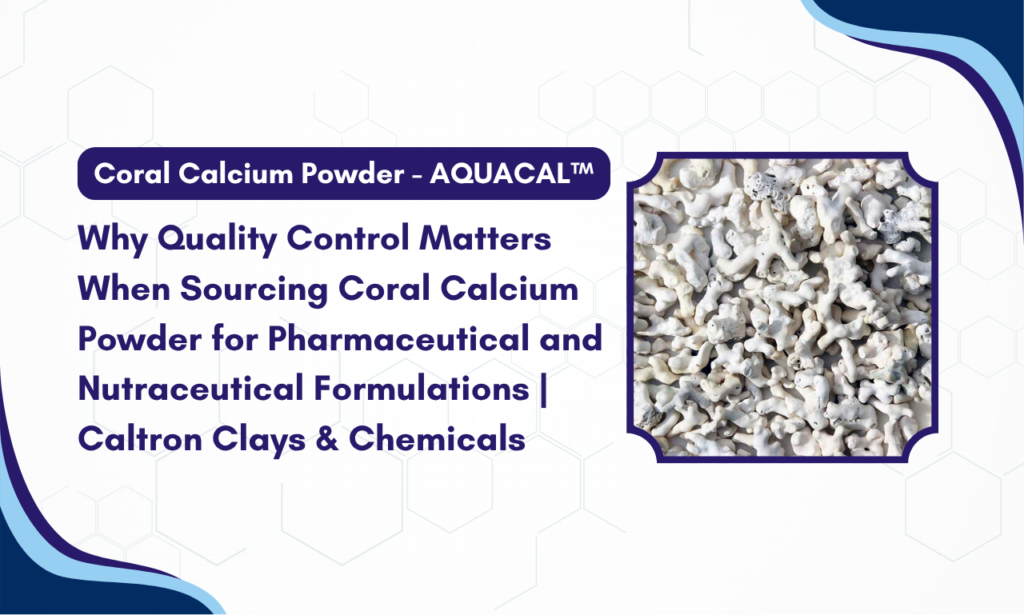
From Coral Source to Finished Supplement: Quality Determines What Happens in Between
For a pharmaceutical or nutraceutical manufacturer, coral calcium powder is more than a line item on a procurement sheet. Once purchased, the ingredient moves through incoming quality checks, formulation development, blending, production, documentation review and eventually into a finished product. The quality of the raw material can therefore affect several departments long after the purchase order has been issued.
This is why two apparently similar coral calcium powders should not automatically be treated as equivalent. Differences in raw-material origin, calcium carbonate assay, beneficiation, purity, relevant contaminant controls, particle characteristics and batch consistency may influence whether a material fits the manufacturer’s technical and quality expectations.
Price remains important, particularly for businesses purchasing commercial volumes. However, cost becomes meaningful only after the manufacturer understands exactly what is being supplied. A lower quotation offers limited value if the material creates repeated testing, documentation gaps, inconsistent batches or supply interruptions.
Selecting a Coral Calcium Powder Manufacturer in India should therefore involve a detailed assessment of the ingredient and the manufacturing system behind it. Similarly, choosing a Coral Calcium Powder Supplier in India requires evaluation of commercial reliability, documentation, communication and repeat-order support.
Caltron Clays & Chemicals Pvt. Ltd. addresses this B2B requirement through AQUACAL™ Coral Calcium Powder. Developed as a specialized coral-derived calcium ingredient, AQUACAL™ gives pharmaceutical and nutraceutical companies a natural-source calcium option for technical evaluation, formulation trials and commercial sourcing.
Quality Does Not Begin in the Laboratory—It Begins with the Raw Material
Testing can tell a manufacturer a great deal about a finished batch. It cannot replace careful sourcing and controlled processing.
For natural mineral ingredients, quality begins at the source.
A robust quality approach considers the material through its complete journey:
Source Identification → Raw-Material Selection → Beneficiation → Processing → Powder Preparation → Quality Evaluation → Batch Release → Packaging → Supply
Each stage contributes to the characteristics of the material eventually received by the customer.
This matters particularly with coral calcium because its natural origin forms part of the ingredient’s identity. The goal of processing is therefore not to remove that identity, but to convert naturally sourced mineral material into a more controlled ingredient suitable for professional evaluation.
According to Caltron’s product information, AQUACAL™ is produced using non-living/fossilized coral material sourced from above-sea deposits. Caltron combines this source approach with beneficiation and quality evaluation as part of preparing its coral calcium powder.
For buyers, this provides a useful starting point. The next stage is to evaluate the finished ingredient against technical and commercial requirements.
Understanding Coral Calcium Powder Before You Approve a Supplier
What Is Coral Calcium Powder?
Coral calcium powder is a naturally derived mineral material in which calcium carbonate forms the principal calcium-containing component. The original coral mineral matrix may also contain naturally associated minerals.
This makes coral calcium distinct in origin from standard industrial calcium carbonate and other calcium raw materials.
However, a distinctive source does not automatically make a material appropriate for every pharmaceutical or nutraceutical formulation.
Formulators need to evaluate whether its composition and physical characteristics suit the intended product. QA teams need to establish whether the material conforms to agreed specifications. Procurement teams need to determine whether the supplier can deliver consistent commercial quantities.
The ingredient therefore needs to satisfy several requirements simultaneously.
Where AQUACAL™ Fits into the Calcium Ingredient Landscape
AQUACAL™ is Caltron Clays & Chemicals specialized coral-derived calcium ingredient.
Caltron states a 99.5% CaCO₃ assay for its coral calcium powder and highlights the naturally associated mineral profile derived from its coral source.
These characteristics can be relevant for manufacturers developing natural-source mineral formulations.
Yet the correct B2B approach is still to verify the current specification, review relevant batch documentation and conduct appropriate formulation evaluation before approving the material.
AQUACAL™ should therefore be viewed not simply as “natural coral calcium,” but as a defined mineral ingredient that can move through a professional qualification process.
Natural Source Is the Beginning of the Story, Not Proof of Quality
Natural-source positioning can support product differentiation, particularly in nutraceutical markets. But terms such as “natural” and “marine-origin” do not answer the questions that matter most to a quality team.
QA requires measurable parameters.
R&D requires formulation-relevant information.
Procurement requires commercial clarity.
This means manufacturers should move from broad product descriptions to specific questions:
- What is the exact identity of the supplied material?
- Where does the coral source originate?
- How is the raw material selected?
- What beneficiation is performed?
- What CaCO₃ assay is specified?
- Which relevant contaminants are evaluated?
- What physical characteristics are controlled?
- How is each batch identified?
- What documentation is available?
- What packaging is used?
- What storage conditions are recommended?
- Can repeat commercial quantities be supplied?
An experienced Coral Calcuim Supplier in India should understand why these questions matter.
For Caltron Clays & Chemicals, answering technical and commercial enquiries around AQUACAL™ forms part of supporting professional manufacturers evaluating natural mineral ingredients.
Coral Calcium vs Other Calcium Sources: Ask “Which Fits?” Rather Than “Which Is Best?”
Calcium raw materials should be selected according to the formulation, not according to a universal ranking.
Conventional calcium carbonate is extensively used across pharmaceutical and nutraceutical products. Its established availability makes it appropriate for numerous formulations.
Coral calcium offers a different proposition because it originates from coral-derived mineral deposits and carries the naturally associated mineral characteristics of that source.
Neither description alone determines which ingredient is appropriate.
Formulators should instead compare:
- Raw-material origin
- Chemical composition
- CaCO₃ assay
- Associated minerals
- Purity parameters
- Relevant contaminant specifications
- Particle characteristics
- Powder behaviour
- Intended dosage form
- Processing requirements
- Documentation
- Batch consistency
- Commercial availability
- Cost
The answer may differ between formulations.
A manufacturer developing a straightforward calcium product may choose one ingredient, while a brand creating a differentiated natural-source mineral formulation may evaluate another.
For the latter requirement, AQUACAL™ Coral Calcium Powder from Caltron Clays & Chemicals provides an option for professional R&D and procurement evaluation.
Eight Quality Parameters That Deserve Attention Before You Buy
Quality specifications transform raw-material purchasing from assumption into evidence.
1. Ingredient Identity: Confirm the Material Before Comparing It
Identity should always come first.
The supplied material should correspond to a defined product, grade and batch. This provides a basis for traceability and helps prevent confusion where several mineral ingredients are being sourced or processed.
For manufacturers, clear identification also connects procurement records with incoming inspection, production and quality documentation.
2. CaCO₃ Assay: Understand the Main Mineral Composition
Calcium carbonate assay is one of the most relevant parameters when assessing coral calcium powder.
Caltron states a 99.5% CaCO₃ assay for AQUACAL™.
Buyers evaluating the material should confirm the current specification and relevant batch documentation as part of their internal qualification procedure.
Assay should then be evaluated alongside other parameters rather than being treated as a complete definition of quality.
3. Purity: Look Beyond a Single Percentage
A raw material may meet its principal assay while still requiring evaluation for additional quality characteristics.
For natural mineral ingredients, manufacturers should understand how unwanted foreign material and relevant impurities are controlled.
Caltron describes beneficiation as part of its approach to processing coral calcium.
For a buyer evaluating a Coral Calcium Powder Manufacturer in India, processing capability is therefore an important part of the discussion.
4. Relevant Elemental Contaminants: Let Data Guide the Decision
Natural mineral ingredients should be evaluated for relevant elemental contaminants according to the intended application and applicable requirements.
Instead of depending on broad statements such as “pure” or “heavy-metal free,” buyers should request measurable specifications and appropriate analytical information.
5. Particle Characteristics: Chemistry Is Only Half the Formulation Story
Particle properties may influence how a mineral powder behaves during processing.
Depending on the formulation and manufacturing method, R&D teams may need to consider:
- Particle-size characteristics
- Dispersion
- Mixing
- Blending
- Powder handling
- Flow
- Tablet development
- Capsule filling
These properties should be evaluated through appropriate formulation trials.
6. Moisture: Consider the Condition of the Powder
Moisture-related considerations may be relevant to powder handling and storage.
Manufacturers should review applicable specifications and supplier storage recommendations.
7. Packaging and Storage: Protect Quality After Manufacturing
A properly manufactured ingredient still needs suitable packaging and handling.
Buyers should establish appropriate storage practices based on information supplied for the material and their own internal procedures.
8. Batch Consistency: Evaluate What Happens After the First Order
A sample demonstrates the characteristics of one quantity of material.
Commercial reliability requires the supplier to repeatedly deliver material conforming to agreed requirements.
This is why consistency should be treated as one of the most important supplier-performance indicators.
Heavy-Metal Specifications: Why “Natural” Should Never Replace Analytical Data
Naturally sourced minerals come from real geological and environmental systems.
Responsible quality control therefore requires relevant contaminants to be assessed objectively.
The correct approach is neither to assume contamination nor to presume absence.
It is to examine data.
Quality teams should determine:
- Which relevant elemental contaminants are specified
- What limits or acceptance criteria apply
- How testing is documented
- Whether results are associated with the supplied batch
- Whether buyer-specific requirements apply
- Whether destination-market requirements need additional consideration
This evidence-based approach is considerably more useful than broad purity statements.
A COA should also be reviewed for content rather than simply collected for records.
Buyers can ask whether the document clearly identifies the product and batch, whether relevant parameters are listed and whether the reported information aligns with the agreed specification.
Manufacturers considering AQUACAL™ can discuss current specifications and applicable analytical documentation with Caltron Clays & Chemicals during supplier qualification.
Batch Consistency: The Point Where Quality Becomes Commercially Valuable
Imagine a formulation team approves a coral calcium sample after several successful development trials.
The product then enters commercial manufacturing.
Three months later, another raw-material batch arrives.
The real measure of supplier reliability begins at this point.
Manufacturers need reasonable consistency from one commercial batch to the next because unexpected variation can affect multiple departments.
For R&D, consistency helps support reproducible formulation work.
For QA, it supports specification-based incoming review.
For production, predictable material characteristics can simplify processing.
For procurement, reliable batches reduce sourcing disruption.
For supply-chain teams, dependable material availability improves planning.
The value of an experienced Coral Calcuim Supplier in India therefore becomes clearer over repeat orders rather than during the initial sales discussion.
Caltron Clays & Chemicals positions AQUACAL™ for B2B sourcing where technical evaluation can progress toward recurring commercial requirements.
Why Beneficiation Deserves Attention During Supplier Qualification
The word “natural” can sometimes make processing sound unnecessary. In mineral raw materials, the opposite is often true.
Naturally sourced material requires appropriate preparation before professional manufacturers can evaluate it as a controlled ingredient.
Beneficiation broadly refers to processing intended to improve the suitability of mineral source material by controlling unwanted components and preparing it for subsequent production stages.
Caltron states that its coral calcium undergoes beneficiation and extensive quality evaluation intended to control foreign particles and impurities.
For procurement and QA teams, this raises useful questions:
- How is the source material selected?
- What happens after collection?
- How is foreign material controlled?
- How is the material prepared for powder processing?
- Which quality parameters are evaluated?
- How is the final batch released?
These questions provide greater insight into a supplier than the phrase “natural coral calcium” alone.
For Caltron, mineral processing experience forms an important part of the AQUACAL™ proposition.
Documentation Can Decide Whether a Good Ingredient Gets Approved
Technical quality and documentation quality need to work together.
A formulation scientist may be satisfied with a sample, but QA may still be unable to approve the supplier without appropriate information.
This is why documentation should be discussed early.
Depending on the application and buyer requirements, relevant information may include:
- Current product specification
- Batch-specific COA
- Technical Data Sheet where available
- Safety Data Sheet where applicable
- Batch or lot identification
- Packaging details
- Storage information
- Traceability information
- Applicable quality documentation
- Relevant manufacturing information
- Supporting declarations where required
Requirements differ across companies, applications and markets.
Buyers should therefore communicate their documentation checklist before commercial procurement.
A capable Coral Calcium Powder Supplier in India should be prepared to discuss available documentation as part of the qualification process.
For AQUACAL™, Caltron Clays & Chemicals can confirm current document availability according to the customer’s B2B requirement.
The Hidden Operational Cost of Choosing the Wrong Raw Material
Procurement teams understandably negotiate price. However, the purchase price is only one cost associated with an ingredient.
An unsuitable or inconsistent batch can create costs across several departments.
Potential consequences include:
- Incoming-material rejection
- Additional laboratory testing
- Repeated QA review
- Supplier investigations
- Additional R&D trials
- Manufacturing delays
- Documentation follow-up
- Inventory shortages
- Emergency replacement sourcing
- Additional logistics
- Production rescheduling
- Increased administrative workload
The impact can become particularly significant when production is dependent on scheduled raw-material availability.
Quality-focused sourcing is therefore not about purchasing the most expensive material.
It is about reducing avoidable uncertainty.
Price Matters—but Total Sourcing Value Matters More
A more complete procurement calculation can be expressed as:
Material Cost + Qualification Effort + Testing + Consistency + Documentation + Rejection Risk + Supply Continuity + Technical Support = Total Sourcing Value
This framework allows procurement to compare suppliers more realistically.
Consider two quotations with a modest price difference.
If the cheaper option repeatedly requires document clarification, re-testing or urgent replacement, the apparent saving can disappear.
A dependable supplier may create value through predictability rather than simply through price.
When comparing a Coral Calcuim Supplier in India, procurement teams should therefore evaluate the complete relationship.
Caltron Clays & Chemicals positions AQUACAL™ within this B2B model by combining a specialized coral-derived ingredient with technical and commercial sourcing discussions.
What Should You Look for in a Coral Calcium Powder Manufacturer in India?
A professional manufacturer should be evaluated across several dimensions rather than on product availability alone.
A practical qualification checklist includes:
- Clearly identified source material
- Relevant mineral-processing experience
- Beneficiation capability
- Defined product specification
- Analytical evaluation
- Relevant contaminant controls
- Batch identification
- Traceability
- Batch consistency
- Technical documentation
- Packaging
- Storage guidance
- Commercial manufacturing capability
- Scalability
- Technical communication
- Repeat-order support
- Export support where relevant
Together, these factors help determine whether a company can support both initial development and ongoing commercial requirements.
For manufacturers seeking a Coral Calcium Powder Manufacturer in India, Caltron Clays & Chemicals offers AQUACAL™ within its specialized natural mineral raw-material portfolio.
Its mineral-focused expertise can also be relevant to companies evaluating a Pharmaceutical Raw Material Manufacturer in India for longer-term sourcing relationships.
Choosing a Supplier That Can Grow with Your Formulation
A supplier may perform well during sample evaluation but struggle once commercial requirements increase.
That is why scalability should be discussed before approval.
The sourcing journey may progress from:
Laboratory Sample → Pilot Quantity → Initial Production → Commercial Batch → Repeat Bulk Orders
At each stage, procurement requirements change.
A reliable Coral Calcium Powder Supplier in India should therefore be assessed for:
- Sample support
- MOQ
- Commercial-volume capability
- Packaging
- Lead times
- Production planning
- Batch documentation
- Repeat supply
- Communication
- Logistics
- Technical support
- Export coordination where relevant
This broader assessment is especially important for companies planning product launches or international distribution.
A responsive Coral Calcuim Supplier in India should be able to discuss both current requirements and potential future volumes.
AQUACAL™: Where Coral-Derived Origin Meets Caltron’s Mineral Expertise
AQUACAL™ represents Caltron Clays & Chemicals’ specialized coral calcium offering for professional B2B customers.
According to Caltron’s product information, the ingredient is derived from non-living/fossilized coral material sourced from above-sea deposits.
Caltron states a 99.5% CaCO₃ assay for its coral calcium and highlights the naturally associated mineral profile originating from the coral source.
The company also describes beneficiation and quality evaluation as part of its approach to preparing the material.
These characteristics allow buyers to evaluate AQUACAL™ across several areas:
- Natural coral-derived source
- Calcium carbonate composition
- Defined assay
- Associated mineral profile
- Beneficiation
- Quality evaluation
- Powder characteristics
- Documentation
- Batch consistency
- Commercial availability
For formulation scientists, this provides a structured basis for R&D assessment.
For QA teams, it provides parameters around which supplier qualification can be developed.
For procurement, it creates a product that can be evaluated from sample requirement through bulk commercial sourcing.
The Caltron Advantage: Specialized Mineral Knowledge Behind Every B2B Discussion
The value of AQUACAL™ is connected to the company supplying it.
Caltron Clays & Chemicals Pvt. Ltd. operates in specialized natural calcium and mineral raw materials, giving the company experience with the technical and commercial questions that commonly arise during ingredient qualification.
This matters because B2B buyers rarely have only one requirement.
R&D may ask about composition or powder characteristics.
QA may need specifications and batch information.
Procurement may require samples, pricing, MOQ and lead times.
Supply-chain teams may need packaging and logistics details.
International buyers may have additional documentation requirements.
Caltron’s mineral-focused approach enables these discussions to take place within a single supplier relationship.
For companies searching for a Pharmaceutical Raw Material Supplier in India, this combination of mineral specialization and B2B support can be valuable when sourcing requirements extend beyond a basic purchase order.
A Smarter Route from AQUACAL™ Sample to Commercial Approval
Manufacturers can reduce sourcing uncertainty by following a structured qualification sequence.
Step 1: Define Your Requirement
Establish the intended formulation, dosage format, target quantity and internal quality expectations.
Step 2: Begin a Technical Discussion
Contact Caltron regarding AQUACAL™ and request current information relevant to the proposed application.
Step 3: Review the Product Specification
R&D and QA can assess key parameters before proceeding to laboratory trials.
Step 4: Request and Evaluate a Sample
Test the material according to internal raw-material and formulation procedures.
Step 5: Conduct Formulation Trials
Determine whether AQUACAL™ is appropriate for the intended product and manufacturing process.
Step 6: Complete the QA Review
Evaluate applicable documentation, supplier information and batch requirements.
Step 7: Discuss Commercial Supply
Procurement can confirm MOQ, packaging, lead times, quantities and repeat requirements.
Step 8: Proceed Through Supplier Approval
Once technical, quality and commercial expectations have been aligned, the material can progress toward commercial sourcing.
This approach allows manufacturers to make decisions based on evidence from several departments rather than relying solely on a product brochure.
12 Questions Worth Asking Before Your Next Coral Calcium Purchase
Before approving a bulk order, procurement and quality teams can ask:
- Where does the coral source originate?
- Is the raw material obtained from non-living coral deposits?
- What CaCO₃ assay is specified?
- What current product specification is available?
- How is the source material processed?
- What beneficiation is performed?
- Which relevant contaminants are evaluated?
- What physical characteristics are controlled?
- Is batch-specific documentation available?
- What packaging and storage requirements apply?
- What are the MOQ and commercial lead time?
- Can the supplier support recurring bulk requirements?
These questions provide a practical foundation for evaluating a Coral Calcium Powder Manufacturer in India and help purchasing teams move beyond price-only comparisons.
Frequently Asked Questions
1. What is Coral Calcium Powder?
Coral Calcium Powder is a naturally derived mineral ingredient containing calcium primarily in the form of calcium carbonate, together with minerals naturally associated with its coral source.
2. What is AQUACAL™ Coral Calcium Powder?
AQUACAL™ is the specialized coral-derived calcium ingredient offered by Caltron Clays & Chemicals for B2B pharmaceutical and nutraceutical evaluation.
3. What CaCO₃ assay does Caltron state for AQUACAL™?
Caltron states a 99.5% CaCO₃ assay for its coral calcium. Manufacturers should confirm the current product specification and applicable batch documentation during qualification.
4. What should buyers check before sourcing Coral Calcium Powder?
Buyers should examine source, identity, CaCO₃ assay, purity, relevant contaminants, physical characteristics, processing, documentation, batch consistency and commercial supply capability.
5. Why should heavy metals be evaluated in coral calcium?
Naturally derived mineral ingredients should be evaluated against relevant elemental contaminant requirements for the intended application and market. Specifications and analytical information provide a reliable basis for assessment.
6. What documents should a coral calcium supplier provide?
Depending on the buyer’s requirements, relevant documents may include product specifications, batch-specific COAs, technical or safety information where applicable, packaging information, storage recommendations and other applicable quality documentation.
7. How do I select a Coral Calcium Powder Manufacturer in India?
Evaluate source control, processing, beneficiation, specifications, analytical testing, consistency, documentation, traceability, commercial capability and technical responsiveness.
8. What makes a reliable Coral Calcium Powder Supplier in India?
A reliable supplier combines suitable product quality with consistent commercial availability, clear documentation, dependable communication, appropriate packaging and repeat-order capability.
9. Can AQUACAL™ be evaluated for pharmaceutical and nutraceutical formulations?
AQUACAL™ can be evaluated as a calcium raw material for relevant formulations according to the manufacturer’s R&D, quality and applicable regulatory requirements.
10. How can manufacturers source AQUACAL™ in bulk?
Pharmaceutical companies, nutraceutical manufacturers, contract manufacturers, importers and distributors can contact Caltron Clays & Chemicals regarding current specifications, samples, documentation, packaging and bulk commercial requirements.
Quality Control Is What Converts Coral Calcium into a Dependable Sourcing Decision
Successful raw-material procurement is not defined by how quickly a purchase order is placed. It is defined by how confidently the material can move through formulation, quality approval, production and repeat commercial manufacturing.
For coral calcium, that confidence comes from understanding the source, verifying composition, evaluating purity and relevant contaminants, reviewing physical characteristics, examining processing, checking documentation and assessing batch consistency.
Supplier capability completes the picture.
A technically suitable ingredient has limited commercial value if it cannot be supplied consistently. Likewise, a dependable logistics operation cannot compensate for material that fails to meet agreed technical requirements.
Manufacturers should therefore evaluate the ingredient and supplier together.
For companies searching for a Coral Calcium Powder Manufacturer in India or Coral Calcium Powder Supplier in India, Caltron Clays & Chemicals offers AQUACAL™ as a specialized coral-derived calcium ingredient supported by its experience in natural mineral raw materials.
For organizations additionally seeking a Pharmaceutical Raw Material Manufacturer in India or Pharmaceutical Raw Material Supplier in India, Caltron’s mineral-focused portfolio provides a broader foundation for B2B ingredient sourcing.
The result is a sourcing conversation based not simply on “How much does coral calcium cost?” but on the more valuable question:
“Can this ingredient and supplier consistently support our formulation, quality and commercial requirements?”
Explore AQUACAL™ with Caltron Clays & Chemicals
Looking for Coral Calcium Powder for your next pharmaceutical or nutraceutical formulation?
Connect with Caltron Clays & Chemicals Pvt. Ltd. to discuss AQUACAL™ Coral Calcium Powder, current specifications, available technical documentation, sample requirements, packaging and bulk commercial quantities.
Caltron Clays & Chemicals Pvt Ltd
Address: Office No. 211, 2nd Floor, Orbit Premises, Next to Sheetal Banquets, Opp to Inox Plaza, Mindspace, Malad West, Mumbai, Maharashtra 400064 India
Phone No.: 022 3571 9844 | +91 70214 37453 | +91 22 2876 4864
Website: https://caltronclays.com
Email: marketing@caltronclays.com | sales@caltronclays.com
Google Maps: https://maps.app.goo.gl/jCuz1ZCf1iAhzZiH7

