

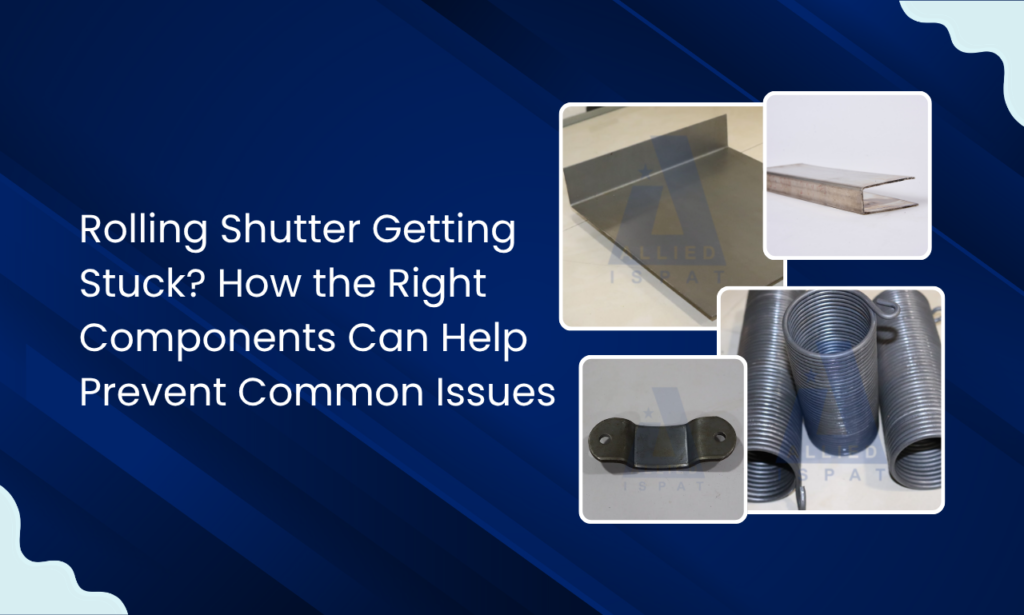
Introduction
When a rolling shutter starts taking more effort to open, catches at the same point, moves unevenly or produces unfamiliar sounds, the problem should not be viewed only as an inconvenience. In warehouses, factories, loading areas, workshops and commercial premises, shutters are part of everyday access. Irregular movement can interrupt routine operations and may indicate that one or more parts of the assembly require attention.
The challenge is that the most visible symptom does not always reveal the actual cause. Debris inside a guide channel can restrict the curtain. Misalignment can create friction on one side. A spring mechanism can develop a problem, while brackets or supporting hardware can affect the position of connected parts. Installation, impact, moisture and gradual wear may also contribute.
For shutter manufacturers and OEMs, many of these considerations begin at the component selection stage. A guide channel needs the correct geometry for the curtain. A bottom section should correspond with the intended assembly. Springs, brackets and fittings need to suit the shutter design. Steel specification and dimensional consistency are equally important for repeat fabrication. In applications where additional corrosion protection is required, galvanized rolling shutter parts can be selected according to the operating environment and project specification.
At Allied Ispat Pvt. Ltd., we manufacture rolling shutter components for OEMs, fabricators, contractors, dealers, distributors and industrial buyers. As a Rolling Shutter Parts Manufacturer in India, our approach focuses on understanding what the customer needs for manufacturing, assembly and repeat procurement.
Our manufacturing operations at MIDC Taloja support customers across Maharashtra and other regions. Businesses searching for a Rolling Shutter Parts Manufacturer in Mumbai can discuss standard components, custom profiles, materials and bulk requirements with our team.
Rolling Shutter Getting Stuck? Start by Understanding the Cause
A shutter can stop moving smoothly for several reasons. Treating every problem as a component failure can lead to unnecessary replacements because installation, alignment and environmental conditions may be equally responsible.
The better approach is to consider how the entire shutter is behaving.
Dirt and Debris Inside the Guides
Guide channels remain exposed along the sides of the shutter opening. In busy industrial environments, dust and small foreign materials can accumulate inside them.
This contamination can reduce the clear path available to the moving curtain. The operator may notice scraping, resistance or a shutter that repeatedly catches at one point.
Periodic inspection of accessible guide areas can help identify this type of problem before operation becomes severely restricted.
Uneven Guide Alignment
Both guides need to maintain an appropriate relationship with the shutter curtain.
If one side shifts or is installed incorrectly, the curtain may begin rubbing more heavily against the guide. This can create uneven movement and additional resistance.
Correcting alignment is important because replacing an otherwise suitable component will not solve a positioning problem.
Changes in Spring Performance
Rolling shutter springs work within the opening and closing mechanism.
If the spring arrangement becomes worn or develops a mechanical issue, the shutter may feel different during operation. A sudden increase in effort is a reason to stop and investigate rather than continue forcing movement.
Spring mechanisms can contain stored energy. Inspection and adjustment should therefore be performed by trained professionals.
Damaged or Incorrectly Positioned Brackets
Brackets support important parts of the shutter mechanism.
Physical damage, incorrect positioning or an unsuitable component can affect the arrangement of the connected assembly. This may eventually influence how the shutter operates.
For OEM buyers, bracket dimensions and compatibility should be treated as part of the shutter specification.
Normal Wear Can Gradually Change Operation
Not every shutter problem develops suddenly.
Repeated operation, vibration, dust, moisture and environmental exposure can gradually influence component condition. A shutter used frequently at a warehouse loading bay may experience different service conditions from one installed at a low traffic commercial entrance.
Routine inspection makes it easier to identify these gradual changes.
Rolling Shutter Guide Channels: More Than Just a Steel Profile
Guide channels play a central role in shutter movement because the curtain travels through them during every opening and closing cycle.
For manufacturers, guide channels also need to integrate into an established fabrication process. Profile dimensions and repeatability therefore matter both during operation and production.
How Guide Channels Control Movement
Guide channels are positioned vertically along the shutter opening.
As the curtain moves, its edges travel inside these channels. The profile needs to provide a suitable path for the intended curtain design.
Damage, deformation, obstruction or unsuitable geometry can increase unwanted contact and make operation less smooth.
Why Profile Geometry Matters
A guide channel is a formed component with a functional profile.
Its dimensions need to correspond with the curtain and shutter arrangement. Even relatively small differences can become relevant when an OEM has designed its production around established dimensions.
Clearly defining the required profile helps reduce uncertainty during procurement.
Repeatability Matters for Volume Production
Fabricators often produce similar shutters repeatedly.
Once cutting, assembly and other production processes are established around a particular component, unexpected profile changes can create additional work.
Consistent guide channels help manufacturers maintain a more predictable workflow across repeat quantities.
Installation Must Complement Manufacturing Quality
A correctly manufactured guide channel still needs accurate installation.
If the two sides are not appropriately positioned relative to the curtain, unnecessary resistance can develop.
Troubleshooting should therefore examine both the physical condition of the guide and the way it has been installed.
Custom Profiles for OEM Applications
Standard guide channels do not suit every shutter design.
Some OEMs require specific dimensions or geometry based on their existing products. Customized manufacturing can help address these requirements.
At Allied Ispat Pvt. Ltd., customers can share drawings, samples, dimensions and material details when discussing custom rolling shutter guide channels.
Rolling Shutter Springs and Brackets: Small Components with Important Functions
Springs and brackets may not be prominent when looking at a closed shutter, but they contribute to the mechanical system behind its operation.
Their selection should be based on the shutter configuration rather than treated as a generic hardware purchase.
Springs and Shutter Operation
A rolling shutter spring works as part of a broader mechanism.
Its specification needs to correspond with the shutter arrangement. Changes in spring condition or associated mechanical parts can affect opening and closing behaviour.
For manufacturers, this makes accurate spring selection an important part of component procurement.
Brackets Support Key Mechanical Elements
Rolling shutter brackets provide support within the mechanism.
The correct dimensions and construction depend on the shutter configuration. Their installation position also influences how connected parts remain arranged.
Consistent bracket specifications are especially useful for manufacturers producing the same shutter design repeatedly.
Component Compatibility Comes First
A high quality component is not automatically the correct component.
A spring, bracket or guide may be manufactured properly but still be unsuitable if its dimensions or function do not correspond with the surrounding shutter parts.
OEM buyers should therefore evaluate compatibility before considering price or availability.
Safe Handling of Spring Systems
Spring systems should be approached carefully during maintenance.
Attempting to adjust, release or dismantle a spring without the required training can create significant risk.
Where a spring related problem is suspected, qualified personnel should inspect the shutter and determine the appropriate corrective action.
Bottom Sections, Fittings and Other Components That Complete the Shutter
A rolling shutter assembly contains several components beyond its guides and mechanical system. Bottom sections, fittings, accessories and steel profiles all contribute to the finished shutter.
For B2B manufacturers, consistency across these components supports more organized production.
Bottom Sections and Curtain Completion
The bottom section forms the lower edge of the shutter curtain.
Its dimensions and geometry should correspond with the curtain design and intended assembly.
For manufacturers producing repeat quantities, maintaining a defined bottom section specification helps reduce unnecessary fabrication adjustments.
Fittings and Accessories Matter During Assembly
Smaller fittings and accessories can easily be overlooked during procurement.
However, these components still need to correspond with the shutter configuration. Differences in dimensions or design can create additional work during assembly.
A coordinated purchasing approach can make it easier for fabricators to manage related shutter components.
Steel Inputs Influence the Finished Component
Every steel shutter profile begins with material.
GI, CR and HR steel can be considered for different requirements depending on the component, manufacturing process and buyer specification.
Material should therefore be defined before production rather than treated as a secondary purchasing detail.
When Galvanized Components Make Sense
Galvanized steel uses a zinc coating to provide additional corrosion protection to the underlying steel.
For appropriate environments, galvanized rolling shutter parts can form part of a shutter manufacturer’s material strategy.
The decision should consider the component, exposure conditions and customer specification instead of assuming galvanized material is necessary for every application.
Selecting the Right Steel for Rolling Shutter Components
Different steel materials offer characteristics that make them suitable for different manufacturing requirements.
The correct choice should reflect the finished component rather than a general preference for one material.
Understanding GI Steel
GI steel has a zinc coated surface that helps protect the underlying steel against corrosion.
This makes it relevant where corrosion protection is part of the required specification.
For industrial and commercial applications where GI material is appropriate, galvanized rolling shutter parts can be manufactured according to the required profile and dimensions.
Understanding CR Steel
Cold Rolled steel is used in a variety of formed component applications.
Whether it is appropriate for a rolling shutter part depends on profile requirements and manufacturing specifications.
OEM buyers should clearly define CR requirements when maintaining consistency across recurring component orders.
Understanding HR Steel
Hot Rolled steel is widely used in industrial fabrication.
Its suitability for rolling shutter components depends on the specific application and required manufacturing process.
Buyers should therefore evaluate the component first and select the steel specification accordingly.
Why Material Consistency Matters to OEMs
Repeat production requires predictable manufacturing inputs.
If material changes unexpectedly between batches, the downstream manufacturing process may also be affected.
Clear material specifications make recurring procurement easier to control and communicate.
Galvanized Steel Is Not Maintenance Free
Corrosion protection should never be confused with zero maintenance.
Even galvanized rolling shutter parts can experience coating damage, contamination, physical wear or other service related conditions.
Regular inspection remains an important part of maintaining the overall shutter system.
Precision Manufacturing: Why Consistency Matters Beyond the First Order
A component can meet expectations on the first purchase, but B2B manufacturing often depends on what happens on the tenth or twentieth repeat order.
OEMs need components that continue to correspond with their established production requirements.
Dimensional Consistency Helps Reduce Rework
Fabrication processes are often built around known component dimensions.
Unexpected changes can require additional cutting, adjustment or fitting.
Manufacturing components according to defined specifications supports more predictable downstream production.
Roll Forming for Steel Profiles
Roll forming creates profiles by progressively shaping steel strip through a sequence of forming stations.
Rather than producing the entire geometry in a single step, the profile develops gradually through the machine.
Appropriate tooling, machine setup and material selection contribute to the finished section. Allied Ispat Pvt. Ltd.’s roll forming capabilities support our steel profile manufacturing activities.
Mechanical Pressing for Suitable Components
Certain rolling shutter parts require manufacturing methods other than roll forming.
Mechanical presses can be used for relevant component designs.
The manufacturing process should therefore be selected according to the part rather than applying the same method to every shutter component.
Quality Checks Throughout Production
Quality control is not only about checking the finished product before dispatch.
Material selection, production setup, profile condition and dimensional requirements all contribute to manufacturing consistency.
Allied Ispat Pvt. Ltd. follows an ISO 9001:2015 quality management approach to support structured production and quality practices.
Custom Manufacturing for Repeat OEM Requirements
Custom components can be valuable where a manufacturer has an established shutter design.
Guide channels, bottom sections, brackets and related components can be discussed according to specific dimensions, geometry and material requirements.
As a Rolling Shutter Parts Supplier in India, we work with OEMs and fabricators to understand these requirements before proceeding with customized production.
Choosing Components for Factories, Warehouses and Commercial Buildings
Application matters when specifying rolling shutter components.
Usage frequency, environmental exposure and surrounding activity can vary significantly between factories, warehouses and commercial properties.
Factory Shutters
Factory shutters may be installed at production entrances, storage areas, material movement zones and internal access points.
Dust, regular operation and industrial activity can influence their working environment.
Buyers should therefore consider material, component compatibility and future maintenance when specifying factory shutter parts.
Warehouse and Logistics Shutters
Warehouse shutters often operate close to loading and unloading activity.
Vehicle and equipment movement can increase the possibility of impact around the shutter opening.
Regular inspection of guide channels and surrounding components can help identify visible damage before it significantly affects operation.
Commercial and Retail Shutters
Commercial shutters frequently operate according to regular business schedules.
Smooth everyday movement therefore has practical importance.
Guide condition, alignment, fittings and component compatibility all deserve attention. Where additional corrosion protection is specified, galvanized rolling shutter parts may be considered according to the project environment.
What Should a B2B Buyer Mention in an Enquiry?
An effective component enquiry should communicate more than a product name.
Buyers should provide the required component, dimensions, material, profile details, quantity and intended application.
Drawings or samples can be useful when a customized profile is required.
Why Repeat Supply Capability Matters
A shutter manufacturer may require the same component month after month.
Changing suppliers or specifications repeatedly can complicate established manufacturing processes.
B2B buyers should therefore evaluate whether a supplier can understand recurring requirements in addition to fulfilling the initial order.
Why Allied Ispat Pvt. Ltd. for Rolling Shutter Component Requirements?
Our rolling shutter components are supplied to businesses that use them within their own manufacturing, fabrication, distribution and project activities.
Understanding that downstream use is central to the way we approach B2B requirements.
A Range Designed for Shutter Manufacturing Needs
Our rolling shutter component range includes:
- Guide channels
- Bottom sections
- Rolling shutter springs
- Rolling shutter brackets
- Fittings
- Accessories
- Relevant steel coils and strips
- Handles and related components
This range allows customers to discuss multiple rolling shutter requirements with our team.
GI, CR and HR Material Requirements
Different components can require different steel specifications.
We work with GI, CR and HR material for relevant manufacturing requirements.
Customers sourcing galvanized rolling shutter parts can discuss their profile, dimensions, quantities and material specification together.
Manufacturing Experience Since 1997
Allied Ispat Pvt. Ltd. has been involved in steel processing and manufacturing since 1997.
Our activities include rolling shutter components, POP and false ceiling profiles, trading coils and roll forming machinery.
This experience helps us understand the connection between steel material, forming processes and the needs of industrial B2B buyers.
Custom Profiles for OEMs and Fabricators
Established shutter manufacturers may need components based on their own designs.
We work with customers requiring customized guide channels, bottom sections, brackets and related profiles where requirements can be clearly defined.
Drawings, samples and dimensional details can support the custom development discussion.
Supporting Bulk and Recurring Procurement
B2B purchasing requirements vary.
An OEM may need recurring production quantities, a distributor may need stock for resale, and a contractor may need components for a specific project.
As a Rolling Shutter Parts Manufacturer in India, Allied Ispat Pvt. Ltd. supports these different procurement requirements.
For ongoing sourcing, customers can also work with us as a Rolling Shutter Parts Supplier in India for standard, custom and bulk component requirements.
Manufacturing Support from Mumbai and Taloja
Our Mumbai presence supports business communication and customer enquiries.
Our works at MIDC Taloja, Raigad support manufacturing and place us within Maharashtra’s established industrial network.
Businesses looking for a Rolling Shutter Parts Manufacturer in Mumbai can discuss component specifications and customization directly with our team.
Customers requiring repeat supply can also contact Allied Ispat Pvt. Ltd. as a Rolling Shutter Parts Supplier in Mumbai.
Frequently Asked Questions About Rolling Shutter Parts
1. What is the most common reason a rolling shutter gets stuck?
There is no single cause. Guide obstruction, misalignment, wear, mechanical issues and physical damage can all restrict movement. Allied Ispat Pvt. Ltd. recommends checking the overall shutter system so the actual cause can be identified before replacing parts.
2. Which components are important in a rolling shutter?
Common components include guide channels, springs, brackets, bottom sections, fittings, accessories and related steel profiles. Allied Ispat Pvt. Ltd. manufactures multiple rolling shutter components for OEMs, fabricators and industrial B2B buyers.
3. Why are rolling shutter guide channels important?
Guide channels provide the path followed by the curtain during opening and closing. Allied Ispat Pvt. Ltd. manufactures guide channels for customers requiring consistent steel profiles for standard and customized shutter manufacturing.
4. Can a spring problem make a rolling shutter difficult to open?
Yes. Changes within the spring mechanism can affect shutter operation. Allied Ispat Pvt. Ltd. recommends using trained professionals for spring inspection, adjustment or replacement because stored mechanical energy can create safety risks.
5. Which steel is used for rolling shutter parts?
GI, CR and HR steel can be used for different shutter component requirements depending on the application and specification. Allied Ispat Pvt. Ltd. works with these materials for relevant B2B manufacturing requirements.
6. What are galvanized rolling shutter parts used for?
They are used where zinc coated steel is specified to provide additional corrosion protection to the underlying material. Allied Ispat Pvt. Ltd. works with galvanized steel for suitable rolling shutter component requirements based on customer specifications.
7. How should I select a Rolling Shutter Parts Manufacturer in India?
Evaluate manufacturing capability, material options, dimensional consistency, customization, quality processes and repeat supply support. Allied Ispat Pvt. Ltd. serves OEMs, fabricators, dealers, contractors and procurement teams requiring B2B rolling shutter components.
8. Can Allied Ispat Pvt. Ltd. make customized rolling shutter parts?
Yes. Allied Ispat Pvt. Ltd. works with customized component requirements based on defined dimensions, profiles, materials and quantities. Buyers can provide drawings, samples or specifications to help our team understand their manufacturing needs.
9. Where can I source rolling shutter parts in Mumbai?
Allied Ispat Pvt. Ltd. has a Mumbai presence and manufacturing operations at MIDC Taloja in Raigad. B2B buyers can contact our team for guide channels, springs, brackets, bottom sections and other rolling shutter component requirements.
10. Does Allied Ispat Pvt. Ltd. support OEM and bulk orders?
Yes. Allied Ispat Pvt. Ltd. works with OEMs, shutter manufacturers, fabricators, dealers, distributors and project buyers requiring repeat or bulk quantities. Customers can discuss specifications, materials, customization and quantities directly with our team.
Conclusion: Better Shutter Performance Starts with Better Component Planning
A rolling shutter that begins sticking, dragging or becoming difficult to operate is often showing the effect of a broader issue within the assembly. Obstruction, alignment, springs, brackets, installation and ordinary wear can all contribute. Understanding the complete system helps maintenance teams focus on the real cause instead of repeatedly changing individual parts.
For manufacturers and OEMs, component planning begins before installation. Suitable steel, accurate dimensions, consistent profiles and compatibility between parts can support efficient fabrication and assembly. Where corrosion protection is an important project consideration, galvanized rolling shutter parts can form part of the specification while inspection and maintenance continue throughout service.
Allied Ispat Pvt. Ltd. manufactures guide channels, bottom sections, springs, brackets, fittings, accessories and related components for B2B customers. As a Rolling Shutter Parts Manufacturer in India, we support standard requirements as well as customized profiles and OEM production needs.
Our Mumbai presence and manufacturing works at MIDC Taloja support businesses across Maharashtra’s industrial market. Buyers evaluating a Rolling Shutter Parts Manufacturer in Mumbai can discuss material, dimensions, profile geometry and production quantities directly with our team.
Recurring procurement requires continuity in addition to product availability. As a Rolling Shutter Parts Supplier in India, Allied Ispat Pvt. Ltd. works with manufacturers, dealers, distributors, contractors and industrial buyers requiring repeat and bulk supply.
Businesses sourcing within the Mumbai region can also approach us as a Rolling Shutter Parts Supplier in Mumbai. From standard shutter components to custom profiles and OEM orders, our team can discuss the requirement according to your manufacturing or project application.
More Steel Solutions Engineered for Modern Manufacturing and Construction
Allied Ispat Pvt. Ltd. brings its steel processing and manufacturing experience across multiple product categories. Along with rolling shutter components, we support manufacturers, fabricators, contractors and project buyers with roll forming machinery, trading coils and POP ceiling profiles for diverse industrial and construction requirements.
Shape Better Profiles with Allied Ispat Roll Forming Machines
Looking to strengthen your steel profile production? As a Roll Forming Machine Manufacturer in India, Allied Ispat Pvt. Ltd. provides roll forming solutions for producing consistent metal profiles across different manufacturing applications. Our machines are developed with a focus on practical production requirements, profile accuracy and dependable operation.
Quality Trading Coils for Your Next Manufacturing Requirement
Every well-formed steel product starts with the right material. As a Trading Coil Manufacturer in India, Allied Ispat Pvt. Ltd. supplies GI, PPGI and GL coils for fabrication, profile manufacturing and other industrial applications. We support B2B buyers requiring suitable steel coil materials for regular as well as bulk procurement.
Strong False Ceilings Start with the Right POP Framework
A finished ceiling depends on the steel framework working behind it. As a POP Parts Manufacturer in India, Allied Ispat Pvt. Ltd. manufactures ceiling sections, intermediate sections, perimeter channels, angles, C-studs and floor channels for false ceiling and partition framework requirements.
Contact Allied Ispat Pvt. Ltd. for Rolling Shutter Parts
For standard rolling shutter components, customized profiles, OEM requirements and bulk procurement, contact our team with your specifications.
Allied Ispat Mumbai Central
Address: Shop 69, Maulana Shaukat Ali Road, Chhota Sonapur, Siddharth Nagar, Mumbai Central, Mumbai, Maharashtra 400008
Phone: 098211 77009
Get Directions: https://maps.app.goo.gl/gyEqxBGcw9jLsYm26
Allied Ispat Works:
Plot no. C-17 9, MIDC Road behind Bank of Baroda Bank Taloja Panvel, Maharashtra 410208 India
Get Directions: https://maps.app.goo.gl/6ujLCuHpQLu1Uy3r8
Phone: 087790 51606
Email: info@alliedispatindia.com | sales@alliedispatindia.com
Website: www.alliedispatindia.com
Contact Allied Ispat Pvt. Ltd. for rolling shutter guide channels, springs, brackets, bottom sections, fittings, accessories, customized steel profiles and other OEM or bulk rolling shutter component requirements.

