

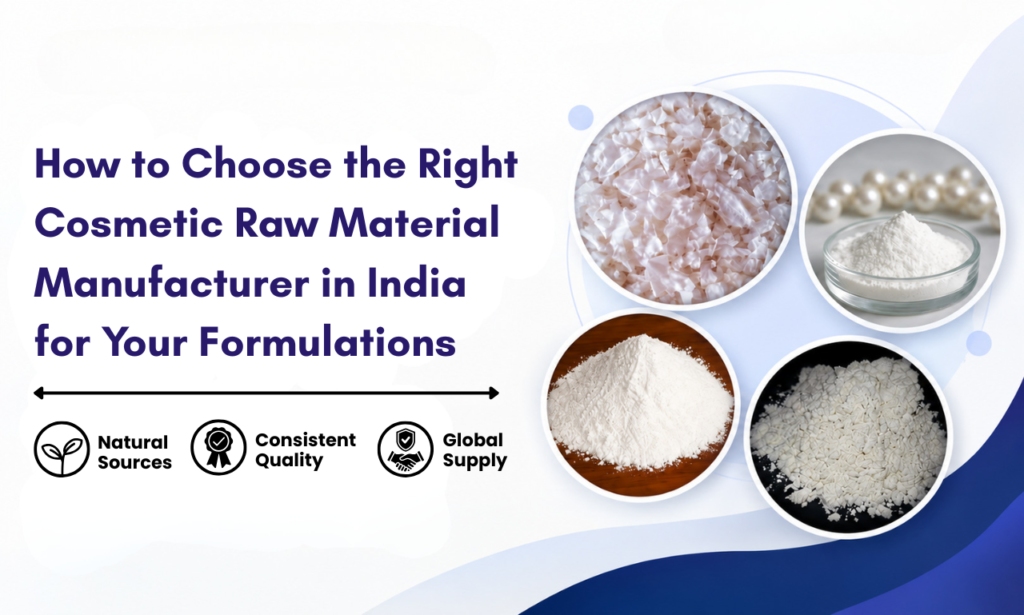
How to Choose the Right Cosmetic Raw Material Manufacturer in India for Your Formulations
The success of a cosmetic formulation begins long before ingredients enter the mixing vessel. It starts with choosing raw materials that meet the formulation’s technical, sensory, quality and commercial requirements. For cosmetic brands, contract manufacturers, private-label companies and R&D teams, this makes supplier selection a strategic part of product development rather than a routine purchasing decision.
Two ingredients sold under the same generic name can behave very differently. Mineral source, purity, processing method, particle characteristics, whiteness, texture, composition and batch consistency may influence how an ingredient disperses, feels and performs within the finished formulation. A laboratory sample may work well during initial development, but commercial production requires the same level of predictability across repeated orders.
Therefore, choosing a Cosmetic Raw Material Manufacturer in India requires more than comparing quotations. Manufacturers should examine technical capability, quality control, documentation, processing infrastructure, formulation suitability and supply continuity.
Caltron Clays & Chemicals supports B2B cosmetic formulation requirements through specialized ingredients including SANKOL™ Kaolin Powder, PRLCAL™ Pearl Calcium Powder, EGGCAL-ESM™ Egg Shell Membrane Powder and DIATOMi™ Natural Scrubbing Salt. These ingredients provide formulators with distinct options for mineral-based, naturally derived and differentiated cosmetic concepts.
Why Cosmetic Raw Material Quality Is Critical to Successful Formulation Development
A cosmetic ingredient is not simply another item on a formulation sheet. Its physical and chemical characteristics can influence processing, product appearance, sensory properties and overall formulation consistency.
For powdered and mineral ingredients in particular, parameters such as particle characteristics, colour, whiteness, texture and absorbency can become important. A change in these characteristics may affect how the finished formulation looks or feels.
Raw Material Variability Can Affect Finished Product Consistency
Consider a cosmetic powder that becomes slightly coarser between batches. The formulation may still contain exactly the same percentage of the ingredient, but its sensory feel or dispersion behaviour may change.
Similarly, differences in mineral whiteness can become noticeable in face masks, powders and other formulations where the ingredient contributes visibly to the finished product.
For this reason, cosmetic manufacturers should evaluate:
- Ingredient identity and source
- Cosmetic grade and intended application
- Purity and relevant quality specifications
- Particle and physical characteristics
- Colour and whiteness where applicable
- Texture and sensory properties
- Processing behaviour
- Batch-to-batch consistency
- Packaging and storage conditions
- Technical documentation
- Commercial supply capability
A reliable supplier should support not only initial formulation development but also repeated commercial manufacturing.
Cosmetic Raw Material Manufacturer vs Supplier: What Should B2B Buyers Evaluate?
The cosmetic ingredient industry includes manufacturers, suppliers, distributors and traders. Each can play an important role, but B2B buyers need clarity about where their ingredients originate and who controls processing and quality.
A manufacturer is directly involved in producing or processing a material. This can provide greater visibility into manufacturing processes, quality controls, specifications and consistency.
A distributor or supplier may offer other advantages, including regional availability, consolidated sourcing or inventory management. However, buyers should understand the original manufacturing source and available traceability.
Questions to Ask Your Cosmetic Ingredient Supplier
When evaluating a Cosmetic Raw Material Manufacturer in India, ask:
- Where does the raw material originate?
- Where and how is it processed?
- Which quality parameters are routinely monitored?
- How are incoming raw materials evaluated?
- How is batch consistency maintained?
- What technical documents are available?
- Can representative samples be supplied?
- Can the manufacturer support commercial-scale quantities?
- What packaging options are available?
- Can the supplier support export requirements?
When choosing a Cosmetic Raw Material Supplier in India, buyers should also determine whether the company manufactures directly or sources the material from another producer.
Transparency throughout the supply chain makes technical qualification easier for R&D, QA/QC and procurement teams.
Cosmetic-Grade Ingredient Purity, Safety and Quality Control
The term “natural” can describe an ingredient’s origin, but it does not automatically establish its suitability for cosmetic manufacturing.
Natural minerals and biologically derived materials can vary according to their source. Processing and quality control are therefore essential to converting naturally occurring materials into ingredients suitable for controlled cosmetic formulation.
Evaluate Identity, Purity and Physical Properties
The relevant parameters will depend on the material, but cosmetic manufacturers may need to evaluate:
- Mineral or biological identity
- Composition
- Appearance
- Colour
- Whiteness
- Particle characteristics
- Texture
- Dispersibility
- Absorbency
- Sensory profile
- Relevant contaminants
- Microbiological requirements where applicable
For example, selecting cosmetic-grade kaolin involves more than confirming that a sample contains kaolin. A formulator may also need to consider its fineness, whiteness, absorbency, powder feel and compatibility with the intended formulation.
Quality Specifications Should Match the Application
There is no universal specification suitable for every cosmetic ingredient or finished product.
A raw material intended for a dry facial powder may have different functional priorities from one being incorporated into a rinse-off clay mask. Similarly, a natural exfoliating ingredient needs to be assessed differently from a material intended primarily for sensory or absorbent properties.
Supplier qualification should therefore begin with the requirements of the finished formulation.
Cosmetic Mineral Processing Infrastructure and Manufacturing Capability
Raw-material processing is especially important when sourcing mineral-based cosmetic ingredients.
Naturally occurring minerals may require controlled selection, refining, pulverising and handling before they achieve characteristics appropriate for cosmetic formulation. Processing affects much more than powder appearance—it can influence particle characteristics, texture, consistency and ease of incorporation.
Dedicated Mineral Processing at Caltron Clays & Chemicals
Caltron Clays & Chemicals has dedicated processing capability at Vapi for cosmetic raw materials of mineral origin. This manufacturing infrastructure is particularly relevant to products such as SANKOL™ Cosmetic Grade Kaolin Powder.
For procurement and QA teams, important manufacturing questions include how raw minerals are selected, how they are processed, which characteristics are controlled and how finished materials are evaluated before supply.
Manufacturing infrastructure should always be considered together with the actual product specification and formulation requirements.
Batch-to-Batch Consistency in Commercial Cosmetic Manufacturing
One of the biggest differences between laboratory development and commercial manufacturing is repetition.
A formulation may perform perfectly using the original sample. Commercial production, however, may require multiple raw-material batches over months or years.
Significant variation between those batches can create unnecessary formulation and production challenges.
Which Raw Material Characteristics Should Remain Consistent?
Depending on the ingredient, variation can influence:
- Colour
- Whiteness
- Powder texture
- Spreadability
- Dispersion
- Sensory characteristics
- Processing behaviour
- Finished-product appearance
- Apparent viscosity in certain formulations
For naturally derived ingredients, consistency does not necessarily mean eliminating every natural variation. Instead, manufacturers and buyers should agree on appropriate specifications that keep the ingredient within a range suitable for reliable formulation performance.
This makes batch consistency one of the most important criteria when qualifying a long-term cosmetic raw material partner.
Formulation Compatibility Testing Before Bulk Cosmetic Ingredient Procurement
A specification sheet tells formulators what an ingredient is expected to meet. It does not tell them exactly how that ingredient will behave inside every formulation.
Raw materials interact with oils, surfactants, polymers, pigments, water phases and other components. Processing temperature, mixing sequence and equipment can also affect the outcome.
What Should Cosmetic R&D Teams Test?
Before approving an ingredient for commercial use, formulators should evaluate relevant parameters such as:
- Ease of incorporation
- Dispersion behaviour
- Texture
- Spreadability
- Sensory feel
- Finished-product appearance
- Interaction with the formulation base
- Processing sequence
- Relevant stability observations
- Pilot-scale behaviour
Testing should reproduce the intended application as closely as practical.
A powder intended for a dry formulation should not be qualified using exactly the same criteria as a powder intended for a cream, cleanser or mask.
Cosmetic Raw Material Documentation, COA and Technical Support
Technical documentation creates a common reference point between R&D, quality, regulatory, purchasing and manufacturing departments.
Documentation requirements vary according to the ingredient and destination market, but B2B buyers may need to review:
- Product specifications
- Certificate of Analysis (COA)
- Technical Data Sheet
- Safety Data Sheet, where applicable
- Ingredient identity information
- Origin information
- Packaging specifications
- Storage recommendations
- Shelf-life or retest information, where applicable
- Traceability information
- Relevant quality or regulatory-support documents
Why Documentation Matters Beyond Regulatory Requirements
Good documentation reduces ambiguity.
R&D can identify the exact material used during development. QA/QC can establish appropriate incoming-material checks. Procurement can reorder the correct grade, while production receives the ingredient that was originally qualified.
This becomes particularly important when ingredients are being supplied to international cosmetic manufacturers or distributors.
B2B Cosmetic Ingredient Procurement and Supply Chain Reliability
An ingredient can be technically excellent but commercially unsuitable if reliable quantities cannot be supplied when production requires them.
Procurement teams should therefore evaluate the entire supply relationship.
Important commercial factors include:
- Minimum order quantity
- Packaging configuration
- Lead time
- Production capacity
- Supply continuity
- Scalability
- Documentation availability
- Technical communication
- Export capability
- Logistics coordination
- Long-term availability
The lowest price per kilogram does not always represent the lowest total sourcing cost. Inconsistent material, delayed supply or repeated qualification can create additional costs elsewhere in the manufacturing process.
A stronger B2B procurement strategy balances technical quality with commercial reliability.
Natural and Mineral Cosmetic Raw Material Sourcing from India
India has a substantial manufacturing ecosystem across minerals, specialty ingredients, personal care, pharmaceuticals and related industries, creating opportunities for both domestic and international cosmetic businesses.
However, buyers should avoid assuming that country of origin alone establishes quality.
Each raw-material manufacturer should be independently assessed according to the relevant product, manufacturing process, documentation and supply requirements.
What International Cosmetic Buyers Should Consider
For international sourcing, buyers should establish requirements for:
- Product specifications
- Samples and pre-shipment evaluation
- Packaging
- Documentation
- Order quantities
- Commercial lead times
- Export documentation
- Logistics
- Communication procedures
- Change management
A technically capable Cosmetic Raw Material Supplier in India should be able to communicate clearly with procurement and technical teams throughout qualification and routine commercial supply.
Caltron Clays & Chemicals: Cosmetic Raw Materials for Modern Formulations
Different cosmetic ingredients solve different formulation challenges. The right selection depends on the finished product, desired sensory profile, technical requirements and intended market positioning.
Caltron Clays & Chemicals offers specialized options that enable formulators to evaluate mineral and naturally derived ingredients according to these requirements.
SANKOL™ Cosmetic Grade Kaolin Powder for Skincare and Personal Care
SANKOL™ is a cosmetic-grade kaolin clay powder sourced from high-purity natural Indian mineral deposits. It is an ultra-fine hydrated aluminium silicate developed for cosmetic and personal-care applications.
Its high whiteness, mineral composition, absorbent characteristics and smooth powder profile make it relevant where oil management, mattifying properties, texture and sensory characteristics are important.
Cosmetic Applications of SANKOL™
Formulators can evaluate SANKOL™ for applications including:
- Clay masks
- Face powders
- Foundations
- Baby powders
- Sunscreen formulations
- Soaps
- Selected personal-care and oral-care formulations
Businesses searching for a Kaolin Powder Manufacturer in India should compare more than product pricing. Purity, whiteness, particle characteristics, texture, absorbency and batch consistency can all influence formulation performance.
Caltron Clays & Chemicals’ dedicated mineral-processing capabilities at Vapi support its positioning as a specialized B2B source of SANKOL™.
When selecting a Kaolin Powder Supplier in India, R&D teams should request representative samples and evaluate the kaolin in the actual formulation before moving to commercial procurement.
PRLCAL™ Pearl Calcium Powder for Differentiated Cosmetic Concepts
PRLCAL™ is cosmetic-grade Pearl Calcium derived from natural pearls and composed primarily of calcium carbonate in the aragonite form.
Its pearl-derived mineral origin creates opportunities for formulators developing distinctive cosmetic concepts where ingredient provenance, sensory character and premium product positioning are important.
Potential Cosmetic Applications of PRLCAL™
PRLCAL™ can be evaluated for:
- Premium skincare concepts
- Radiance-positioned products
- Mature-skin cosmetic concepts
- Face masks
- Specialty soaps
When selecting a Pearl Calcium Powder Manufacturer in India, buyers should investigate ingredient origin, composition, processing, particle characteristics, sensory behaviour, documentation and batch consistency.
A reliable Pearl Calcium Powder Supplier in India should also provide sufficient technical information for R&D and quality teams to assess suitability.
Where a finished product makes specific skin-performance, anti-ageing or collagen-related claims, those claims should be supported by appropriate evidence for the final formulation.
EGGCAL-ESM™ Egg Shell Membrane Powder for Advanced Skincare Development
EGGCAL-ESM™ is derived from the natural inner membrane of hen eggshells. Egg shell membrane has a naturally complex composition associated with structural proteins and other constituents.
Its distinctive biogenic origin makes it an interesting ingredient for cosmetic developers seeking differentiated skincare concepts.
Formulation Opportunities with EGGCAL-ESM™
Cosmetic R&D teams can investigate EGGCAL-ESM™ for concepts such as:
- Mature-skin formulations
- Firming-positioned cosmetics
- Hydration-focused skincare
- Under-eye formulations
- Premium serums
- Repair-positioned cosmetic creams
Companies looking for an EggShell Membrane Powder Manufacturer in India should evaluate raw-material origin, processing controls, composition, relevant microbiological requirements, traceability and batch consistency.
Similarly, choosing an EggShell Membrane Powder Supplier in India requires careful review of supporting documentation because egg shell membrane is a naturally derived biogenic material.
Specific finished-product efficacy claims should be established through suitable formulation-level evidence.
DIATOMi™ Diatomaceous Earth Natural Scrubbing Salt for Cosmetic Exfoliation
DIATOMi™ is a cosmetic-grade diatomaceous earth ingredient derived from naturally occurring fossilized diatoms. Its silica-rich mineral structure makes it relevant to physical exfoliation applications.
Within appropriately developed formulations, DIATOMi™ can provide a mineral-based exfoliating effect while supporting cleansing and oil-management concepts.
Cosmetic Applications of DIATOMi™
Formulators can evaluate it for:
- Facial exfoliating formulations
- Body scrubs
- Foot scrubs
- Herbal cleansers
- Professional cosmetic products
- Spa-oriented exfoliating formulations
It can also be explored by brands seeking mineral-based alternatives to conventional plastic microbeads.
Companies searching for a Diatomaceous Earth Powder Manufacturer in India should examine particle characteristics, exfoliation intensity, purity, sensory behaviour and consistency.
When qualifying a Diatomaceous Earth Powder Supplier in India, formulators should ensure that the supplied grade is appropriate for the intended cosmetic application rather than assuming that all diatomaceous earth grades are interchangeable.
Sustainable Cosmetic Ingredients and Circular Raw Material Opportunities
Sustainability is increasingly becoming part of cosmetic ingredient selection. Manufacturers are exploring natural minerals, biodegradable exfoliation systems, alternatives to plastic microbeads and ingredients associated with more resource-conscious product concepts.
DIATOMi™ provides formulators with a mineral-based physical exfoliation option that can be considered when moving away from plastic microbeads.
EGGCAL-ESM™ can also be considered within circular-material discussions because egg membrane originates from an egg-derived material stream.
However, environmental terminology should be used carefully. Claims such as “sustainable,” “eco-friendly,” “zero waste” or similar statements should be supported by suitable evidence relating to sourcing, processing and the relevant supply chain.
Common Cosmetic Raw Material Sourcing Mistakes Manufacturers Should Avoid
Price-focused sourcing is one of the most common procurement mistakes. Ingredient cost matters, but it should not overshadow quality consistency, technical suitability or supply reliability.
Other sourcing mistakes include approving a supplier after testing only one sample, failing to define critical raw-material specifications, assuming every natural ingredient is automatically cosmetic grade and overlooking the effect of scale-up.
Manufacturers should also avoid comparing ingredients solely by their generic names. Two kaolin powders, for example, may differ substantially in whiteness, fineness, sensory characteristics and processing behaviour.
Finally, QA/QC, regulatory and production teams should not be brought into the qualification process too late. Cross-functional evaluation can prevent problems after commercial production begins.
Cosmetic Raw Material Supplier Qualification Checklist for B2B Buyers
Before approving a cosmetic ingredient manufacturer or supplier, assess the following areas:
Ingredient: Confirm identity, source, grade, composition and intended application.
Quality: Evaluate relevant purity parameters, physical characteristics, appearance and batch consistency.
Documentation: Review specifications, COA, technical information and applicable supporting documents.
Formulation: Test representative samples for compatibility, processing and sensory performance.
Manufacturing: Understand processing capabilities, quality-control practices and handling procedures.
Commercial Supply: Review MOQ, packaging, lead times, scalability and supply continuity.
Technical Support: Determine whether the manufacturer can respond effectively to R&D, QA and procurement enquiries.
International Supply: Where applicable, discuss export documentation, packaging and logistics requirements.
Supplier qualification should ultimately reflect the technical and commercial risk associated with the individual raw material.
Why Formulators Evaluate Caltron Clays & Chemicals as a Cosmetic Raw Material Manufacturer in India
Selecting a raw-material partner should begin with the formulation objective.
For absorbency, mattifying and mineral texture requirements, formulators can evaluate SANKOL™ Cosmetic Grade Kaolin Powder. For differentiated pearl-derived mineral concepts, PRLCAL™ Pearl Calcium Powder provides another formulation direction.
EGGCAL-ESM™ Egg Shell Membrane Powder offers a naturally derived biogenic ingredient for advanced skincare concepts, while DIATOMi™ Diatomaceous Earth Natural Scrubbing Salt provides a mineral-based option for physical exfoliation.
For companies evaluating Caltron Clays & Chemicals as a Cosmetic Raw Material Manufacturer in India, the recommended approach remains technical: identify the intended application, review the appropriate grade and documentation, request samples, conduct formulation trials and establish commercial requirements before bulk procurement.
This process helps connect ingredient selection with R&D performance, QA expectations and long-term manufacturing requirements.
Frequently Asked Questions About Cosmetic Raw Material Manufacturers in India
1. How do I choose the right Cosmetic Raw Material Manufacturer in India?
Evaluate ingredient quality, manufacturing or processing capability, specifications, documentation, batch consistency, formulation compatibility and commercial supply reliability. Caltron Clays & Chemicals offers specialized cosmetic raw materials for B2B formulation requirements.
2. What should cosmetic manufacturers check before ordering raw materials in bulk?
Review the exact grade, specifications, COA, relevant quality parameters, packaging, storage requirements and supply conditions. The ingredient should also be tested in the intended formulation before commercial approval.
3. How can I find a reliable Kaolin Powder Manufacturer in India?
Evaluate mineral source, purity, whiteness, particle characteristics, processing capability and batch consistency. Caltron Clays & Chemicals offers SANKOL™ Cosmetic Grade Kaolin Powder for cosmetic and personal-care formulation requirements.
4. What is cosmetic-grade kaolin powder used for?
Kaolin can be evaluated for absorbency, mattifying effects, powder texture and sensory characteristics. SANKOL™ from Caltron Clays & Chemicals is suitable for evaluation in masks, face powders, foundations and other selected personal-care formulations.
5. What should I check when choosing a Kaolin Powder Supplier in India?
Look beyond price and assess the grade, whiteness, physical characteristics, documentation, consistency and commercial supply capability. Always conduct formulation trials using a representative sample.
6. What is Pearl Calcium Powder used for in cosmetics?
Pearl-derived calcium can be explored for premium skincare, radiance-positioned concepts, masks and specialty cosmetic formulations. Caltron Clays & Chemicals offers this ingredient under the PRLCAL™ brand.
7. How should EggShell Membrane Powder be evaluated for cosmetic formulations?
Evaluate its source, processing, composition, relevant quality parameters, traceability and compatibility with the intended formulation. EGGCAL-ESM™ from Caltron Clays & Chemicals can be explored for differentiated skincare concepts.
8. What is Diatomaceous Earth Powder used for in cosmetics?
Cosmetic-grade diatomaceous earth can be evaluated as a physical exfoliating ingredient for facial scrubs, body exfoliators, foot-care products and selected cleansing formulations. Caltron Clays & Chemicals offers DIATOMi™ for cosmetic formulation applications.
9. Which documents should a Cosmetic Raw Material Supplier in India provide?
Depending on the material and market, buyers may require a product specification, COA, technical information, applicable safety documentation, packaging details, storage recommendations and relevant traceability or regulatory-support information.
10. Why consider Caltron Clays & Chemicals for cosmetic raw materials?
Caltron Clays & Chemicals offers specialized ingredients including SANKOL™, PRLCAL™, EGGCAL-ESM™ and DIATOMi™, giving cosmetic R&D and procurement teams different mineral and naturally derived options to evaluate according to their formulation requirements.
Build Better Formulations by Choosing the Right Cosmetic Raw Material Partner
Choosing the right Cosmetic Raw Material Manufacturer in India is not simply a procurement exercise. The decision can influence formulation development, production consistency, quality control and long-term supply planning. Manufacturers should therefore evaluate purity, physical characteristics, processing capability, documentation, batch consistency, formulation compatibility and commercial scalability together.
Caltron Clays & Chemicals supports B2B cosmetic manufacturers with specialized ingredients including SANKOL™ Kaolin Powder, PRLCAL™ Pearl Calcium Powder, EGGCAL-ESM™ Egg Shell Membrane Powder and DIATOMi™ Diatomaceous Earth Natural Scrubbing Salt. Each provides a different formulation opportunity, from mineral absorbency and exfoliation to differentiated pearl-derived and biogenic cosmetic concepts.
For cosmetic manufacturers, R&D teams, private-label businesses, procurement professionals, distributors and international buyers, the practical next step is technical evaluation. Discuss the intended application, request relevant product information and representative samples, conduct formulation trials and establish commercial requirements before moving to bulk procurement.
Caltron Clays & Chemicals Pvt Ltd
Address: Office No. 211, 2nd Floor, Orbit Premises, Next to Sheetal Banquets, Opp to Inox Plaza, Mindspace, Malad West, Mumbai, Maharashtra 400064 India
Phone No.: 022 3571 9844 | +91 70214 37453 | +91 22 2876 4864
Website: https://caltronclays.com
Email: marketing@caltronclays.com | sales@caltronclays.com
Google Maps: https://maps.app.goo.gl/jCuz1ZCf1iAhzZiH7

