

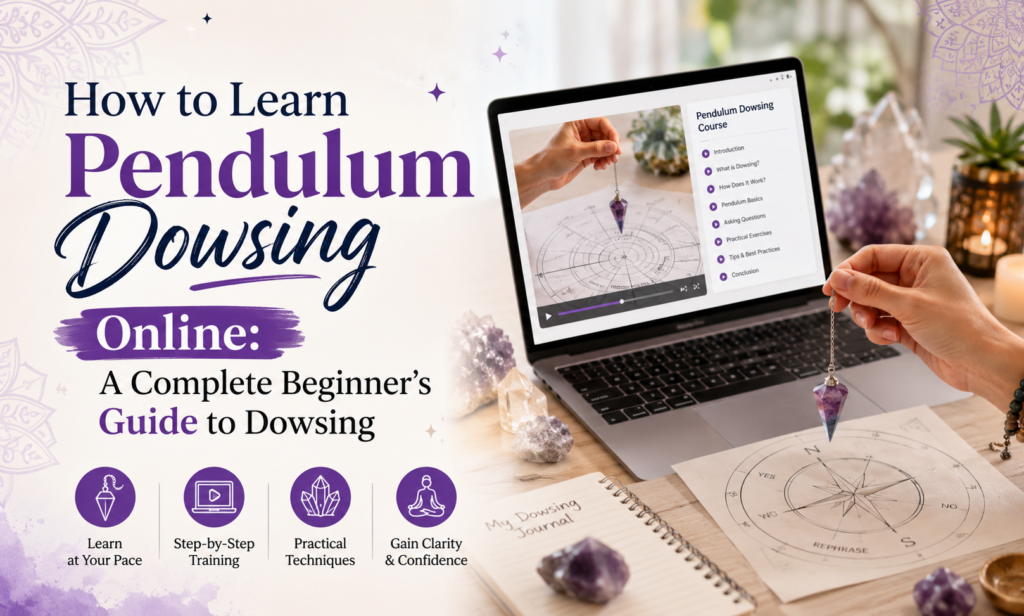
Pendulum dowsing is one of the most accessible practices for people who want to explore intuition, concentration, spiritual awareness and traditional energy-based techniques. The method appears simple—a pendulum is suspended from a chain or cord and its movement is observed—but learning to work with it consistently requires patience, clear questioning and regular practice.
For beginners, learning without proper guidance can sometimes become confusing. Different online videos may recommend different pendulum movements, cleansing methods, question styles and interpretations. This is one reason a structured Pendulum Dowsing Course Online can be helpful. Instead of collecting unrelated information, students can follow a logical learning sequence that begins with basic concepts and gradually introduces practical applications.
India Reiki Foundation offers training in pendulum dowsing alongside Reiki, crystal healing and other spiritual-learning programmes. This makes the subject particularly relevant for beginners who are exploring intuitive practices for the first time, as well as existing students considering a Reiki Healing Course or Online Reiki Course who want to expand their knowledge.
This beginner’s guide explains the fundamentals of pendulum dowsing, how to choose and prepare a pendulum, how to establish responses, what questions to ask, how to practise effectively and what to consider before enrolling in an online dowsing course.
Pendulum dowsing should be approached as a traditional spiritual and intuitive practice. It should not be treated as a replacement for professional medical, legal, financial or scientific advice.
What Is Pendulum Dowsing and How Does It Work?
Pendulum dowsing is a practice in which a small weighted object is suspended from a chain, thread or cord and allowed to move freely. The person holding it observes the direction or pattern of movement and assigns meaning to particular responses. For example, one direction may be interpreted as “yes,” another may represent “no,” while a different movement may indicate uncertainty or the need to stop asking the question.
The pendulum itself can be made from many materials. Crystal pendulums are popular within spiritual communities, but pendulums are also available in metal, wood and other materials. The material is less important for a beginner than having a pendulum that hangs evenly and moves freely.
Traditional dowsing practices extend beyond pendulums. Some practitioners also use L-shaped rods, Y-rods, bobbers and other tools. However, the pendulum is often the easiest starting point because it is compact, inexpensive and simple to practise with at home.
Spiritually oriented practitioners commonly describe pendulum dowsing as a way of working with intuition or subtle energetic awareness. From a physical perspective, tiny movements of the fingers, wrist and muscles can also cause a pendulum to swing. This means beginners should avoid assuming that every movement represents an infallible answer. The value of structured practice lies in learning to observe movements carefully, ask clear questions and recognise how expectations or emotions may influence the session.
Can Beginners Learn Pendulum Dowsing Online?
Yes. Pendulum dowsing can be introduced to complete beginners through online learning. Most foundational skills can be demonstrated through video lessons, live online classes and guided practice. Students can learn how to hold a pendulum, recognise movements, formulate questions and conduct simple exercises without travelling to a physical training centre.
Online learning can be especially convenient for students who have limited time or live far from a spiritual-training institute. A Pendulum Dowsing Course Online allows the learner to practise from home while following an organised curriculum.
Beginners generally do not require previous experience in Reiki or other healing systems. Pendulum dowsing can be studied independently. However, learners who are already taking a Reiki Healing Course may find certain concepts familiar, especially subjects related to meditation, concentration, chakras, aura awareness and energy-based practices.
An online course becomes more useful when it combines explanation with practical demonstrations. The learner should not simply memorise definitions. They should see how the pendulum is held, how response signals are established and how a question is formulated before practising independently. Regular practice remains important. Completing a lesson does not automatically create consistency. Beginners should repeat basic exercises several times before moving to more complex applications.
What Do You Need to Start Pendulum Dowsing?
Starting pendulum dowsing does not require a large collection of tools. The first requirement is a suitable pendulum. It should hang freely and be easy to hold for several minutes without creating unnecessary tension in the fingers. A quiet environment can also improve practice. Beginners often find it easier to concentrate when they are not distracted by conversations, television, notifications or frequent movement around them. A table or stable surface is useful because the elbow can be supported while the pendulum hangs freely. Supporting the arm may reduce unnecessary movement and make observation easier.
You may also keep a notebook dedicated to your practice. Record the date, the question, the pendulum movement and your observations. If a session feels inconsistent, noting your emotional state or level of concentration can help you identify possible patterns.
Pendulum charts can be introduced later. These may contain letters, numbers, choices or different response options arranged in a visual format. Beginners should first become comfortable with simple yes-and-no practice before moving to elaborate charts. You do not need expensive crystals, complex equipment or many different pendulums when starting. For most beginners, the basic setup includes: a pendulum, a comfortable place to sit, a quiet environment,
clear questions, and a willingness to practise regularly. The simplicity of the setup is one reason pendulum dowsing is popular among people exploring spiritual learning online.
How Do You Choose the Right Pendulum for Dowsing?
Choosing a pendulum should be based on comfort, balance and ease of movement rather than price alone. Many beginners are attracted to crystal pendulums because different crystals are traditionally associated with different spiritual qualities. Clear quartz, amethyst and rose quartz are examples commonly seen in pendulum collections. Metal pendulums are also popular because they are often evenly balanced and produce clear movements. There is no requirement that beginners must purchase a particular crystal.
Hold the pendulum before buying it if possible. Check whether the chain or cord is comfortable between your fingers and whether the weighted end hangs vertically. The pendulum should have enough weight to create noticeable movement but should not feel uncomfortable or difficult to control.
Shape may also influence ease of use. Symmetrical pendulums generally swing more predictably than irregular objects. Beginners sometimes make the mistake of buying several pendulums immediately and switching between them every day. It can be more useful to choose one pendulum and practise consistently with it while learning the fundamentals.
Once you understand how the pendulum responds in your hand, you can explore other materials and styles. Your first pendulum does not have to be perfect. It simply needs to be practical enough for you to learn how dowsing exercises are performed.
Do You Need to Cleanse or Prepare Your Pendulum Before Using It?
Pendulum cleansing is commonly practised within spiritual traditions, although different teachers recommend different methods. Some learners prefer to cleanse a new pendulum before using it. Others simply hold it quietly, meditate and set an intention for the practice session. The cleansing method may depend on the material. For example, not every crystal should be exposed to water, salt or strong sunlight. Beginners should therefore learn about the physical properties of their pendulum before using any cleansing method that could damage it.
Simple preparation may be enough. Sit comfortably and allow your breathing to become calm. Hold the pendulum gently and avoid beginning a session while feeling rushed or distracted. Some practitioners use a brief meditation or grounding exercise before dowsing. The purpose is to become calm and focused rather than immediately asking several questions.
Students learning through an Online Reiki Course may already use meditation or grounding techniques as part of their Reiki practice. These can sometimes help create a peaceful state before a pendulum session, although Reiki knowledge is not required for dowsing. The most practical preparation involves relaxing your hand, maintaining a comfortable posture and becoming aware of your expectations. If you strongly want a certain result, stop and reconsider whether the question is suitable for that session.
How Do You Use a Dowsing Pendulum Step by Step?
Beginners should practise pendulum dowsing using a simple sequence. Start by sitting comfortably at a table or another stable surface. Support your elbow if necessary so that your arm remains relaxed. Hold the upper part of the chain between your thumb and finger. Allow the pendulum to hang freely without touching the table. Wait until the pendulum becomes relatively still.
Now begin by identifying a neutral position. Observe how the pendulum behaves when you are not asking anything. Next, ask it to demonstrate a positive response. You can mentally or verbally say, “Show me yes.” Observe the direction. Allow the pendulum to return to a neutral position. Then ask, “Show me no.” Observe whether the direction is different. You can repeat this process for an uncertain response by asking for “maybe,” “unclear” or “cannot answer.”
After establishing your signals, practise with simple facts. For example, ask questions where you already know the answer. This may include your name, your current location or something clearly visible in front of you. Avoid beginning with emotional questions.
Once you are comfortable with basic responses, you can practise hiding an object and attempting to locate it, use simple charts or explore other exercises introduced in your training programme. Stop the session if the pendulum responses become increasingly inconsistent. Short and focused practice is generally better for beginners than repeatedly working for long periods.
How Do You Identify Yes, No and Maybe with a Pendulum?
There is no universal movement that must represent “yes” or “no” for every person. One beginner may experience a clockwise circle for yes, while another may observe a forward-and-backward movement. This is why response calibration should be completed before asking important questions. Hold the pendulum calmly and ask, “Show me my yes response.” Observe the movement. Return to neutral.
Then say, “Show me my no response.” If the movements appear similar, repeat the process after relaxing your hand. You can also establish a third signal.
Ask, “Show me unclear,” “Show me maybe” or “Show me when the question should not be answered.” Having an uncertain response can prevent beginners from forcing every question into a yes-or-no result. Write your response patterns in your practice notebook. During future sessions, briefly confirm them again before proceeding because movements may not always remain identical.
Do not deliberately move your wrist to produce the expected signal. The aim is to observe rather than control. If the pendulum does not give a clear movement, that does not mean you have failed. Pause, relax and try again later.
What Questions Can You Ask a Dowsing Pendulum?
Beginners should start with simple and objective questions. Questions with known answers provide the best early practice because you can immediately evaluate whether your established signals remain consistent.
Examples may include:
“Am I sitting indoors?”
“Is today Monday?”
“Is this object blue?”
“Is my name [your name]?”
After becoming familiar with the process, traditional dowsing practices may include questions related to personal choices, locating misplaced objects or other intuitive exercises. However, a pendulum should not be treated as an authority for serious medical, financial, legal or safety decisions. Do not use questions such as whether you should stop prescribed medication, whether a serious health condition exists or whether a particular investment is guaranteed to succeed.
In these situations, professional expertise is required. A useful pendulum question should be simple enough that the expected response can be clearly interpreted. The more complicated the question, the more difficult it becomes to know what the movement actually refers to.
How Should You Frame Questions for Accurate Pendulum Dowsing?
Question framing is one of the most important skills beginners can learn. A clear question should generally focus on one subject at a time. For example: “Should I take this course and will I become successful immediately?” This contains two different ideas. A clearer approach would be to separate the questions. Avoid vague language such as:
“Will everything be good?”
The word “everything” does not define a specific subject or time period. Neutral wording is also important. Instead of asking a question while strongly hoping for a particular answer, try to become emotionally neutral before beginning.
Strong expectations can influence small movements in your fingers or wrist. Where appropriate, add context. For example, instead of asking:“Is this good?” you might identify exactly what “this” means. Beginners should remember three basic principles: Ask one question at a time. Keep the wording simple.
Avoid questions where you are emotionally unwilling to accept one of the possible responses. Learning to frame questions clearly is one of the reasons a structured Pendulum Dowsing Course Online can be beneficial. Good instruction teaches not only how to hold the pendulum but also how to communicate questions effectively within the practice.
What Can Pendulum Dowsing Be Used For in Everyday Life?
Traditional pendulum dowsing is associated with a variety of personal and spiritual applications. One of the most common beginner uses is practising yes-and-no questioning. Another traditional application is attempting to locate a misplaced object. A person may ask a series of simple questions to narrow down possible locations. Some spiritual practitioners use pendulums alongside charts for selecting between several options.
Pendulum-based practices are also sometimes incorporated into chakra, aura and energy-awareness exercises. India Reiki Foundation’s dowsing curriculum includes practices related to chakra and aura scanning, home scanning, energy assessment and working with different dowsing tools.
Students interested in Reiki may therefore explore dowsing as a complementary area of study. Someone completing a Reiki Healing Course may already be familiar with concepts such as chakras, energetic balance and meditation, making the transition into certain dowsing exercises easier to understand.
Nevertheless, pendulum dowsing should remain a spiritual and reflective activity. For everyday decisions involving safety, health, money or legal responsibilities, objective information and qualified professional guidance should take priority.
What Common Pendulum Dowsing Mistakes Should Beginners Avoid?
Beginners often make mistakes because they expect immediate accuracy. The first common mistake is trying to control the pendulum. Even small deliberate movements can change the response.
Another mistake is holding the chain too tightly. Tension in the fingers, wrist or arm may create inconsistent movement. Asking vague questions is also common. If the question contains several ideas, the resulting answer becomes difficult to interpret.Repeated questioning is another problem. Suppose you receive a “no” response but wanted “yes.” Repeating the question ten times until the pendulum changes direction does not improve the quality of the practice.
Emotional involvement can also influence a session. Questions about relationships, money or major life choices may create strong expectations. Another mistake is attempting advanced techniques before learning basic calibration. Beginners sometimes purchase detailed charts and immediately start asking complicated questions without first developing consistent yes/no responses.
Finally, avoid treating pendulum responses as guaranteed predictions. A healthy learning approach combines curiosity with critical thinking. You can enjoy dowsing as a spiritual practice while recognising that it should not replace evidence-based information.
How Can You Improve Your Pendulum Dowsing Skills with Practice?
Regular practice is one of the best ways to become more comfortable with pendulum dowsing. Begin with short sessions. Five to fifteen minutes of concentrated practice can be more useful than an hour of distracted questioning. Use known-answer exercises frequently. For example, prepare several statements that are obviously true or false and observe how consistently your pendulum responds.
You can also practise with hidden objects. Ask another person to place an object inside one of several boxes and attempt to identify the correct location using a structured questioning method. Keep a journal. Your notes can include: the date, your response signals, the questions asked, the results, and how focused you felt. Over time, patterns may become easier to recognise.
Practise question writing away from the pendulum as well. Rewrite vague questions until they become simple and specific. Meditation may help improve concentration. A few minutes of quiet breathing before practice can reduce mental distraction. Do not compare your pendulum movements constantly with those of another learner. Different people may experience different response patterns. Improvement means developing a disciplined process rather than trying to create dramatic pendulum movements.
What Will You Learn in an Online Pendulum Dowsing Course?
A well-designed Pendulum Dowsing Course Online should provide much more than a basic explanation of pendulum movement. The programme should first introduce the meaning and background of dowsing. Students may then learn about different dowsing tools and how each is traditionally used. Pendulum handling and response calibration should be covered early because these form the foundation for later exercises. Question framing is another important subject. Learners need to understand how wording can affect the interpretation of a session.
Practical exercises may include yes/no questioning, finding hidden objects and working with different dowsing instruments. India Reiki Foundation’s pendulum dowsing training also covers topics such as meditation with a dowser, different types of dowsing tools, chakra and aura scanning, home scanning and related spiritual applications. Some modules may be particularly interesting for people already studying Reiki.
A learner who has completed an Online Reiki Course may wish to explore how pendulum techniques are traditionally used alongside chakra and aura concepts. However, a good beginner course should not require extensive prior spiritual knowledge. The training should be understandable even for a first-time learner.
How Do You Choose the Right Pendulum Dowsing Course Online?
Choosing the right course involves more than comparing prices. Start with the syllabus. A structured beginner programme should clearly explain what students will learn.
Look for a logical sequence that begins with fundamentals before moving to advanced techniques. Training should ideally include: basic dowsing principles, pendulum handling, yes/no calibration, question framing, practical exercises, and responsible use of the practice. Consider the teaching format as well. Pre-recorded courses offer flexibility. You can repeat lessons, pause demonstrations and study according to your schedule.
Live online courses may offer greater interaction and opportunities to clarify questions. Some students prefer a combination of both. You should also consider the background of the training organisation. If you are interested in other spiritual-learning programmes, choosing an institute that also offers Reiki, crystal healing or related subjects may provide a broader learning pathway.
Be cautious about courses that promise guaranteed predictions, perfect accuracy or unrealistic results. A responsible course should encourage observation, practice and patience. The best Pendulum Dowsing Course Online for a beginner is one that helps the learner develop a clear foundation before introducing more specialised techniques.
Why Learn Pendulum Dowsing from India Reiki Foundation?
India Reiki Foundation provides learning opportunities across Reiki and several related spiritual disciplines, making it suitable for students who want to explore more than one area of holistic learning.
Its pendulum dowsing programme is structured for learners who want to understand the practice from the fundamentals rather than simply learning a few isolated pendulum techniques. The course introduces dowsing concepts, different types of tools, meditation techniques, yes/no responses and practical exercises.
Students can also explore applications such as locating objects and working with traditional dowsing tools for energy-related exercises. One advantage for beginners is that previous Reiki experience is not essential for starting pendulum dowsing. This allows someone with no background in energy healing to begin with dowsing first.
At the same time, learners who later want broader knowledge can consider subjects such as a Reiki Healing Course, crystal healing or other programmes available through India Reiki Foundation. The online format is particularly useful for learners who are unable to attend regular physical classes. Students can learn from home while following a structured sequence. Existing Reiki learners may also find value in combining their knowledge.
For example, someone studying an Online Reiki Course may already be familiar with topics such as chakras, aura awareness, meditation and energy concepts. Pendulum dowsing can provide another traditional method for exploring these subjects.
For beginners looking for organised spiritual learning rather than random online tutorials, India Reiki Foundation provides a dedicated pathway for studying pendulum dowsing alongside its wider range of energy and metaphysical courses.
Frequently Asked Questions About Learning Pendulum Dowsing Online
1. Is pendulum dowsing easy for beginners to learn?
The basic method is relatively simple to understand. Beginners can quickly learn how to hold a pendulum and establish response movements. Developing consistency, however, requires regular practice, good question framing and patience.
2. Do I need Reiki training before learning pendulum dowsing?
No. You can learn pendulum dowsing without completing Reiki training first. Reiki and dowsing are separate subjects, although they may be combined within some spiritual practices. Students interested in both can study a Reiki Healing Course alongside or after learning dowsing.
3. Can I learn pendulum dowsing at home?
Yes. Pendulum dowsing is particularly suitable for home practice because very little equipment is required. A pendulum, quiet environment and structured learning material are enough to begin.
4. What is the best pendulum for a beginner?
A balanced pendulum that is comfortable to hold and swings freely is generally suitable. Crystal, metal and wooden pendulums can all be used. Beginners should prioritise ease of use over expensive materials.
5. How do I find my pendulum’s yes and no signals?
Hold the pendulum in a relaxed position and ask it to demonstrate “yes.” Observe the movement, return it to neutral and then ask for “no.” Repeat the calibration at the beginning of practice sessions until the signals feel clear.
6. Why does my pendulum sometimes give different answers?
Inconsistent answers can result from unclear questions, tension, expectation, fatigue or small unconscious movements. Stop the session if responses become confusing and return later with a relaxed mindset.
7. Can pendulum dowsing help find lost objects?
Locating misplaced or hidden objects is one of the traditional exercises associated with dowsing. Beginners can practise with deliberately hidden items as a learning activity before attempting more complex applications.
8. Is an online pendulum dowsing course suitable for complete beginners?
Yes, provided the programme starts with basic concepts and gradually introduces practical exercises. A beginner-friendly Pendulum Dowsing Course Online should not assume previous dowsing or Reiki experience.
9. Can Reiki practitioners use a pendulum?
Many Reiki practitioners choose to study pendulum dowsing because traditional dowsing courses sometimes include chakra, aura and energy-related exercises. Someone taking an Online Reiki Course may therefore explore pendulum dowsing as an additional spiritual skill.
10. How long should beginners practise pendulum dowsing each day?
There is no fixed requirement. Short, focused sessions of approximately five to fifteen minutes can be sufficient when starting. Quality of concentration is more important than practising for long periods.
Conclusion
Pendulum dowsing can be an interesting starting point for people exploring intuition, concentration and traditional spiritual practices. The technique may look simple, but effective learning involves several important skills. Beginners need to understand how to hold the pendulum comfortably, establish clear yes/no signals, formulate suitable questions and maintain a neutral state while observing responses. Regular practice makes the learning process easier.
Starting with known-answer questions, maintaining a journal and gradually progressing to practical exercises can help beginners develop a more disciplined approach. Instead of trying to learn every advanced method immediately, focus on building a strong foundation. For learners who prefer organised instruction, a Pendulum Dowsing Course Online can provide a clear pathway from fundamental concepts to more detailed applications.
India Reiki Foundation offers pendulum dowsing training within a wider environment of Reiki and spiritual education. Beginners can start learning dowsing even without previous Reiki experience, while existing Reiki practitioners can use the course to expand their understanding of traditional energy-based practices. Students interested in a broader learning journey may also explore a Reiki Healing Course or Online Reiki Course alongside pendulum dowsing.
The most effective approach is to remain curious, patient and realistic. Use the pendulum as a spiritual and reflective practice, develop your technique gradually and avoid relying on it as a substitute for qualified professional guidance. With consistent learning and structured practice, beginners can develop a clearer understanding of pendulum dowsing and decide how they want to incorporate it into their personal spiritual journey.
India Reiki Foundation | Online Reiki Course & Spiritual Healing Academy
Adress- 502-503, Stanford Plaza, Veera Desai Road, Andheri West, Mumbai, Maharashtra 400065, India
Phone number +91 96254 88550
Website- indiareikifoundation.com
Mail- mail@indiareikifoundation.com