
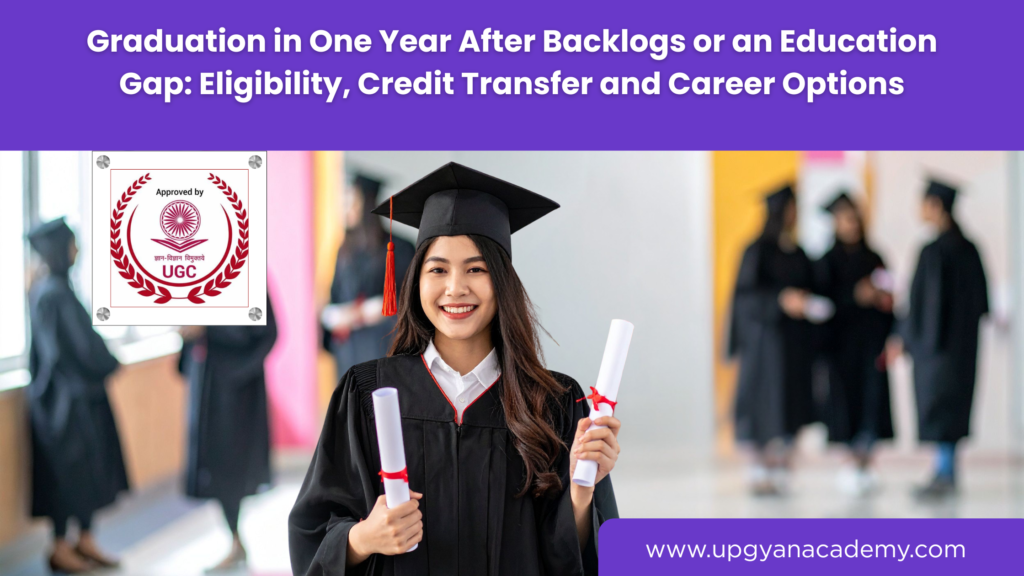
Graduation in One Year is widely searched by students who could not finish their bachelor’s degree because of failed subjects, financial difficulties, family responsibilities, employment, relocation or a long break from education. Many of these learners have already completed one or more years of college but remain without a final degree because a few subjects, semesters or academic formalities are still pending.
For such students, Graduation in One Year should not be understood as a method of obtaining a complete bachelor’s degree without studying. It is better understood as an eligibility-based academic completion route where previous education, passed subjects and earned credits may be assessed by an authorised university. The student may then be required to complete the remaining examinations, projects, assignments or other academic requirements.
Terms such as Single sitting Degree and One Year Degree course are often used online to describe fast-track education options. However, students must carefully understand what these terms mean in their specific situation. The validity of a qualification depends on the university, programme, learning mode, admission process, credit policy and completion of all prescribed requirements.
UpGyan Academy provides academic guidance for students, working professionals and college dropouts who want to understand suitable education pathways. The role of an education guidance platform is to help students evaluate their profile, organise documents and explore possible options. The final admission, examination and degree must always be handled by the recognised university offering the programme.
What Does Graduation in One Year for Students with Backlogs Mean?
Graduation in One Year for students with backlogs generally refers to a degree-completion pathway for learners who have already studied at the undergraduate level but have not completed every required subject. A backlog may involve one failed paper, several pending semesters, an incomplete project, missed practical examinations or an interrupted final year.
For example, a student may have passed the first and second years of BCom but left college before completing the final year. Another student may have completed all semesters except two pending subjects. These learners are different from students who have completed only Class 12 and never enrolled in a bachelor’s degree.
The previous academic record is important because it shows how much of the programme has already been completed. A university may review marksheets, subject combinations, the previous syllabus and the number of credits earned. If the earlier academic work is considered acceptable, the learner may be allowed to complete only the remaining portion.
Therefore, Graduation in One Year should be viewed as an academic continuation or completion option rather than a shortcut. The exact duration and remaining requirements depend on the student’s documents and the rules of the university.
Students should also be cautious when they see the term Single sitting Degree. A legitimate academic pathway requires enrolment, assessment, examinations and verifiable university records. A certificate issued without a proper academic process can create difficulties during employment or higher education verification.
Can Students with Backlogs Complete Graduation in One Year?
Students with backlogs may be able to complete Graduation in One Year when they have already passed a substantial part of their bachelor’s programme and meet the receiving university’s eligibility conditions. However, no student should assume that all pending subjects will automatically be cleared.
The university may evaluate:
- The number of years or semesters already completed
- The number of subjects passed
- The number and type of backlogs
- The university from which the student previously studied
- The age of the previous marksheets
- Changes in the course syllabus
- Availability of equivalent subjects
- The current programme structure
- Credit-transfer rules
A student with one or two pending final-year papers may have a different pathway from someone who failed most subjects in the second year. Similarly, a student who completed two years of BA may not be able to transfer every credit into BCom or BCA because the subject structures are different.
Graduation in One Year can be considered only after the academic profile has been reviewed. Students should share complete marksheets, including failed subjects. Hiding academic details may lead to incorrect counselling or rejection during verification.
A trustworthy One Year Degree course should clearly explain what the student still needs to complete. This may include examinations, assignments, projects, practicals or additional subjects. Students should avoid claims such as guaranteed passing or a degree without examinations.
Can Students Resume Graduation After a Long Education Gap?
Yes, students can often resume their education after a long gap, but they may not always be able to continue from the exact point where they stopped. The available option depends on university rules, syllabus changes, previous credits and the maximum period allowed for completion.
Education gaps are common. Students may leave college because of:
- Financial pressure
- Employment responsibilities
- Marriage or family commitments
- Health-related issues
- Relocation to another city
- Preparation for competitive examinations
- Personal emergencies
- Lack of career guidance
- Business responsibilities
A gap of five, eight or even ten years does not automatically mean that previous education has no value. If the student has authentic marksheets and university records, those documents can be evaluated.
In some cases, the previous subjects may still match the present syllabus. In other cases, the university may require additional papers because the curriculum has changed. Graduation in One Year may be possible when enough previous academic work is accepted and the remaining requirements can be completed within the permitted schedule.
Students without any previous graduation record may need to enrol in a regular-duration bachelor’s programme. Therefore, the length of the gap is only one factor. The more important factors are previous study, available documents and university eligibility.
Who Is Eligible for Graduation in One Year After a Study Gap?
Eligibility for Graduation in One Year is not identical for every student. The strongest profiles are generally those of learners who have already completed part of a recognised bachelor’s degree.
Possible applicants may include:
- Students who passed the first or second year but later discontinued
- Learners with pending final-year subjects
- College dropouts with available marksheets
- Students whose graduation was interrupted because of employment
- Working professionals who need a degree for promotion
- Learners who changed cities and could not continue at the same college
- Students with multiple academic backlogs
- Candidates seeking a recognised credit-transfer pathway
- Adults returning to education after a long break
Basic eligibility usually includes Class 12 or an equivalent qualification. Students must also provide evidence of previous undergraduate study when applying for a completion-based route.
The proposed course should generally be related to the student’s earlier course. For instance, continuing from BCom to BCom may be more practical than changing from BCom to a specialised science programme.
Final eligibility is decided by the university. Counsellors can explain possible routes, but they cannot independently approve admission or guarantee credit acceptance.
Graduation in One Year should therefore be recommended only after checking the complete educational background.
How Does Graduation in One Year Work for Students with Backlogs?
The process usually starts with a student profile review. The learner provides previous marksheets, certificates and details about the incomplete course. The documents are then examined to understand what has already been completed and what remains pending.
A typical Graduation in One Year process may involve the following stages:
Academic profile assessment
The student’s Class 10, Class 12 and graduation documents are reviewed. The counsellor identifies completed years, passed subjects and pending papers.
Course mapping
The previous course is compared with the available programme. The purpose is to understand whether the earlier subjects or credits are compatible.
University eligibility review
The university or authorised admission department reviews the case. It decides which credits can be accepted and what additional requirements must be completed.
Admission confirmation
Once eligibility is approved, the learner receives details about the programme, session, learning mode, fee structure and academic schedule.
Completion of pending work
The student may need to appear for examinations, submit assignments, complete projects or attend practical sessions.
Result and degree issuance
After all university requirements are successfully completed, the result and degree are issued according to the institution’s academic process.
A genuine One Year Degree course should include clear academic steps. Students should not pay fees only on the basis of a verbal promise. Written confirmation and official enrolment details are essential.
What Is Credit Transfer and How Does It Help Students with Backlogs?
Credit transfer allows a student’s previously completed academic work to be considered by another eligible institution or programme. Instead of repeating every year from the beginning, the learner may receive recognition for subjects or credits already passed.
For students with backlogs, this can be helpful because it separates completed academic work from pending requirements. A student who passed 70% or 80% of a programme may only need to complete the remaining eligible subjects, depending on university rules.
Credit transfer does not mean that failed subjects are converted into passed subjects. It also does not mean that every old subject will automatically be accepted. The receiving university evaluates the syllabus, credit value, academic level and compatibility of the previous programme.
The Academic Bank of Credits is designed to support academic mobility and credit accumulation across eligible institutions. However, the degree-awarding university remains responsible for deciding which credits can be used toward a particular qualification.
In a Graduation in One Year pathway, credit transfer may reduce repetition and help eligible students resume education efficiently. It must be supported by genuine marksheets, enrolment records and university approval.
Students should ask the following questions:
- How many previous credits will be accepted?
- Which subjects must be repeated?
- Are bridge papers required?
- Will the course title remain the same?
- What examinations must be completed?
- Who will issue the final degree?
Clear answers to these questions can prevent misunderstandings later.
Which Graduation Courses Are Available for Students with Education Gaps?
Course availability depends on the student’s previous stream and the programmes offered by the selected university. Common options explored by students with education gaps include:
- Bachelor of Arts
- Bachelor of Commerce
- Bachelor of Business Administration
- Bachelor of Computer Applications
- Bachelor of Science
- Bachelor of Social Work
- Other recognised undergraduate programmes
The best option is usually the course that closely matches the student’s previous education. A learner who studied BA for two years may receive better academic continuity in BA than in a completely unrelated technical course.
Students should not select Graduation in One Year only because a programme appears easy or quick. The degree should support future plans such as employment, promotion, government examinations, MBA admission or other postgraduate study.
Before selecting a course, students should check:
- Whether their previous subjects are compatible
- Whether the programme is available in the proposed mode
- Whether the university can legally offer the programme
- Whether the academic session is recognised
- Whether practical or laboratory requirements apply
- Whether the degree meets future career requirements
A Single sitting Degree advertised without complete programme information should be approached carefully. Students should always know the university and exact course before paying admission fees.
What Documents Are Required for Graduation in One Year Admission?
Documents are central to eligibility evaluation. Incomplete or incorrect documents can delay the admission process or affect credit-transfer approval.
Students may be asked to submit:
- Class 10 marksheet
- Class 10 passing certificate
- Class 12 marksheet
- Class 12 passing certificate
- Previous graduation marksheets
- Semester-wise or year-wise results
- Previous university enrolment number
- Transfer certificate
- Migration certificate
- Leaving certificate
- Aadhaar card
- Address proof
- Passport-size photographs
- Gap certificate or affidavit, where required
- Name-change proof, if applicable
- Work-experience documents for certain professional pathways
All records should be authentic and readable. Students who have lost marksheets should contact the earlier university or college for duplicate copies.
Graduation in One Year admission should never involve altered documents or fabricated certificates. Any mismatch in the student’s name, date of birth or parent’s name should be corrected through the appropriate authority.
Students should keep copies of application forms, payment receipts, university communications, identity cards and enrolment numbers. These documents may be needed during examinations and final degree verification.
Is Graduation in One Year Valid in India?
Graduation in One Year may be valid when it is based on a legitimate academic pathway and awarded by an authorised institution. The phrase itself does not make a programme valid or invalid.
Validity depends on several factors:
- The legal status of the university
- Recognition of the exact programme
- Approval of the learning mode
- The academic session of admission
- The student’s eligibility
- Acceptance of previous credits
- Completion of examinations
- Compliance with academic regulations
- Authenticity of records
Students must understand that a university may be recognised, but a specific programme or mode may not be approved for every academic year. Therefore, recognition should be checked for the exact course, mode and admission session.
Graduation in One Year should not involve backdated enrolment, fake attendance, purchased marksheets or certificates issued without assessment. These practices can create problems during document verification.
A valid One Year Degree course should have an official admission record, university enrolment, academic participation, result declaration and degree issuance.
How Can Students Verify the Recognition of a University and Course?
Students should independently verify recognition before admission. They should not rely entirely on brochures, social media advertisements or verbal statements.
The following checks are useful:
Check the official university website
Verify the programme name, admission details, learning mode and examination process.
Check relevant regulatory portals
For online and distance education, students should check the current recognition or entitlement status on the appropriate official education portals.
Check the admission session
Recognition can differ between academic sessions. A programme available in one year may not necessarily be approved in another year.
Ask for written confirmation
Students should request written details about the university, course, learning mode, fees and academic requirements.
Verify academic records digitally
Students can use the National Academic Depository to understand digital academic award verification. NAD supports secure access to academic records uploaded by participating institutions.
Graduation in One Year applicants should also ask whether their degree and marksheets will be verifiable through the issuing university.
A website displaying terms such as UGC approved should not be considered sufficient proof. Students should verify the actual university and programme on official platforms.
Is Graduation in One Year Valid for Government and Private Jobs?
A recognised graduation degree may be accepted for government and private jobs when it meets the employer’s eligibility conditions. However, acceptance is not automatic for every vacancy.
Government recruitment notifications may specify:
- A recognised bachelor’s degree
- A particular subject or stream
- Minimum percentage
- Age limits
- Professional approval
- Specific learning mode
- Additional qualifications
Students should read the official job notification before applying. A degree that is acceptable for one recruitment process may not meet the requirements of another specialised role.
Private employers often focus on degree recognition, skills, experience and the candidate’s ability to perform the job. For working professionals, Graduation in One Year may help remove the qualification barrier for promotion or a job change.
Students should maintain complete documentation, including:
- Admission confirmation
- University enrolment
- Marksheets
- Provisional certificate
- Final degree
- Digital verification details
A Single sitting Degree should never be promoted as guaranteed for all government jobs. The recruiting authority has the final right to interpret eligibility conditions.
Can Students Apply for Higher Education After Completing Graduation?
Students who complete a recognised bachelor’s degree may apply for postgraduate education, subject to the admission policy of the receiving university.
Possible higher education options include:
- MBA
- MA
- MCom
- MSc
- MCA
- MSW
- Postgraduate diplomas
- Professional certification programmes
Graduation in One Year can help eligible learners complete the bachelor’s qualification needed for postgraduate admission. However, the student must also meet course-specific conditions.
For example, an MBA may require a recognised bachelor’s degree and entrance examination. An MSc programme may require graduation in a related science discipline. An MCA may have mathematics-related eligibility criteria.
Students planning higher education should first identify their future course and then choose the graduation pathway accordingly. This avoids selecting a bachelor’s degree that does not meet the next programme’s requirements.
International universities and credential evaluation agencies may apply different rules. Students planning overseas education should check their policies before joining a One Year Degree course.
Does an Education Gap Affect Career Opportunities?
An education gap can affect some applications, but it does not permanently damage a person’s career. Employers usually want a clear explanation for the break and evidence that the candidate remained productive.
A student may have worked, managed a family business, cared for relatives, learned new skills or handled personal responsibilities during the gap. These experiences can be explained honestly during interviews.
Graduation in One Year may help a candidate meet basic eligibility requirements for roles that require a bachelor’s degree. However, the degree alone may not guarantee employment.
Candidates should also build:
- Communication skills
- Computer skills
- Industry knowledge
- Professional certifications
- Practical project experience
- Interview confidence
- Updated résumé and LinkedIn profile
Working professionals can present Graduation in One Year as part of their commitment to completing unfinished education and improving career prospects.
The education gap should be explained briefly and positively. Students should focus on what they learned and how they are now prepared for the next stage.
What Mistakes Should Students Avoid While Choosing a Graduation Programme?
Students often make decisions quickly because they are worried about lost time. This urgency can make them vulnerable to misleading claims.
The following mistakes should be avoided:
Choosing only on the basis of duration
The shortest programme is not always the most suitable or valid programme.
Not checking the university
Students should know the name of the university before making any payment.
Ignoring programme recognition
General university recognition does not automatically cover every programme and mode.
Believing guaranteed passing claims
No genuine academic institution should guarantee passing without assessment.
Accepting a backdated admission
Backdated records can create major verification problems.
Hiding failed subjects
All backlogs should be disclosed during profile evaluation.
Paying without a receipt
Students should always receive proper payment confirmation.
Ignoring future eligibility
The degree should support future employment or higher education goals.
Choosing an unrelated course
Changing streams may reduce the number of transferable credits.
Depending only on an agent
Students should independently verify official information.
Graduation in One Year should be selected only after understanding the complete academic process. A genuine programme will explain examinations, assignments, university records and degree verification.
How Can UpGyan Academy Help Students Complete Their Pending Graduation?
UpGyan Academy provides academic guidance to students who want to restart or complete interrupted education. The support can be useful for learners who are confused about eligibility, backlogs, documentation and credit transfer.
The guidance process may include:
- Reviewing previous academic records
- Understanding the reason for discontinuation
- Identifying suitable graduation programmes
- Explaining possible credit-transfer routes
- Helping organise required documents
- Clarifying university admission steps
- Explaining examination and assessment requirements
- Guiding working professionals toward flexible options
UpGyan Academy can help a student understand whether Graduation in One Year is worth exploring based on the available records. However, the university is responsible for final admission, academic evaluation, examinations and degree issuance.
Students should give complete information during counselling. This includes all previous marksheets, pending subjects and education gaps. Transparent information helps the counsellor suggest a more appropriate option.
UpGyan Academy can also explain the difference between a recognised academic pathway and an unsafe Single sitting Degree claim. The aim should be to help students make informed decisions rather than select a programme only because it promises quick completion.
Is an MBA a Good Option for Working Professionals After Graduation?
An MBA can be a valuable next step for working professionals who want to move into management, leadership, finance, marketing, operations, human resources or entrepreneurship.
After completing Graduation in One Year through an eligible pathway, a professional may explore MBA options based on career goals and university eligibility.
Flexible MBA programmes may help working learners continue their jobs while studying. However, students should compare:
- University recognition
- MBA specialisation
- Learning mode
- Course duration
- Examination format
- Academic support
- Fees
- Career relevance
A marketing professional may consider an MBA in Marketing, while someone working in banking may explore Finance. Employees managing teams may benefit from Human Resource Management or Operations.
UpGyan Academy can guide MBA for working professionals. The choice should not be based only on speed. A recognised programme with a practical curriculum is more valuable than a qualification selected only because it appears easy.
Students should first complete a valid bachelor’s degree and then verify the MBA admission requirements.
Should Working Professionals Consider B.Tech for Career Advancement?
Working professionals in technical industries may consider B.Tech when an engineering qualification is necessary for promotion, job eligibility or long-term professional growth.
However, B.Tech is a regulated technical programme with academic, practical and institutional requirements. It should not be treated as an ordinary Single sitting Degree.
Diploma holders may explore lateral-entry pathways where permitted. Professionals who discontinued engineering may need their previous semesters and credits to be evaluated.
Before joining a B.Tech programme, students should check:
- Entry qualification
- Institution approval
- Programme recognition
- Practical requirements
- Laboratory facilities
- Attendance conditions
- Examination pattern
- Duration
- Credit-transfer policy
- Mode of delivery
UpGyan Academy can help working professionals understand available B.Tech education pathways and the documents required for profile assessment. Students should still verify the institution and programme through official sources.
Graduation in One Year and B.Tech for working professionals are different academic routes. A general graduation completion option cannot automatically be applied to a technical engineering degree.
Frequently Asked Questions
1. Can I complete Graduation in One Year after failing in the final year?
It may be possible if you have completed the earlier years and the university accepts your previous academic record. The remaining subjects and assessments will depend on your eligibility review.
2. Is Graduation in One Year possible after a ten-year study gap?
A long gap does not automatically make you ineligible. Your earlier marksheets, course structure and the university’s current rules will determine the available pathway.
3. Can I complete graduation if I have multiple backlogs?
Yes, some students with multiple backlogs may be considered, but every pending subject must be disclosed. The university will decide what needs to be completed.
4. Can a Class 12 student directly join a One Year Degree course?
A student without previous graduation study generally needs to complete the full prescribed bachelor’s programme. One-year completion is mainly relevant to eligible students with earlier credits.
5. Is a Single sitting Degree accepted for government jobs?
Acceptance depends on the university, programme, mode and recruitment rules. Students should verify the qualification and read the official job notification before applying.
6. Can previous college marksheets be used for credit transfer?
Previous marksheets may be considered if they are genuine and issued by a recognised institution. The receiving university decides whether the subjects are equivalent.
7. Does Graduation in One Year require examinations?
A legitimate academic completion pathway normally includes examinations, assignments, projects or other assessments. Students should avoid programmes promising a degree without academic participation.
8. Can I apply for MBA after completing my graduation?
Yes, a recognised bachelor’s degree may make you eligible to apply for an MBA. The MBA university may also have entrance, percentage or other admission conditions.
9. How can I check whether my degree is genuine?
Verify the university and programme on official education portals, check your enrolment directly with the university and review digital academic records where available.
10. Can working professionals complete pending graduation while employed?
Flexible online, distance or other permitted programmes may help working professionals continue their education. Students should check attendance, examination and assignment requirements before enrolling.
Conclusion
Backlogs and education gaps can slow down a student’s academic journey, but they do not always mean that graduation must be abandoned. Learners who have already completed part of a bachelor’s programme may be able to use their previous study toward an eligible completion pathway.
Graduation in One Year can be useful for college dropouts, students with pending subjects and working professionals who need a bachelor’s degree for career growth. However, the pathway must be based on genuine academic records, university approval, credit evaluation and completion of all remaining requirements.
Students should not choose a One Year Degree course only because it promises quick results. They should verify the university, programme, learning mode, academic session and examination process. Official resources such as the National Academic Depository can also support document verification.
UpGyan Academy can guide students through profile evaluation, course selection and documentation. The final decision should always be based on eligibility and official university rules.
A responsible Graduation in One Year pathway is not about avoiding education. It is about recognising completed study, resolving pending academic requirements and helping students move forward with a valid and verifiable qualification.
Contact Upgyan Academy
UpGyan Academy – Graduation In One Year in Mumbai | One Year Degree Course | Direct Admission In B.Tech
Address: 69, Level-2, Dewan Centre, S.V. Road, Jogeshwari (West), Mumbai – 400 102
Phone: 09867864152
Website: https://upgyanacademy.com/
Google Maps: Get Directions