

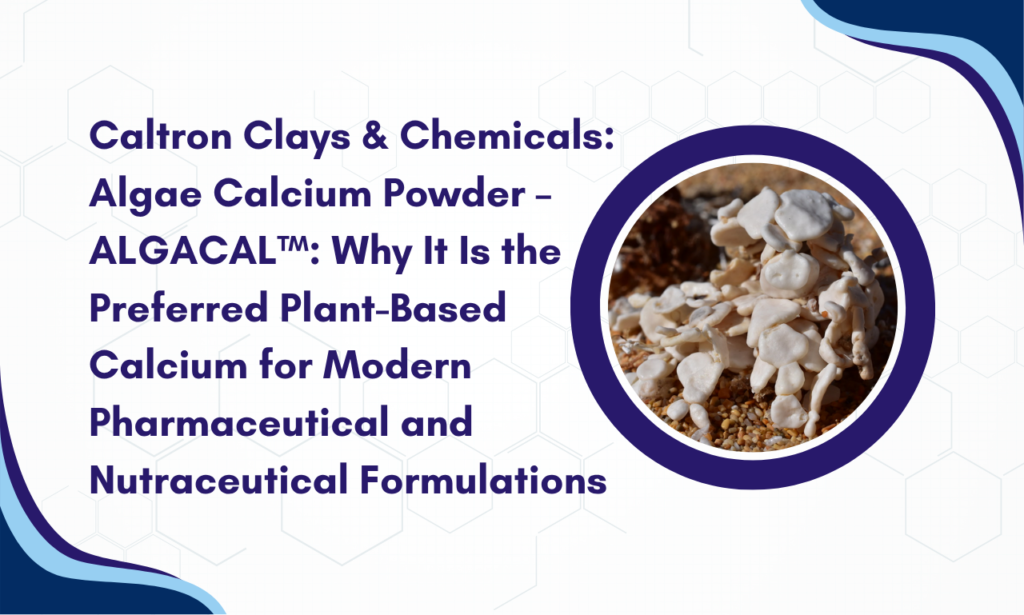
Introduction: Why the Source of Calcium Now Matters as Much as the Specification
When a pharmaceutical or nutraceutical manufacturer selects a calcium ingredient, the decision can influence far more than the calcium value shown on the finished-product label. Raw-material origin, mineral composition, physical characteristics, processing performance, documentation and supply consistency can all affect whether an ingredient moves successfully from laboratory evaluation to commercial manufacturing.
This is one reason algae-derived calcium is receiving greater consideration in mineral formulation.
Certain marine algae develop mineral-rich structures through interaction with their surrounding marine environment. These mineralized algae can provide calcium alongside naturally associated magnesium and other trace mineral components. For manufacturers, this creates an opportunity to evaluate calcium through two perspectives: technical mineral performance and plant-based ingredient positioning.
The distinction is important. An appealing natural origin can support product differentiation, but it cannot replace raw-material qualification. R&D teams still need dependable specifications. QA teams require quality documentation and contaminant controls. Procurement professionals need consistent commercial supply.
Caltron Clays & Chemicals offers its algae-derived calcium range under the brand ALGACAL™, with both Rhodophyta–Lithothamnion Calcareum and Chlorophyta options.
For companies evaluating an Algae Calcium Powder Manufacturer in India, ALGACAL™ provides two algae-source choices for pharmaceutical and nutraceutical product development.
Businesses looking for an Algae Calcium Powder Supplier in India can assess Caltron based on current specifications, samples, quality documentation and commercial sourcing requirements.
As a Calcium Raw Material Manufacturer in India, Caltron provides ALGACAL™ for manufacturers interested in combining algae-derived sourcing with specification-led formulation.
What Is Algae Calcium Powder? Understanding the Ingredient Beyond the “Plant-Based” Label
Algae Calcium Powder is a mineral ingredient derived from calcium-rich marine algae. Unlike calcium ingredients obtained from certain geological or animal-derived sources, its origin is linked to algae that naturally accumulate minerals from their environment.
This origin has resulted in several commonly used descriptions, including algal calcium, seaweed calcium, plant calcium, plant-based calcium and vegan calcium.
From a B2B formulation perspective, however, these descriptions answer only one question: where does the ingredient come from?
They do not explain how the material will behave in a manufacturing process.
What Information Matters to Formulators?
A thorough raw-material evaluation may include:
- Identity and algae source
- Calcium assay
- Magnesium specification
- Trace-mineral composition
- Particle size
- Particle-size distribution
- Bulk and tapped density
- Moisture
- Powder flow
- Heavy-metal limits
- Microbiological specifications
- Batch consistency
- Traceability
- Certificate of Analysis
- Relevant quality documentation
The combination of these parameters provides a much clearer picture of ingredient suitability than the word “natural” alone.
For pharmaceutical and nutraceutical manufacturers, algae calcium should therefore be viewed as a specialized mineral raw material requiring the same disciplined qualification applied to other formulation ingredients.
Why Plant-Based Calcium Is Becoming More Relevant to Supplement Brands
Plant-based product development is no longer limited to botanical extracts, proteins and functional foods. Supplement manufacturers are increasingly reviewing the origin of minerals, excipients, capsules and other formulation components as part of a broader ingredient strategy.
Calcium can play an important role in this process.
An algae-derived calcium source gives manufacturers another option when designing products around plant-based, vegetarian or vegan-oriented concepts.
Product Development Opportunities Can Include:
- Plant-based calcium supplements
- Vegan mineral formulations
- Vegetarian calcium products
- Calcium-magnesium combinations
- Multi-mineral supplements
- Plant-oriented powder blends
- Natural-source mineral products
Ingredient origin can also help create a more transparent sourcing narrative. Instead of simply stating “calcium,” manufacturers may be able to communicate that the mineral originates from a defined marine algae source, subject to applicable labeling and regulatory requirements.
However, plant origin and physiological performance should not be treated as interchangeable concepts.
Being algae-derived does not independently demonstrate superior absorption, greater safety or better clinical performance. Those questions require appropriate evidence and consideration of the complete formulation.
A responsible Calcium Raw Material Manufacturer in India should therefore support natural-source positioning without replacing technical evidence with marketing assumptions.
Inside ALGACAL™: Two Algae Sources for Different Formulation Requirements
Caltron Clays & Chemicals supplies ALGACAL™ in two algae-source options, allowing R&D teams to compare different material profiles before deciding which grade fits their formulation.
ALGACAL™ Rhodophyta – Lithothamnion Calcareum
This option originates from calcified red marine algae. Caltron provides defined calcium and magnesium specifications for its Lithothamnion Calcareum grade.
ALGACAL™ Chlorophyta
This option is derived from green algae and gives manufacturers an alternative algae source for calcium formulation.
Why offer more than one source?
Because two products marketed within the same calcium category may have very different development requirements.
A high-dose tablet may prioritize ingredient loading and compression characteristics. A capsule product may be more sensitive to bulk density. A plant-based powder may require particular dispersibility and organoleptic characteristics.
The appropriate ALGACAL™ grade should therefore be selected according to the finished-product specification rather than algae terminology alone.
ALGACAL™ Lithothamnion Calcareum: Examining the Red Algae Mineral Specification
Lithothamnion Calcareum is a calcified red marine algae belonging to the Rhodophyta group.
Caltron’s ALGACAL™ Lithothamnion grade is specified with:
- Calcium – NLT 35%
- Magnesium – NLT 2.2%
- A naturally occurring profile described by Caltron as containing 74 trace minerals
For R&D teams, the calcium value provides an important basis for ingredient-loading calculations.
If a finished formulation has a defined elemental calcium target, formulators can use the verified raw-material assay to estimate the required ALGACAL™ inclusion level.
The magnesium content also needs to be considered when calculating the total mineral contribution.
What About the 74 Trace Minerals?
A broader trace-mineral profile is useful for characterizing the ingredient, but the presence of multiple minerals should be interpreted carefully.
Formulation teams should establish:
- Which minerals are present
- Their measured concentrations
- Their contribution at the intended dosage
- Whether they affect nutrient declarations
- Whether they influence the finished formulation
- Whether any proposed claims are supported
This prevents a raw-material characteristic from being converted into an unsupported nutritional conclusion.
For companies assessing a Calcium Raw Material Manufacturer in India, clearly defined calcium and magnesium specifications provide a stronger basis for technical discussion than generalized claims about natural mineral richness.
ALGACAL™ Chlorophyta: Evaluating Green Algae Calcium on Its Own Specifications
The Chlorophyta grade provides another route for manufacturers interested in algae-derived calcium.
Chlorophyta represents green algae, and Caltron includes this source within the ALGACAL™ range for pharmaceutical and nutraceutical applications.
The important point for formulators is that Chlorophyta should be evaluated independently.
Specifications established for Lithothamnion Calcareum should not automatically be transferred to a green algae-derived material.
Before starting development work, request the current Chlorophyta specification and evaluate:
- Calcium assay
- Magnesium level
- Trace-mineral profile
- Particle size
- Density
- Moisture
- Powder characteristics
- Heavy-metal limits
- Microbiological quality
- Batch consistency
- Documentation
- Commercial availability
These factors allow R&D teams to determine whether Chlorophyta matches the nutritional and manufacturing requirements of the planned product.
Offering both algae sources allows an Algae Calcium Powder Manufacturer in India to support more application-specific raw-material discussions.
Rhodophyta vs Chlorophyta: Which ALGACAL™ Grade Matches Your Formulation Brief?
The most useful comparison between ALGACAL™ grades is not based on whether red algae or green algae sounds more attractive.
It should be based on the formulation.
| Evaluation Criteria | Rhodophyta / Lithothamnion | Chlorophyta |
|---|---|---|
| Source | Calcified red marine algae | Green algae |
| Calcium | Caltron specifies NLT 35% | Verify current specification |
| Magnesium | Caltron specifies NLT 2.2% | Verify current specification |
| Trace-mineral profile | Caltron describes 74 trace minerals | Review current technical data |
| Plant-based positioning | Relevant | Relevant |
| Physical evaluation | Required for intended dosage form | Required for intended dosage form |
| Documentation review | Required | Required |
| Commercial assessment | Required | Required |
A manufacturer developing tablets may reach a different conclusion from one developing powder blends or capsules.
The most appropriate grade is therefore the one that satisfies the chemical, physical, regulatory and commercial requirements established in the product-development brief.
Calcium Percentage Is Important—But It Does Not Tell You How the Powder Will Perform
A calcium assay answers an important question: how much calcium is present?
It does not answer another equally important question: how will the ingredient behave during manufacturing?
Particle characteristics, density, moisture and flow can influence whether a powder blends uniformly, fills efficiently or performs consistently during processing.
For Tablet Development, Consider:
- Powder flow
- Blend uniformity
- Compression behaviour
- Tablet hardness
- Friability
- Disintegration
For Capsule Development, Consider:
- Bulk density
- Fill weight
- Capsule size
- Powder flow
- Blend consistency
For Powder Formulations, Consider:
- Dispersibility
- Segregation
- Homogeneity
- Taste
- Mouthfeel
- Moisture behaviour
This is why comparing calcium raw materials purely on assay or price can provide an incomplete picture.
When evaluating a Calcium Raw Material Manufacturer in India, procurement and technical teams should examine whether specifications translate into predictable performance at commercial scale.
Algae Calcium Bioavailability: Why Formulators Should Avoid Shortcuts
Bioavailability is often used as a selling point in mineral supplements, but responsible formulation requires a more careful approach.
A calcium source cannot be assumed to provide better absorption simply because it is algae-derived, marine-sourced or plant-based.
Calcium absorption and utilization can depend on several variables, including:
- Calcium form
- Elemental calcium quantity
- Amount consumed at one time
- Serving design
- Food intake
- Vitamin D status
- Other nutrients
- Individual physiological factors
This makes the overall formulation important.
For example, the quantity of calcium delivered per serving, other minerals included in the product and directions for use can all influence how a calcium formulation is designed.
ALGACAL™ should therefore be evaluated for its mineral composition, algae origin and technical formulation characteristics without converting those features into unsupported promises of guaranteed or universally superior absorption.
Building Vegan and Vegetarian Mineral Products with ALGACAL™
For manufacturers developing vegan-oriented products, calcium sourcing can become part of the broader formulation strategy.
ALGACAL™ offers an algae-derived option that can be evaluated for:
- Vegan calcium supplements
- Vegetarian mineral formulations
- Plant-based capsules
- Calcium-magnesium products
- Multi-mineral blends
- Plant-positioned nutritional powders
Caltron identifies ALGACAL™ as suitable for vegan-oriented formulation and states that the ingredient has vegan approval. Manufacturers should request and review current applicable documentation when this attribute forms part of finished-product positioning.
It is equally important to evaluate the rest of the formula.
Capsule shells, coatings, processing aids, excipients, flavours and other active ingredients can affect the vegan status of the finished product.
ALGACAL™ can therefore support the calcium component of the formulation, while finished-product positioning must be assessed across the complete ingredient system.
Where Can ALGACAL™ Fit? Tablet, Capsule, Powder and Mineral Blend Applications
ALGACAL™ can be considered for several pharmaceutical and nutraceutical product formats, subject to formulation validation and applicable regulatory requirements.
Calcium Tablets
Tablet development may require evaluation of flow, compression, hardness, friability and disintegration.
Mineral Capsules
Capsule feasibility can depend on ingredient loading, density, fill volume, capsule size and powder flow.
Nutritional Powders
Powder products introduce considerations around dispersion, taste, mouthfeel, homogeneity and segregation.
Calcium-Magnesium Formulations
Where mineral specifications support the intended formulation, calcium and magnesium contributions can be assessed together.
Multi-Mineral Premixes
ALGACAL™ may also be evaluated as part of broader mineral systems where compatibility and uniformity become important development considerations.
For these reasons, a Calcium Raw Material Manufacturer in India should be evaluated not only by what it supplies but also by the technical information available to support formulation trials.
From Bench Trial to Commercial Batch: An ALGACAL™ R&D Evaluation Framework
R&D teams can reduce development uncertainty by evaluating the ingredient systematically.
1. Define the Calcium Target
Establish the desired elemental calcium contribution per serving.
2. Review the Verified Assay
Use current specifications or batch data rather than assumptions.
3. Calculate Ingredient Loading
Determine how much ALGACAL™ is required to reach the formulation target.
4. Include Magnesium in the Calculation
For applicable grades, evaluate magnesium contribution within the complete formula.
5. Assess Particle Characteristics
Determine whether particle size and density suit the intended dosage form.
6. Test Ingredient Compatibility
Evaluate ALGACAL™ with selected vitamins, minerals, excipients and other active ingredients.
7. Produce Laboratory Prototypes
Observe blending, compression, filling or dispersion behaviour.
8. Evaluate Stability
Assess relevant finished-product parameters throughout the intended shelf-life program.
9. Conduct Pilot-Scale Trials
Confirm that laboratory observations remain valid under representative manufacturing conditions.
10. Complete Regulatory Review
Confirm ingredient suitability, labeling requirements and permitted claims for the intended market.
This process turns ingredient selection into a structured technical decision rather than a marketing-led choice.
Choosing an Algae Calcium Powder Manufacturer in India: What Should Procurement Verify?
Procurement teams often enter the process after an ingredient has already attracted R&D interest. Supplier qualification should then determine whether that ingredient can support reliable commercial manufacturing.
When evaluating an Algae Calcium Powder Manufacturer in India, review:
- Algae source and identity
- Current product specification
- Calcium assay
- Relevant mineral composition
- Heavy-metal specifications
- Microbiological parameters
- Physical specifications
- Batch-specific COA availability
- Traceability
- Quality documentation
- Applicable certifications
- Sample availability
- Batch consistency
- Production capacity
- Packaging options
- Lead times
- Export documentation
Procurement should also consider what happens after the first commercial order.
Can the supplier maintain specification consistency? Can supply scale with demand? Can documentation be provided when required by customers or regulatory teams?
A capable Algae Calcium Powder Supplier in India should be assessed on the complete sourcing relationship rather than quotation price alone.
Why Quality Consistency Matters for Naturally Derived Algae Calcium
Natural-origin raw materials require disciplined specification control.
Variation can arise in naturally sourced ingredients, making raw-material qualification, testing and batch release important parts of commercial supply.
Relevant quality activities may include:
- Incoming-material qualification
- Identity testing
- Assay verification
- Mineral-composition assessment
- Heavy-metal controls
- Microbiological testing
- Moisture monitoring
- Physical-property evaluation
- Process controls
- Finished-material testing
- Batch documentation
- Packaging verification
- Traceability
- Release procedures
Caltron states that quality checks are maintained from raw-material procurement through dispatch.
Buyers should review current specifications, Certificates of Analysis and other relevant documents as part of their own supplier-qualification procedures.
For a Calcium Raw Material Manufacturer in India, consistent quality ultimately means maintaining agreed material characteristics across repeated commercial supplies.
ALGACAL™ vs Conventional Calcium: Compare What Matters to the Finished Product
A useful ingredient comparison should avoid declaring one calcium source universally superior.
Instead, compare each source against the finished-product requirements.
| Factor | ALGACAL™ Algae Calcium | Conventional Calcium Sources |
|---|---|---|
| Origin | Marine algae | Varies |
| Plant-based positioning | Relevant | Depends on source |
| Vegan-oriented potential | Relevant with documentation | Source-dependent |
| Naturally associated minerals | May include magnesium and trace minerals | Varies |
| Source differentiation | Distinct algae origin | Depends on ingredient |
| Calcium assay review | Required | Required |
| Physical-property review | Required | Required |
| Contaminant control | Required | Required |
| Documentation | Required | Required |
| Formulation trials | Application-dependent | Application-dependent |
The appropriate choice depends on the intended calcium contribution, dosage form, physical performance, regulatory environment, commercial requirements and product positioning.
The goal is not to identify the calcium source with the most attractive story. It is to identify the ingredient that best satisfies the finished-product specification.
From Commodity Calcium to Ingredient Differentiation: The ALGACAL™ Opportunity
Calcium is an established nutritional category, which can make meaningful product differentiation challenging.
Ingredient origin provides one possible route.
ALGACAL™ can support formulation concepts built around:
- Algae-derived calcium
- Marine botanical sourcing
- Plant-based mineral positioning
- Vegan-oriented product development
- Naturally occurring mineral composition
- Calcium-magnesium combinations
- Multi-mineral formulations
- Transparent ingredient sourcing
For the Lithothamnion Calcareum grade, Caltron specifies NLT 35% calcium.
Caltron separately specifies NLT 2.2% magnesium for this grade.
The company also describes a naturally occurring profile containing 74 trace minerals.
Together, these characteristics provide a more defined ingredient identity.
The most credible product positioning, however, comes from connecting that identity with verified specifications and responsible claims.
Why Pharmaceutical and Nutraceutical Manufacturers Evaluate ALGACAL™ from Caltron Clays & Chemicals
A successful raw-material partnership needs to work for R&D, QA and procurement at the same time.
Caltron Clays & Chemicals has experience in naturally derived mineral ingredients and supplies ALGACAL™ as part of its calcium portfolio.
Companies looking for an Algae Calcium Powder Manufacturer in India can evaluate Caltron’s Lithothamnion Calcareum and Chlorophyta options according to their formulation requirements.
Businesses requiring an Algae Calcium Powder Supplier in India can discuss current specifications, documentation, samples and commercial requirements with Caltron.
Caltron also supports businesses searching for a Pharmaceutical Raw Material Manufacturer in India.
Its ingredient supply activities are relevant to customers evaluating a Pharmaceutical Raw Material Supplier in India.
Nutraceutical companies can consider Caltron when qualifying a Nutraceutical Raw Material Manufacturer in India.
Commercial sourcing teams can separately evaluate the company as a Nutraceutical Raw Material Supplier in India.
For businesses specifically seeking a Calcium Raw Material Manufacturer in India, ALGACAL™ provides an algae-derived option within Caltron’s broader natural calcium ingredient portfolio.
This allows B2B conversations to focus on what matters most: source, specification, quality, documentation, formulation suitability and commercial supply.
Which ALGACAL™ Grade Should You Select? Let the Product Brief Decide
Choosing between Rhodophyta and Chlorophyta becomes easier when the product-development team first defines its requirements.
Ask:
- How much elemental calcium is required?
- Is magnesium contribution important?
- What dosage form will be manufactured?
- What ingredient loading can the formulation accommodate?
- Are particular physical properties required?
- Is vegan positioning important?
- Is plant-based sourcing central to the product concept?
- Which regulatory markets are being targeted?
- What documentation will be required?
- What commercial quantities are expected?
Once these questions are answered, formulation teams can compare current ALGACAL™ specifications.
Laboratory and pilot trials can then determine how each suitable grade behaves in the actual formulation.
This approach changes the question from “Which algae calcium should we buy?” to “Which ALGACAL™ grade satisfies our finished-product requirements?”
That is a much stronger basis for commercial ingredient selection.
The Future of Algae Calcium: Technical Transparency Will Matter as Much as Natural Origin
Interest in plant-based ingredients is likely to continue influencing nutraceutical development, but natural-origin messaging alone will not satisfy increasingly technical B2B buyers.
Manufacturers will expect clearer information about:
- Ingredient identity
- Algae source
- Mineral composition
- Calcium assay
- Physical properties
- Contaminant controls
- Traceability
- Batch consistency
- Quality documentation
- Application suitability
This creates a meaningful opportunity for algae-derived calcium.
The ingredient can provide a differentiated origin while still being evaluated through the same disciplined technical framework expected of pharmaceutical and nutraceutical raw materials.
For ALGACAL™, long-term relevance will therefore depend on the combination of plant-based sourcing, measurable specifications, controlled quality and formulation compatibility.
That combination is ultimately more valuable to B2B manufacturers than natural-origin positioning on its own.
FAQs About ALGACAL™ Algae Calcium Powder
1. What is Algae Calcium Powder?
Algae Calcium Powder is a mineral ingredient derived from calcium-rich marine algae. Caltron Clays & Chemicals supplies ALGACAL™ for pharmaceutical and nutraceutical manufacturers evaluating algae-derived calcium formulations.
2. What is ALGACAL™?
ALGACAL™ is the algae-derived calcium range from Caltron Clays & Chemicals. It is available in Rhodophyta–Lithothamnion Calcareum and Chlorophyta options for different B2B formulation requirements.
3. Is algae calcium a plant-based calcium source?
Algae-derived calcium is commonly positioned as plant-based because its mineral source originates from marine algae. Caltron Clays & Chemicals offers ALGACAL™ for plant-based, vegetarian and vegan-oriented formulation concepts.
4. How much calcium is present in ALGACAL™ Lithothamnion?
Caltron Clays & Chemicals specifies NLT 35% calcium for its ALGACAL™ Lithothamnion Calcareum grade. Manufacturers should confirm current specifications and individual batch values during raw-material qualification.
5. Does ALGACAL™ contain magnesium?
Yes. Caltron Clays & Chemicals specifies NLT 2.2% magnesium for its Lithothamnion Calcareum ALGACAL™ grade, which should be considered when calculating the overall mineral contribution.
6. Does ALGACAL™ contain trace minerals?
Caltron describes ALGACAL™ Lithothamnion as having a naturally occurring profile containing 74 trace minerals. Caltron Clays & Chemicals recommends specification-led evaluation when assessing their relevance to a formulation.
7. Is ALGACAL™ suitable for vegan product development?
ALGACAL™ is algae-derived and positioned by Caltron Clays & Chemicals for vegan-oriented formulations. Finished-product manufacturers should review current documentation and verify that all other formulation components meet the intended vegan requirements.
8. What formulations can use Algae Calcium Powder?
Subject to technical and regulatory evaluation, ALGACAL™ from Caltron Clays & Chemicals can be considered for tablets, capsules, mineral premixes, powder supplements and calcium-magnesium formulations.
9. How should manufacturers select an Algae Calcium Powder supplier?
Evaluate specifications, assay, physical properties, heavy-metal limits, microbiological parameters, traceability, COA, batch consistency and commercial capabilities. Caltron Clays & Chemicals supports ALGACAL™ evaluation for B2B formulation requirements.
10. Where can pharmaceutical and nutraceutical manufacturers source ALGACAL™?
Manufacturers can contact Caltron Clays & Chemicals for ALGACAL™ grade information, current specifications, samples, technical documentation and commercial sourcing requirements.
Conclusion: Make the Calcium Source Part of a Smarter Formulation Decision
Algae-derived calcium gives pharmaceutical and nutraceutical manufacturers another way to approach mineral formulation—one that connects ingredient origin with technical raw-material evaluation.
ALGACAL™ from Caltron Clays & Chemicals provides both Rhodophyta–Lithothamnion Calcareum and Chlorophyta options.
The Lithothamnion grade is specified by Caltron at NLT 35% calcium.
Caltron also specifies NLT 2.2% magnesium and describes a broader naturally occurring trace-mineral profile.
These characteristics can support formulation planning and product differentiation, but they should always be considered alongside physical properties, contaminant controls, documentation, dosage-form performance and regulatory requirements.
The strongest calcium formulation is therefore not necessarily the one with the most compelling ingredient story. It is the one where source, specification, processing performance, quality and commercial supply work together.
For businesses evaluating a Calcium Raw Material Manufacturer in India, Caltron Clays & Chemicals offers ALGACAL™ as a plant-positioned algae calcium option for modern pharmaceutical and nutraceutical product development.
Planning an algae-derived calcium formulation?
Connect with Caltron Clays & Chemicals to discuss ALGACAL™ grade selection, current technical specifications, samples, quality documentation and bulk sourcing requirements.
Caltron Clays & Chemicals Pvt Ltd
Address: Office No. 211, 2nd Floor, Orbit Premises, Next to Sheetal Banquets, Opp to Inox Plaza, Mindspace, Malad West, Mumbai, Maharashtra 400064 India
Phone No.: 022 3571 9844 | +91 70214 37453 | +91 22 2876 4864
Website: https://caltronclays.com
Email: marketing@caltronclays.com | sales@caltronclays.com
Google Maps: https://maps.app.goo.gl/jCuz1ZCf1iAhzZiH7

