

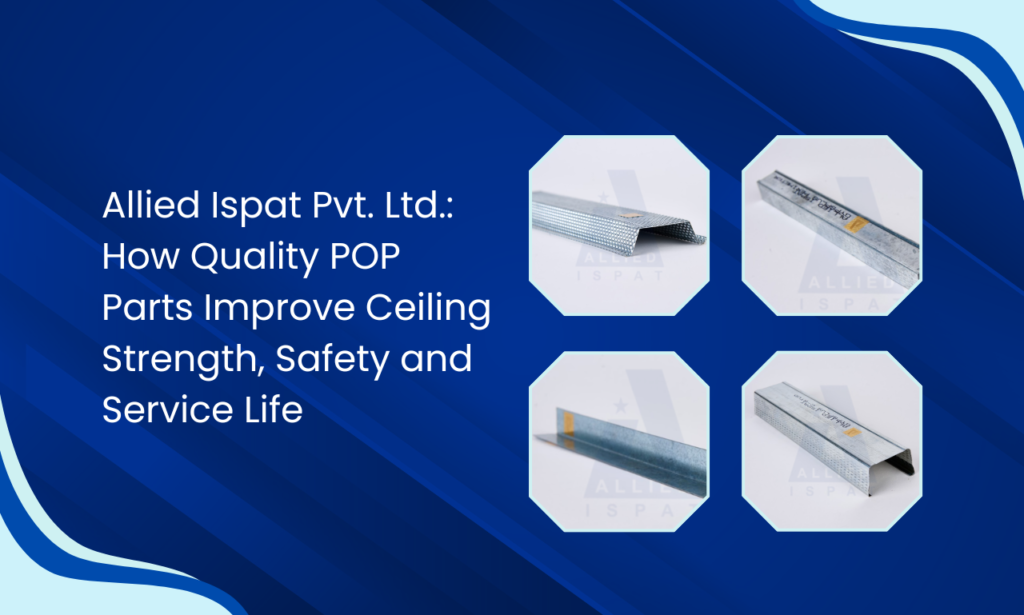
Introduction: The Real Strength of a False Ceiling Lies Above the Surface
A false ceiling is usually judged by what people can see: straight lines, smooth finishing, neat lighting recesses and a clean architectural appearance. Yet the visible board is only the outer layer. The actual stability of the ceiling depends on the steel framework concealed above it.
That framework has to remain straight, support the specified ceiling system, maintain spacing, resist unwanted movement and provide a reliable base for boards and finishing materials. If the steel profiles are inconsistent, poorly formed or unsuitable for the application, installation can become more difficult and long-term performance may be affected.
This makes the selection of POP framing components an important engineering and procurement decision. Contractors, architects, developers and purchase teams need to look beyond price and evaluate steel quality, section geometry, galvanization, thickness, dimensional accuracy and manufacturing consistency.
Choosing an experienced POP Parts Manufacturer in India can help project teams source sections developed for different ceiling requirements rather than relying on one profile specification for every application. A capable POP Ceiling Frame Manufacturer can also support project buyers with consistent profiles across repeated orders, which becomes particularly important on commercial, industrial and large residential developments.
Allied Ispat Pvt. Ltd., part of the Malik Group of Companies, manufactures galvanized POP ceiling and drywall partition sections for professional construction applications. With more than two decades of experience, ISO 9001:2015 certification and manufacturing operations in Navi Mumbai, the company supplies precision-formed profiles for projects requiring strength, dimensional consistency and dependable bulk availability.
Why POP Parts Matter More Than They Appear
POP parts form the structural skeleton behind false ceilings and selected partition systems. Although these sections become hidden after installation, they continue performing throughout the life of the ceiling.
Typical framing components include ceiling sections, intermediate sections, perimeter sections and angles. Partition applications may also use C-studs and floor sections.
Each profile performs a particular function, but their performance is interconnected. A straight ceiling section provides little benefit if the perimeter is distorted. A strong intermediate profile cannot compensate for incorrect spacing. A well-designed frame can still underperform if inappropriate sections are used for the load or environment.
This is why ceiling quality should be viewed as a system.
A good framing system helps:
- Maintain the planned ceiling level
- Support ceiling boards and approved components
- Keep framework spacing consistent
- Improve alignment of intersecting profiles
- Reduce unwanted twisting and movement
- Provide a dependable fixing base
- Support installation accuracy
- Contribute to long-term ceiling stability
The finished surface may be what occupants notice, but the framework is what helps that surface remain stable.
From Steel Coil to Finished Ceiling: How Quality Travels Through the System
The connection between manufacturing and finished ceiling performance can be explained simply:
Raw Material Quality → Accurate Profile Formation → Easier Installation → Stable Framework → Better Long-Term Performance
If profile dimensions vary during production, installers often compensate on site. Small corrections may include adjusting intersections, changing spacing, trimming sections or spending additional time establishing levels.
On a small ceiling, the impact may be limited. On a commercial floor or large housing project, repeated dimensional differences can affect productivity across thousands of profiles.
Consistently manufactured GI ceiling sections reduce this variability. Contractors can work with more predictable dimensions and maintain the intended framing layout more efficiently.
This is why buyers evaluating a POP Parts Manufacturer in India should look at production consistency as closely as they look at pricing.
1. Structural Stability Starts with the Right Profile
Ceiling strength is not determined by thickness alone.
The behavior of a framing section depends on multiple variables, including:
- Steel properties
- Section geometry
- Material thickness
- Formed ribs or knurling
- Span
- Support spacing
- Fixing arrangement
- Connection details
- Installation quality
A profile that is adequate for a decorative residential ceiling may not be appropriate for a more demanding commercial installation.
If a section lacks sufficient rigidity for the intended configuration, it may be more susceptible to bending, twisting or excessive deflection.
Possible consequences can include uneven ceiling lines, poor board alignment, localized deformation and additional corrective work.
The purpose of quality framing is not simply to use more steel. It is to use the correct steel profile for the application.
An experienced POP Ceiling Frame Manufacturer should therefore provide different section options for different project categories rather than treating every ceiling requirement as identical.
2. Why Steel Thickness Must Be Selected Carefully
Thickness is one of the first specifications buyers compare, but it should never be treated as the only indicator of quality.
A heavier section can offer greater rigidity in comparable conditions, but performance also depends on profile geometry, steel characteristics, forming process, support spacing and installation method.
For this reason, selecting the thickest available section does not automatically make a ceiling better.
A lightweight profile may be suitable for decorative interiors where loads and spans are controlled. Larger commercial or industrial ceiling systems may require heavier framing.
Project teams should therefore ask:
Is this section suitable for the intended ceiling design, span, load and support arrangement?
That question is more useful than simply asking which section uses the most steel.
A reliable POP Parts Manufacturer in India should give buyers access to different profile categories so that material can be selected according to application requirements.
3. Galvanized Steel Helps Protect the Hidden Framework
False ceiling sections are usually enclosed after installation. Once boards are fixed and finishing is complete, direct access to the framing becomes limited.
This makes corrosion protection important.
Galvanized steel is widely used in false ceiling systems because the zinc coating helps protect the underlying steel from corrosion compared with untreated material.
This can be particularly valuable in projects located in:
- Coastal regions
- High-humidity environments
- Hospitals
- Commercial buildings
- Industrial facilities
- Infrastructure projects
- Certain service areas
Galvanization should not be described as making steel completely immune to rust. Water leakage, prolonged moisture exposure, damage to the coating and aggressive environmental conditions can still affect durability.
The technical benefit is that suitable galvanized steel helps improve corrosion resistance and provides additional protection for concealed framing.
Allied Ispat Pvt. Ltd. manufactures galvanized POP frames and partition sections for construction applications where durability and consistent profile performance are important.
4. Accurate Profiles Make Installation More Predictable
Contractors often recognize profile quality before the ceiling is even completed.
A straight section with consistent dimensions is easier to measure, position, connect and align. Distorted or irregular profiles require additional correction.
Precision roll forming helps control section geometry by passing steel through a sequence of forming stations until the required shape is achieved.
When tooling, roller positioning and material feed are properly controlled, the manufacturer can produce repeatable profiles over long production runs.
Accurate sections can support:
- Better framework alignment
- More consistent spacing
- Cleaner joints
- Faster positioning
- Reduced adjustment
- Improved repeatability across large areas
- More predictable site productivity
This is where the value of a professional POP Ceiling Frame Manufacturer becomes clear. Profile quality is not simply about how a section looks when it leaves the factory. It influences how efficiently the installer can work with it on site.
5. Quality Framing Can Help Control Sagging and Uneven Ceilings
Sagging is one of the most visible signs that a ceiling system is not performing as intended.
However, there is no single cause.
Sagging or deformation may result from:
- Incorrect support spacing
- Excessive spans
- Improper fixing
- Overloading
- Inadequate profile rigidity
- Moisture-related problems
- Poor workmanship
- Material inconsistency
Quality steel sections cannot correct an incorrect ceiling design, but they can remove one major source of uncertainty.
Profiles with consistent geometry and suitable rigidity help contractors build the framework according to the specified layout.
This can reduce problems caused by irregular material and make it easier to maintain level and alignment across the ceiling area.
For procurement teams, this reinforces an important point: the lowest profile rate does not always create the lowest installed cost.
6. Folded Edges Improve Handling Characteristics
Steel framing is handled repeatedly throughout the construction process.
Profiles are bundled, transported, unloaded, carried, measured, cut, lifted and fixed into position.
Edge quality therefore affects day-to-day installation.
Poorly finished edges can make handling more difficult. Folded or properly formed edges can help reduce direct exposure to sharp steel surfaces and create a more installer-friendly profile.
Allied Ispat’s GypsPlus Xpert-Plus incorporates folded-edge construction as part of its design.
This feature does not replace protective equipment or safe-working procedures. Contractors must still follow appropriate site-safety practices.
However, good product design can contribute to safer and more convenient material handling.
7. Better Profiles Support Better Ceiling Lifecycle Value
Ceiling durability is created by the complete system.
It depends on:
- Correct design
- Appropriate section selection
- Steel quality
- Corrosion protection
- Spacing
- Fixings
- Workmanship
- Site conditions
- Maintenance
Quality framing contributes by providing a stable and repeatable structural base.
For developers and contractors, this creates an important distinction between purchase price and lifecycle value.
A cheaper profile may appear attractive during procurement, but additional costs can emerge through:
- Rework
- Installation delays
- Replacement material
- Additional labour
- Alignment correction
- Repairs
- Maintenance
- Premature deterioration
Selecting a suitable profile from a dependable POP Parts Manufacturer in India can therefore provide better overall project value than selecting material solely on the lowest quoted rate.
How Allied Ispat POP Components Work as a Complete System
A ceiling or partition framework depends on several profiles working together.
Allied Ispat manufactures different sections to support these interconnected requirements.
Ceiling Section
Ceiling sections form an important part of the supporting grid.
Their shape and rigidity help establish the structural framework and maintain alignment throughout the ceiling area.
Consistent dimensions are particularly valuable on large installations because small variations can accumulate across long runs.
Intermediate Section
Intermediate sections provide additional support within the framing arrangement.
They help connect components, maintain spacing and contribute to better distribution of forces through the ceiling grid.
Precise forming helps intersections remain consistent during installation.
Perimeter Section
Perimeter sections define the outer boundary of the ceiling.
They establish an important reference line around walls and edges.
Accurate perimeter sections can help contractors achieve clean transitions and better alignment where the ceiling meets surrounding surfaces.
Angle Section
Angles support edge conditions and compatible framing connections.
Consistent bends and straightness help installers establish cleaner perimeter lines and junctions.
C-Stud Section
C-studs are commonly used in drywall partition systems.
They provide vertical support within the framing assembly and help create a defined structure for partition boards.
Accurate stud dimensions help improve compatibility with tracks and related sections.
Floor Section
Floor sections support compatible partition framing systems and provide a track for associated components.
Their dimensional accuracy is important because connected profiles must fit and align correctly.
Together, these sections create a coordinated framing system rather than a collection of unrelated components.
GypsPlus Premium: Heavy-Duty Framing for More Demanding Projects
Some projects place greater demands on their ceiling framework.
Factories, hospitals and large commercial spaces may require more robust profiles than lightweight decorative interiors.
Allied Ispat’s GypsPlus Premium range is developed for such heavy-duty applications.
The range uses prime-grade GI steel with an approximate thickness of 0.5–0.7 mm.
Its key features include:
- Heavy-duty profile construction
- Knurled surface
- Work-hardened steel
- Prime-grade GI material
- Up to 50 kg/m² stated load capacity
- Precision-formed sections
Actual load suitability should always be considered in relation to the complete ceiling design, spacing, fixing arrangement and project requirements.
Why Does the Knurled Surface Matter?
Knurling creates a patterned surface on the steel section.
Depending on the geometry of the profile, this formed surface can contribute to section rigidity and mechanical behavior.
The important point is that profile performance depends on the complete section design rather than thickness alone.
What Does Work-Hardening Contribute?
Cold forming can change the mechanical characteristics of steel in shaped regions.
When correctly controlled during manufacturing, this can contribute to the profile’s rigidity and dimensional behavior.
Suitable Applications for GypsPlus Premium
GypsPlus Premium can be considered for:
- Industrial ceilings
- Factories
- Hospitals
- Commercial facilities
- Institutional buildings
- Projects requiring heavier framing
- Suitable coastal and high-humidity applications
For buyers sourcing from a POP Parts Manufacturer in India, the availability of a heavier profile range makes it easier to match framing to more demanding project conditions.
GypsPlus Xpert-Plus: Precision Framing for Modern Interiors
Interior projects frequently have different priorities.
Instead of maximum profile weight, they may require easy handling, dimensional accuracy and flexibility for decorative geometry.
Allied Ispat’s GypsPlus Xpert-Plus is designed for these applications.
The range uses prime-grade GI steel with an approximate thickness of 0.40–0.45 mm.
Its key characteristics include:
- Folded-edge design
- Lightweight handling
- Precision-crafted geometry
- Easy installation
- 8 ft and 12 ft customizable lengths
- Suitability for modern interior layouts
Better Control for Decorative Ceilings
Contemporary false ceilings may include:
- Recessed lighting
- Stepped levels
- Layered borders
- Geometric details
- 3D ceiling features
- Architectural recesses
These designs depend heavily on alignment.
Accurate steel profiles make it easier for contractors to maintain clean lines and consistent dimensions.
A technically capable POP Ceiling Frame Manufacturer should be able to address both heavy-duty framing and lighter design-focused applications. Allied Ispat’s GypsPlus Premium and GypsPlus Xpert-Plus ranges provide different solutions for these distinct project categories.
POP Parts for Different Types of Construction Projects
Residential Projects
False ceilings in apartments and residential developments are often used to create lighting features, decorative layers and concealed service zones.
Applications can include:
- Living rooms
- Bedrooms
- Corridors
- Apartment lobbies
- Common areas
- Decorative ceiling zones
- Recessed lighting layouts
For residential projects, accurate profiles help contractors maintain cleaner lines and a consistent finished appearance.
GypsPlus Xpert-Plus is particularly relevant where lightweight precision and decorative flexibility are required.
Commercial Projects
Commercial ceilings can cover much larger areas and often have to coordinate with multiple building services.
Offices, retail areas, hospitality spaces and institutional buildings may include HVAC ducts, lighting, cables, inspection points and access panels above the ceiling.
This makes profile consistency especially important.
A small variation repeated across a large ceiling can increase installation adjustments and affect overall productivity.
A reliable POP Parts Manufacturer in India can support these projects with standardized profiles and adequate bulk manufacturing capability.
Industrial and Institutional Projects
Industrial facilities and institutional buildings may require more demanding framing systems.
Factories, hospitals and infrastructure projects may involve:
- Larger ceiling areas
- Heavier service requirements
- More demanding operating environments
- Higher humidity
- Greater emphasis on durability
Allied Ispat positions GypsPlus Premium for these heavier commercial and industrial applications.
Why Manufacturing Quality Matters Before the Profile Reaches Site
The reliability of a ceiling section is largely determined during manufacturing.
Several factors need to remain controlled.
Raw Material Quality
The incoming steel should provide a consistent base for forming.
Material Thickness
Thickness should remain within the specified range across production batches.
Roll-Forming Accuracy
Properly aligned tooling helps produce the intended section geometry.
Tool Condition
Worn rollers and forming tools can affect bends, dimensions and surface quality.
Profile Straightness
Long sections should remain sufficiently straight for accurate installation.
Edge Formation
Cleanly formed edges support better handling and fit.
Coating Condition
Galvanized surfaces should be protected from unnecessary damage.
Dimensional Repeatability
Sections manufactured at different times should remain compatible.
Packaging
Profiles require appropriate packing to reduce transport-related deformation.
Production Capacity
Large construction projects need quantity as well as consistency.
Allied Ispat manufactures more than 3,000 POP profile units per day, supporting bulk project requirements.
For a POP Ceiling Frame Manufacturer, maintaining accuracy across high-volume production is critical. Contractors do not install a single demonstration sample; they need hundreds or thousands of sections with repeatable dimensions.
What Should Contractors Expect from a POP Ceiling Frame Manufacturer?
A contractor should expect more than a catalogue showing available sizes.
The manufacturer should understand how material thickness, steel quality, coating, profile geometry and project environment influence section selection.
Different ceiling conditions require different products.
A decorative apartment ceiling does not automatically need the same section as a factory or hospital project.
The manufacturer should also have enough capacity to support repeated orders without significant variation.
For larger developments, production repeatability, packaging and supply planning can be just as important as nominal section specifications.
What Should Contractors Check Before Buying POP Parts?
Before confirming an order, project buyers should assess:
- Steel quality
- Section thickness
- Galvanization
- Cross-sectional dimensions
- Straightness
- Edge design
- Surface condition
- Available lengths
- Required loads
- Support spacing
- Environmental exposure
- Building type
- Installation system
- Batch consistency
- Manufacturer capacity
- Logistics capability
Contractors should also consider the manufacturing capability of the POP Ceiling Frame Manufacturer. Reliable production, profile consistency and adequate quantity can make a significant difference on multi-phase construction projects.
Why Choose a Reliable POP Parts Manufacturer in India?
Large projects require more than technically suitable material.
They require repeated access to the same quality of material throughout the construction period.
A dependable POP Parts Manufacturer in India should therefore provide:
- Consistent profile specifications
- Controlled production processes
- Suitable product options
- Bulk manufacturing capability
- Reliable packaging
- Repeat-order consistency
- Project-oriented supply support
This is particularly relevant to builders, contractors and procurement teams managing multiple buildings, floors or project phases.
Supplier selection should therefore be viewed as part of the overall project strategy.
Why Allied Ispat Pvt. Ltd. for POP Ceiling and Partition Profiles?
Allied Ispat Pvt. Ltd., part of the Malik Group of Companies, has more than two decades of experience in steel profile manufacturing.
The company is an ISO 9001:2015 certified POP Parts Manufacturer in India producing galvanized ceiling and drywall partition profiles for residential, commercial and industrial applications.
Its portfolio includes:
- Ceiling Sections
- Intermediate Sections
- Perimeter Sections
- Angle Sections
- C-Stud Sections
- Floor Sections
- GypsPlus Premium
- GypsPlus Xpert-Plus
Allied Ispat’s manufacturing setup in Navi Mumbai supports production of more than 3,000 POP profiles per day.
The company also offers 8 ft and 12 ft lengths, supporting different project layouts and procurement requirements.
Its two GypsPlus ranges address distinctly different applications: heavier framing for demanding commercial and industrial projects, and precision-focused profiles for modern interiors.
For architects, contractors and buyers assessing a POP Ceiling Frame Manufacturer, this range allows material selection to be based on actual project requirements rather than a single generic specification.
Allied Ispat’s Strength as a POP Parts Manufacturer in Mumbai
Contractors working across Mumbai, Navi Mumbai and Maharashtra often consider manufacturing location when planning supply.
Allied Ispat maintains its Mumbai presence and operates its works in the Navi Mumbai/Taloja industrial region.
For buyers searching for a POP Parts Manufacturer in Mumbai, this combination provides access to locally manufactured ceiling and partition sections alongside pan-India supply capability.
Its production infrastructure is relevant for:
- Residential developments
- Commercial interiors
- Industrial buildings
- Hospitals
- Institutional projects
- Infrastructure works
- Dealers
- Distributors
- Interior contractors
For project teams evaluating a Mumbai-based POP Ceiling Frame Manufacturer, local production can support coordination, but product selection should still be based on technical suitability, material consistency and project specifications.
How Better POP Parts Help Reduce Project Risk
Construction delays and quality problems often develop through repeated small issues rather than one major failure.
Inconsistent framing can contribute to unnecessary site adjustment, irregular spacing or delayed installation.
Quality POP sections can help reduce these material-related risks.
Reduced Rework
Predictable dimensions require fewer corrective adjustments.
Improved Alignment
Straight profiles support cleaner framework geometry.
Better Installation Planning
Repeatable sections make large-area work more predictable.
Improved Corrosion Resistance
Suitable galvanized steel provides additional protection in appropriate environments.
Consistent Repeat Orders
Controlled manufacturing helps profiles supplied later remain compatible with earlier batches.
Lower Material-Related Maintenance Risk
A stable framing base can reduce some issues associated with inadequate or inconsistent ceiling profiles.
Quality framing does not eliminate engineering or workmanship risks, but it can significantly reduce avoidable material-related uncertainty.
How to Choose the Right POP Profile for Your Project
The correct ceiling profile depends on project conditions.
Buyers should consider:
Building type: Residential, commercial, institutional and industrial applications have different requirements.
Ceiling design: Flat ceilings and decorative multi-level layouts may need different framing approaches.
Span: Larger unsupported distances can change structural demands.
Support spacing: Profile performance depends partly on how frequently the framework is supported.
Load: Boards, finishes and compatible ceiling elements need to be considered.
Environment: Coastal and humid conditions can increase the importance of corrosion protection.
Installation method: Sections should suit the specified framing and fixing system.
Project drawings: Consultant and engineering specifications should guide final product selection.
A knowledgeable POP Parts Manufacturer in India can provide different section options, while the final framing specification should always follow the technical requirements of the project.
Why Better POP Parts Can Deliver Better Lifecycle Value
Material procurement should not be judged only by the price paid at dispatch.
Imagine two ceiling installations.
In the first, the contractor receives straight profiles with consistent dimensions. Installation progresses smoothly and sections connect predictably.
In the second, profiles vary in straightness and geometry. Workers spend additional time measuring, adjusting and sorting material.
The difference in initial material cost may be small, but the second project can incur extra labour, wastage and delays.
This is why lifecycle value matters.
Quality POP framing can contribute to:
- More predictable installation
- Reduced rework
- Improved alignment
- Better material consistency
- Lower risk of premature replacement
- More manageable maintenance
The best profile is not necessarily the cheapest or the thickest.
It is the one that correctly matches the project requirement.
Frequently Asked Questions
1. What are POP parts used for in false ceilings?
POP parts form the steel framework behind false ceiling boards and help maintain alignment, spacing and structural stability. Allied Ispat Pvt. Ltd. manufactures GI ceiling and partition sections for residential, commercial and industrial applications.
2. Which material is commonly used for POP ceiling frames?
Galvanized steel is widely used because it combines framing strength with improved corrosion resistance compared with untreated steel. Allied Ispat Pvt. Ltd. manufactures prime-grade GI POP profiles for different ceiling requirements.
3. What thickness should a POP ceiling frame have?
The required thickness depends on design, span, support spacing and load. Allied Ispat Pvt. Ltd. offers GypsPlus Xpert-Plus at approximately 0.40–0.45 mm and GypsPlus Premium at approximately 0.5–0.7 mm.
4. Can poor POP sections cause a ceiling to sag?
Unsuitable or inconsistent profiles can contribute to deformation, although spacing, fixing, loading and workmanship are also important. Allied Ispat Pvt. Ltd. manufactures precision-formed GI sections to provide contractors with a consistent framing base.
5. Why is galvanized steel preferred for false ceiling profiles?
The zinc coating helps improve corrosion resistance and protects the underlying steel from environmental exposure. Allied Ispat Pvt. Ltd. produces galvanized ceiling and partition sections for varied construction conditions.
6. How do quality POP parts improve ceiling life?
Accurate, correctly specified sections can support better alignment, framework stability and long-term durability. Allied Ispat Pvt. Ltd. supplies precision GI profiles designed for professional ceiling and drywall applications.
7. How can I choose a reliable POP Parts Manufacturer in India?
Evaluate raw material quality, thickness consistency, profile dimensions, galvanization, production capacity and supply reliability. Allied Ispat Pvt. Ltd. is an ISO 9001:2015 certified manufacturer with more than two decades of industry experience.
8. Which POP profile is suitable for industrial ceilings?
Projects requiring heavier framing can consider profiles designed for greater rigidity. Allied Ispat Pvt. Ltd. offers GypsPlus Premium in approximately 0.5–0.7 mm GI steel with a stated load capacity of up to 50 kg/m², subject to proper system design and installation.
9. What is the difference between GypsPlus Premium and GypsPlus Xpert-Plus?
Allied Ispat Pvt. Ltd. positions GypsPlus Premium for heavier commercial and industrial requirements, while GypsPlus Xpert-Plus is designed for lightweight, precision-focused residential and modern interior applications.
10. Where can I find a POP Parts Manufacturer in Mumbai?
Allied Ispat Pvt. Ltd. has a Mumbai presence and manufacturing operations in the Navi Mumbai/Taloja region. The company supports contractors, builders, project buyers, dealers and distributors with POP ceiling and partition sections for projects across India.
Conclusion: Build the Ceiling from a Stronger Foundation
The visible finish of a false ceiling is only as reliable as the framework supporting it. Behind the boards, steel sections are responsible for maintaining levels, creating accurate geometry and supporting the specified ceiling system. Material thickness, profile shape, galvanization, straightness and manufacturing consistency all influence how effectively this framework performs.
For builders, architects, contractors and procurement teams, choosing a dependable POP Parts Manufacturer in India means looking beyond the price of individual sections. The right manufacturer should combine material quality, application-specific product options, repeatable dimensions, bulk manufacturing capability and reliable supply. Working with an experienced POP Ceiling Frame Manufacturer can help contractors build a more predictable framing system from the first section installed to the final project phase.
Allied Ispat Pvt. Ltd. manufactures galvanized POP ceiling and drywall partition profiles for residential, commercial and industrial requirements. With GypsPlus Premium for demanding projects and GypsPlus Xpert-Plus for modern interiors, the company provides distinct framing options designed around different construction needs.
Beyond POP Frames: Explore Allied Ispat’s Complete Steel Solutions
Allied Ispat Pvt. Ltd. extends its manufacturing expertise beyond false ceiling systems with a diversified product portfolio designed for industrial, construction and fabrication requirements. From precision machinery to steel coils and shutter components, the company supports businesses with reliable products, consistent quality and application-focused solutions.
Precision Roll Forming Machines Built for Consistent Profile Production
As a trusted Roll Forming Machine Manufacturer in India, Allied Ispat Pvt. Ltd. manufactures precision-engineered machines for producing consistent steel profiles across industrial applications. Designed for accuracy, repeatability and efficient production, Allied Ispat roll forming machines support manufacturers looking to improve profile quality, production speed and operational reliability.
Quality Trading Coils for Manufacturing and Fabrication Needs
Allied Ispat Pvt. Ltd. is a reliable Trading Coil Manufacturer in India, supplying quality steel coils for roll forming, fabrication, roofing, construction and other industrial applications. With options including GI, PPGI and GL coils, the company supports manufacturers and fabricators with consistent material quality suitable for varied processing requirements.
Reliable Rolling Shutter Parts for Stronger Shutter Systems
As an experienced Rolling Shutter Parts Manufacturer in India, Allied Ispat Pvt. Ltd. manufactures essential components used in commercial, industrial and security shutter systems. From guide channels and bottom sections to springs, brackets and other shutter components, Allied Ispat focuses on dimensional accuracy, durability and dependable performance for professional rolling shutter applications.
Partner with Allied Ispat Pvt. Ltd. for Your POP Framing Requirements
For POP section specifications, project enquiries, bulk orders, dealer and distributor requirements or construction procurement support, connect with Allied Ispat Pvt. Ltd.
Allied Ispat Mumbai Central
Address: Shop 69, Maulana Shaukat Ali Road, Chhota Sonapur, Siddharth Nagar, Mumbai Central, Mumbai, Maharashtra 400008
Phone: 098211 77009
Get Directions: https://maps.app.goo.gl/gyEqxBGcw9jLsYm26
Allied Ispat Works:
Plot no. C-17 9, MIDC Road behind Bank of Baroda Bank Taloja Panvel, Maharashtra 410208 India
Get Directions: https://maps.app.goo.gl/6ujLCuHpQLu1Uy3r8
Phone: 087790 51606
Email: info@alliedispatindia.com | sales@alliedispatindia.com
Website: www.alliedispatindia.com

