

Introduction
The selection of a calcium raw material can directly influence formulation development, quality control and procurement planning. Pharmaceutical, nutraceutical, food and cosmetic manufacturers increasingly assess calcium ingredients based on their source, purity, processing, physical characteristics and consistency rather than considering calcium content alone. Caltron Clays & Chemicals supplies MARINCAL™, a marine-derived oyster shell calcium carbonate ingredient developed for industrial and formulation applications. As an Oyster Shell Calcium Carbonate Powder Manufacturer in India, Caltron supports manufacturers seeking a naturally sourced calcium raw material with controlled processing and dependable B2B supply.
Oyster shell calcium carbonate is produced from oyster shells that naturally contain calcium carbonate. The marine origin gives this material a distinct source profile compared with calcium carbonate obtained from conventional mineral deposits. This can be relevant to manufacturers developing nutritional or mineral products where natural-source ingredients are part of the product strategy.
At the same time, a natural source does not automatically determine raw-material quality. Manufacturers need to evaluate the complete specification, including CaCO₃ assay, elemental calcium, purity, particle size, moisture, microbiological parameters, contaminants, documentation and batch consistency.
This guide explains the important considerations involved in selecting and sourcing oyster shell calcium carbonate. It covers the journey from oyster shell selection to finished powder, compares different shell sources, discusses pharmaceutical and nutraceutical applications, and provides a practical framework for evaluating suppliers.
What Is Oyster Shell Calcium Carbonate Powder?
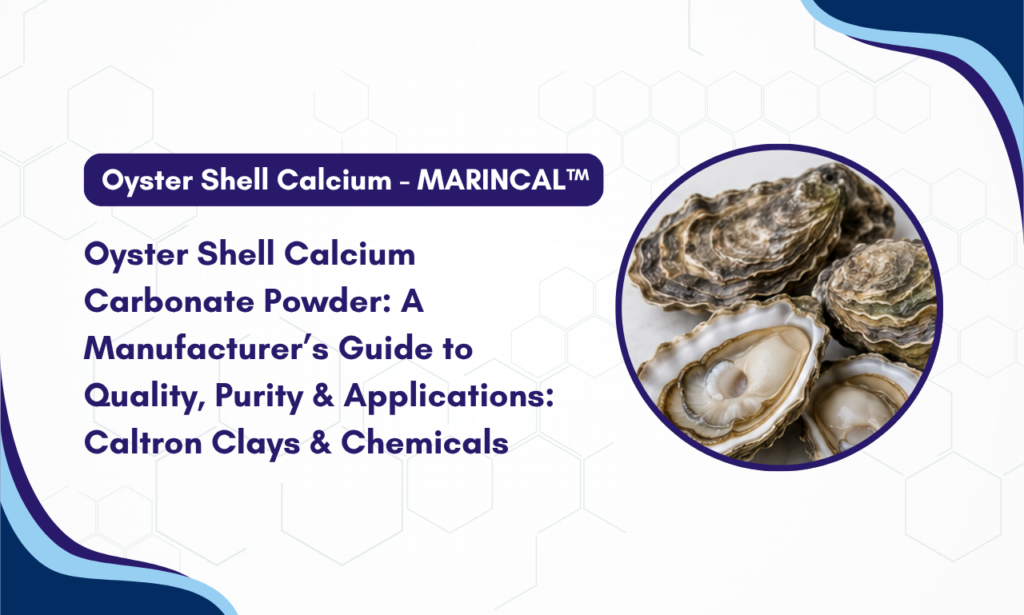
Oyster shell calcium carbonate powder is a naturally sourced calcium raw material manufactured from processed oyster shells. Calcium carbonate forms the primary mineral component of oyster shells, making them a naturally occurring source of calcium carbonate.
The main distinction between oyster shell calcium and conventional calcium carbonate is the origin of the starting material. Oyster shell calcium comes from a marine biological source, while conventional calcium carbonate is commonly associated with limestone and other mineral deposits.
For product developers, this difference can be useful when considering natural calcium ingredients or developing products with a marine-source positioning.
However, source identity is only one part of technical evaluation. The finished powder needs to meet the specifications required for its intended application. Manufacturers may assess chemical composition, powder characteristics, purity, moisture and contaminant limits before approving the ingredient.
Oyster shell calcium carbonate should therefore be viewed as a natural mineral raw material that requires controlled processing and quality assessment before entering pharmaceutical, nutraceutical, food or cosmetic production.
Why Marine-Derived Calcium Is Gaining Attention
Manufacturers are increasingly exploring naturally sourced raw materials as they develop differentiated nutritional and mineral products. Source transparency and ingredient origin can play a role in product development, particularly in the nutraceutical sector.
Marine-derived calcium provides an alternative source to conventional mineral calcium carbonate. Oyster shell calcium carbonate can therefore be considered when a manufacturer is looking for a calcium raw material with a marine origin.
The commercial challenge is maintaining consistency. Natural raw materials can vary according to their source and physical characteristics, so proper supplier controls are important.
For this reason, companies searching for an Oyster shell calcium Powder Supplier in India should evaluate sourcing practices, production controls, testing, documentation and supply continuity together.
MARINCAL™: Marine-Sourced Calcium for B2B Formulations
MARINCAL™ is Caltron Clays & Chemicals oyster shell calcium carbonate powder developed for manufacturers in pharmaceutical, nutraceutical, food and cosmetic industries.
The ingredient can be considered for different product formats, including tablets, capsules, suspensions, soft gelatin capsules and chewable tablets. Its final suitability should be determined according to the specific formulation, manufacturing process and quality requirements.
The production approach starts with the selection of suitable oyster shells. The incoming raw material is assessed before undergoing cleaning, purification and powder-processing stages.
This controlled approach is important because the characteristics of the finished calcium powder depend partly on the quality of the starting shells and the consistency of the processing method.
Caltron also offers several other natural calcium sources, including algae, coral, eggshell, fish bone and milk calcium. This gives manufacturers an opportunity to compare different calcium raw materials during formulation development.
For B2B R&D teams, having access to multiple natural calcium sources can be useful when assessing ingredient origin, formulation behavior, specifications and commercial availability.
How Oyster Shell Calcium Carbonate Powder Is Manufactured
The production of oyster shell calcium carbonate is a multi-stage process. Each stage contributes to the quality and consistency of the finished raw material.
Selecting Suitable Oyster Shells
Raw-material selection is the first important step.
The shells need to be evaluated for their physical condition, cleanliness, structure and suitability for processing. Availability is also important because commercial manufacturers need reliable access to the same or an appropriately controlled source after product approval.
MARINCAL™ includes source categories such as Oysto Teratta and Meta-Calciota, which differ in characteristics, availability and commercial considerations.
A well-planned sourcing process helps manufacturers reduce unnecessary variation between batches and supports long-term procurement.
Inspecting Incoming Raw Material
Before processing begins, incoming shells should undergo appropriate inspection.
The inspection process can help identify unsuitable shells, physical contaminants and other unwanted material.
Quality control at this stage is important because starting-material quality can influence the downstream processing and finished powder.
A strong manufacturing system therefore combines raw-material inspection with in-process controls and final-product testing.
Cleaning and Purification
Oyster shells are natural marine materials and require suitable cleaning before further processing.
Cleaning and purification help remove unwanted material and prepare the shells for conversion into calcium carbonate powder.
This stage is particularly important for manufacturers operating in regulated or quality-sensitive industries.
For pharmaceutical and nutraceutical applications, the objective is to achieve a controlled raw material that can be evaluated against defined quality specifications.
Drying and Pulverization
After cleaning and purification, the processed shell material is dried and reduced into powder.
Pulverization controls the physical form of the finished material. Particle size can influence how a calcium powder behaves during blending, handling and dispersion.
The required powder characteristics may differ between tablets, capsules, chewables and suspension formulations.
Manufacturers should therefore review particle-size specifications according to the intended application.
Final Quality Testing
The finished calcium powder undergoes final quality assessment before release.
The specific tests depend on the product specification and intended application. Manufacturers may evaluate CaCO₃ assay, elemental calcium, moisture, particle size, purity, microbiological parameters and relevant contaminants.
A Certificate of Analysis provides batch-specific information and can support customer quality approval.
Packaging and storage conditions should also be appropriate for maintaining the quality of the finished powder throughout transportation and warehousing.
Oysto Teratta vs Meta-Calciota: Understanding Oyster Shell Sources
The source of the oyster shell can influence the characteristics and commercial considerations of the resulting calcium raw material.
For manufacturers, understanding these differences can make the selection process more practical.
Oysto Teratta: A Distinctive Marine Calcium Source
Oysto Teratta is described as a fibrous, fragile and clean oyster shell source.
The powder produced from this shell source has a characteristic flaky texture. It is also associated with approximately 1.5% magnesium as a naturally occurring mineral component.
Availability is an important consideration because this shell source is comparatively limited.
Manufacturers considering Oysto Teratta should therefore evaluate both its technical characteristics and the expected availability required for ongoing production.
Meta-Calciota: An Abundant and Economical Source
Meta-Calciota is a more widely available oyster shell source.
Its CaCO₃ assay is comparatively lower than Oysto Teratta, but greater availability can make it an attractive option for manufacturers where supply continuity and commercial economics are important.
For volume-oriented products, this source can be evaluated according to the required specification, formulation performance and procurement objectives.
How Should Manufacturers Choose Between the Sources?
The choice should be based on the actual requirements of the product.
R&D teams may prioritize chemical specifications and powder characteristics, while procurement teams may focus on cost, availability, order volume and lead time.
Both perspectives should be considered before selecting the raw material.
A suitable supplier should be able to provide sufficient technical information and samples to support evaluation.
Quality Parameters Manufacturers Should Check Before Purchase
A calcium raw material should be assessed using objective quality criteria. The following parameters are particularly relevant when evaluating oyster shell calcium carbonate.
Calcium Carbonate Assay
CaCO₃ assay is one of the fundamental specifications for calcium carbonate raw materials.
It helps manufacturers understand the calcium carbonate concentration and determine whether the ingredient fits their formulation requirements.
Assay information also allows buyers to make more meaningful comparisons between calcium carbonate grades.
Elemental Calcium
Elemental calcium should be considered separately from CaCO₃ assay.
Formulators need elemental calcium information when determining how much raw material is required to achieve the desired calcium contribution in a finished product.
Purity
Purity is particularly important for pharmaceutical, nutraceutical and food applications.
Manufacturers should understand how the supplier controls unwanted materials throughout sourcing and processing.
A controlled purification process can support the production of a more consistent calcium raw material.
Particle Size
Particle size can influence powder handling and manufacturing behavior.
It can affect blending, flowability and dispersion, depending on the formulation.
The required particle characteristics should therefore be established according to the intended dosage form or application.
Moisture
Moisture can affect powder handling and storage.
Buyers should review the applicable moisture specification and confirm that packaging and storage conditions are appropriate.
Microbiological Quality
For pharmaceutical, nutraceutical and food applications, microbiological parameters may be part of the raw-material specification.
The required limits should be established according to the application and destination market.
Heavy Metals and Other Contaminants
Contaminant specifications should be reviewed during supplier qualification.
Manufacturers should identify the relevant parameters for their intended application and verify the supplier’s testing and documentation.
Batch-to-Batch Consistency
Consistency is critical when moving from product development to commercial production.
A supplier needs to maintain the approved characteristics over repeated batches. Consistent raw material helps reduce unnecessary variation during manufacturing.
Certificate of Analysis and Technical Documents
A Certificate of Analysis provides batch-level information and supports incoming quality checks.
Depending on the application, buyers may also request:
- Product specification
- Safety Data Sheet
- Batch information
- Certifications
- Regulatory documentation
- Packaging details
This documentation helps R&D, quality and procurement teams complete a more structured supplier evaluation.
Why Purification Matters in Oyster Shell Calcium Carbonate Manufacturing
The natural origin of oyster shell calcium carbonate makes appropriate purification an important part of manufacturing.
Oyster shells originate from a marine environment and therefore require controlled cleaning and processing before being converted into a commercial calcium powder.
Purification helps manage unwanted material and supports the production of a more controlled raw material.
For pharmaceutical and nutraceutical manufacturers, this becomes particularly important because the ingredient needs to meet defined specifications.
The objective is to combine the advantages of a natural source with the consistency expected from an industrial raw material.
A dependable Oyster shell calcium Powder Supplier in India should be able to provide clear information about its raw-material handling, processing and quality-control approach.
Pharmaceutical Applications of Oyster Shell Calcium Carbonate
Oyster shell calcium carbonate can be evaluated as a calcium-containing raw material for different pharmaceutical dosage forms.
Calcium Tablets
Tablets are one of the common formats in which calcium ingredients may be used.
Manufacturers can evaluate assay, elemental calcium, particle size, flowability, blending properties and compatibility with other ingredients during formulation development.
Calcium Capsules
Capsule formulations require appropriate powder handling and accurate filling.
Particle characteristics and bulk properties should be assessed to determine compatibility with the manufacturing process.
Chewable Tablets
Chewable products can have additional requirements related to powder texture and physical characteristics.
The ingredient should be evaluated within the complete formulation rather than considered independently.
Calcium Suspension Formulations
Suspension products require the calcium-containing solid to disperse appropriately within the liquid system.
Particle size and physical characteristics can therefore be important during formulation development.
Soft Gelatin Capsules
Soft gelatin capsule formulations have specific manufacturing and formulation requirements.
The calcium ingredient should be evaluated for compatibility with the formulation system before commercial adoption.
MARINCAL™ is positioned for use in tablets, capsules, suspensions, soft gelatin capsules and chewable tablets.
Nutraceutical Applications of Oyster Shell Calcium Carbonate
The nutraceutical industry continues to explore natural mineral ingredients for calcium-based products.
Oyster shell calcium carbonate can be considered for calcium supplements, mineral blends and other nutritional formulations where a marine-derived calcium source fits the product concept.
For manufacturers, the ingredient’s source can be part of the product-development strategy, but technical performance and specification remain essential.
R&D teams should evaluate assay, elemental calcium, purity, particle size and formulation compatibility.
Procurement teams should also assess documentation, supply capacity, MOQ and long-term availability.
Companies searching for a Nutraceutical raw material supplier in India should look for a supplier capable of supporting both product development and commercial-scale procurement.
Food and Cosmetic Industry Applications
Food Applications
Oyster shell calcium carbonate can be evaluated for selected food and nutritional applications where the material meets the required food-grade specification and applicable regulations.
Potential applications may include calcium-fortified products and nutritional formulations.
The appropriate material should be selected according to the intended food application and target market requirements.
Cosmetic Applications
Calcium carbonate is also relevant to selected cosmetic and personal-care formulations.
Manufacturers may consider particle size, purity, texture, appearance and compatibility with other ingredients.
Before commercial production, the selected raw material should be assessed within the intended cosmetic formulation.
Oyster Shell Calcium Carbonate vs Conventional Calcium Carbonate
| Parameter | Oyster Shell Calcium Carbonate | Conventional Calcium Carbonate |
|---|---|---|
| Source | Marine-derived oyster shell | Commonly mineral-derived |
| Origin profile | Natural marine source | Geological mineral source |
| Primary mineral | Calcium carbonate | Calcium carbonate |
| Processing | Cleaning, purification and powder processing | Mineral extraction and processing |
| Source positioning | Natural or marine-origin product concepts | Conventional calcium products |
| Main quality considerations | Source, assay, purity, particle size and consistency | Assay, purity, particle size and consistency |
The comparison should be viewed from a sourcing and formulation perspective rather than as a statement that one calcium source is universally better.
Manufacturers should make their decision based on technical specifications, formulation requirements, regulatory expectations, supply conditions and commercial objectives.
How to Choose an Oyster Shell Calcium Carbonate Powder Supplier in India
Supplier selection can influence the quality and reliability of the entire raw-material supply chain.
Review Manufacturing Capability
Manufacturers should understand the supplier’s processing capabilities and production infrastructure.
Important factors include process controls, manufacturing capacity, quality-control systems and the ability to fulfil repeat orders.
Examine Quality Systems
Quality systems provide an indication of how consistently a supplier manages manufacturing operations.
Buyers should review certifications and quality practices that are relevant to the intended application and target market.
Request Technical Documentation
Before approval, manufacturers should request appropriate documentation.
This may include:
- Certificate of Analysis
- Product specification
- Safety Data Sheet
- Batch details
- Certifications
- Regulatory documents
- Packaging information
Check Supply Capacity
A supplier should be able to support both current and anticipated requirements.
Manufacturers should discuss MOQ, production capacity, lead time, packaging options, inventory planning and export documentation.
Assess Technical Support
Technical communication can simplify the raw-material qualification process.
R&D teams may require samples and specifications, while quality teams may need documentation and testing information. Procurement teams may require details about quantity, packaging and delivery.
A supplier capable of supporting these requirements can become a more effective long-term partner.
Caltron Clays & Chemicals: Supporting Global B2B Raw Material Requirements
Caltron Clays & Chemicals operates in pharmaceutical raw materials, cosmetic raw materials and natural mineral ingredients.
The company has more than 26 years of experience and serves customers in more than 40 countries.
Its natural calcium portfolio includes multiple source categories, including oyster shell, eggshell, algae, coral, fish bone and milk calcium.
This range can help manufacturers compare different natural calcium sources according to their formulation requirements.
For example, one product may require a particular source profile, while another may prioritize availability, particle characteristics or commercial economics.
Having multiple calcium options within one raw-material portfolio can therefore make the development and sourcing process more flexible.
Caltron’s experience supports its position as a Pharmaceutical raw material Manufacturer in India serving domestic and international B2B customers.
The company also maintains quality systems and certifications relevant to its manufacturing activities, providing additional information for supplier evaluation.
Why Manufacturers Consider MARINCAL™ for Bulk Calcium Procurement
MARINCAL™ provides manufacturers with a marine-derived oyster shell calcium carbonate option for pharmaceutical, nutraceutical, food and cosmetic applications.
The material is produced using selected oyster shell sources followed by controlled processing and purification.
For manufacturers, the benefit of a raw material extends beyond its natural origin. Commercial success also depends on consistent specifications, technical documentation, production capacity and dependable supply.
This is particularly important for companies purchasing calcium ingredients in bulk.
Manufacturers evaluating an Oyster shell calcium Powder Supplier in India can assess MARINCAL™ against their own formulation specifications, quality requirements and procurement plans.
A sample evaluation, documentation review and commercial discussion can help determine whether the ingredient is suitable for the intended application.
B2B Procurement Checklist for Oyster Shell Calcium Carbonate
Before approving a supplier, procurement, R&D and quality teams should review the following:
- Oyster shell source
- Species or source category
- Calcium carbonate assay
- Elemental calcium
- Particle size
- Moisture
- Purity
- Foreign-matter control
- Heavy-metal specifications
- Microbiological parameters
- Certificate of Analysis
- Product specification
- Safety Data Sheet
- Relevant certifications
- Regulatory documentation
- Packaging configuration
- Minimum order quantity
- Production capacity
- Lead time
- Export documentation
- Sample availability
- Batch consistency
- Technical support
- Application suitability
A structured checklist allows manufacturers to compare suppliers on practical and measurable criteria.
It also helps identify technical or commercial concerns before the ingredient becomes part of regular production.
Frequently Asked Questions
What is oyster shell calcium carbonate powder?
Oyster shell calcium carbonate powder is a naturally sourced calcium raw material produced by processing oyster shells into a controlled powder. Calcium carbonate is the principal mineral component of the shell.
What makes oyster shell calcium carbonate different from conventional calcium carbonate?
The primary distinction is the source. Oyster shell calcium carbonate originates from marine oyster shells, while conventional calcium carbonate is commonly obtained from mineral sources.
Why are manufacturers considering marine calcium sources?
Marine calcium provides an alternative natural-source profile for manufacturers developing selected nutritional and mineral formulations.
What is MARINCAL™?
MARINCAL™ is Caltron Clays & Chemicals’ oyster shell calcium carbonate powder developed for pharmaceutical, nutraceutical, food and cosmetic applications.
What industries can use oyster shell calcium carbonate?
It can be evaluated for pharmaceutical, nutraceutical, food and selected cosmetic applications, subject to the relevant specifications and regulations.
Is oyster shell calcium carbonate suitable for pharmaceutical formulations?
It can be evaluated for pharmaceutical applications when the material meets the required specification for the intended formulation and dosage form.
Can MARINCAL™ be used in tablets?
MARINCAL™ is positioned for tablet applications. Final suitability should be confirmed through formulation development and quality evaluation.
Can MARINCAL™ be used in capsules?
Yes. MARINCAL™ can be evaluated for capsule formulations, subject to the requirements of the formulation and manufacturing process.
What is the difference between Oysto Teratta and Meta-Calciota?
Oysto Teratta is described as a fibrous and fragile oyster shell source with a flaky powder characteristic and approximately 1.5% naturally associated magnesium. Meta-Calciota is more abundantly available and has a comparatively lower CaCO₃ assay.
Which oyster shell source is more suitable?
The appropriate source depends on the formulation specification, assay requirement, powder characteristics, volume requirement, cost considerations and supply availability.
What quality parameters should a buyer check?
Buyers should evaluate CaCO₃ assay, elemental calcium, purity, particle size, moisture, microbiological parameters, contaminants, batch consistency and technical documentation.
How do I choose an oyster shell calcium powder supplier in India?
Review the supplier’s manufacturing capability, sourcing controls, purification process, quality systems, documentation, production capacity, MOQ, lead time and supply reliability.
What documents should be requested before approval?
Depending on the application, manufacturers may request a Certificate of Analysis, specification sheet, Safety Data Sheet, batch information, certifications and applicable regulatory documentation.
Can manufacturers buy oyster shell calcium carbonate in bulk?
Yes. Bulk requirements can be planned according to specification, quantity, packaging, production schedule and delivery requirements.
Does Caltron Clays & Chemicals supply international markets?
Caltron Clays & Chemicals serves domestic and international B2B customers and has customers across more than 40 countries.
Conclusion: Building a More Reliable Calcium Raw Material Supply Chain
For manufacturers evaluating natural calcium ingredients, oyster shell calcium carbonate offers a marine-derived source of calcium carbonate with applications across several industries.
The most important consideration, however, is not simply where the calcium comes from. Manufacturers need to understand the entire raw-material journey, from shell selection and cleaning to purification, powder processing and final quality assessment.
Technical parameters such as CaCO₃ assay, elemental calcium, purity, particle size, moisture, microbiological quality and contaminant specifications should be reviewed before approval.
Equally important is the supplier’s ability to provide consistent batches and dependable commercial supply. A suitable supplier should be able to support documentation requirements, technical discussions, sample evaluation and bulk procurement.
MARINCAL™ from Caltron Clays & Chemicals provides manufacturers with a marine-derived oyster shell calcium carbonate option for pharmaceutical, nutraceutical, food and cosmetic applications.
Caltron’s experience with natural mineral raw materials and its broader calcium portfolio allows manufacturers to evaluate multiple calcium sources according to their specific formulation and procurement requirements.
When selecting an Oyster shell calcium Powder Supplier in India, companies should therefore assess the complete value of the supply relationship instead of focusing only on price. Consistent quality, transparent documentation, manufacturing capability, technical support and reliable supply can all contribute to a stronger long-term procurement strategy.
For manufacturers developing a new calcium-based product or reviewing their existing raw-material sourcing, MARINCAL™ can be evaluated against the technical, quality and commercial requirements of the intended application.
Experience the Caltron Advantage Today!
Caltron Clays & Chemicals Pvt Ltd
Address: Office No. 211, 2nd Floor, Orbit Premises, Next to Sheetal Banquets, Opp to Inox Plaza, Mindspace, Malad West, Mumbai, Maharashtra 400064 India
Phone No.: 022 3571 9844 | +91 70214 37453 | +91 22 2876 4864
Website: https://caltronclays.com
Email: marketing@caltronclays.com | sales@caltronclays.com
Google Maps: https://maps.app.goo.gl/jCuz1ZCf1iAhzZiH7

