

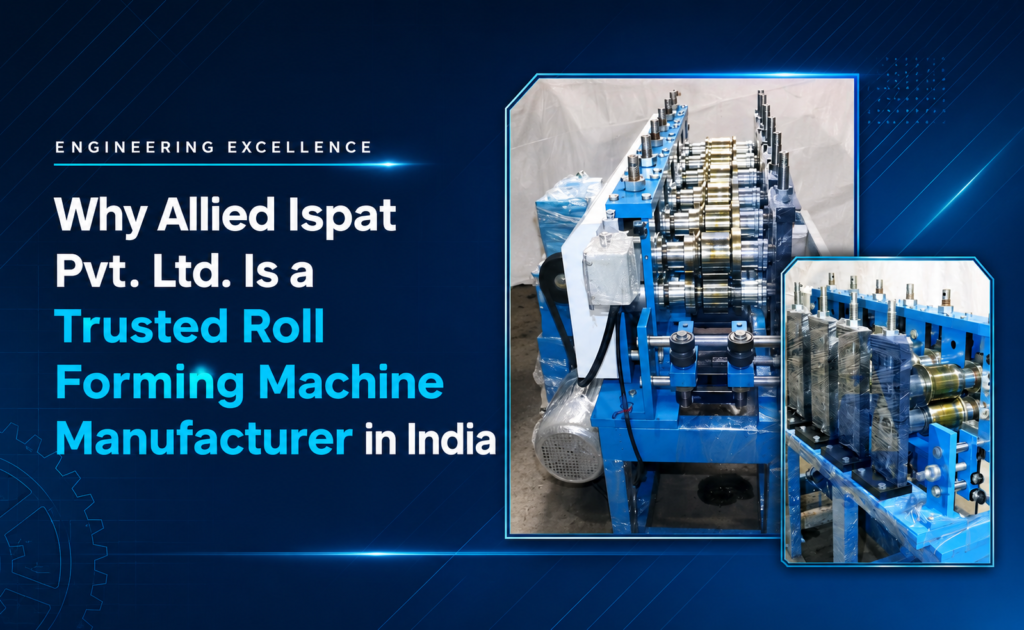
Introduction: Reliable Roll Forming Begins with Purpose-Built Machinery
For a steel profile manufacturer, the quality of the finished section is closely connected to the equipment used to produce it. A roll forming line must do more than bend sheet metal into a particular shape. It needs to guide the material through a controlled forming sequence, maintain repeatability across production runs and support the productivity expected from an industrial manufacturing operation.
These requirements become even more important when manufacturers work with different profile geometries, coated materials or products that must fit accurately into other components. Tooling design, machine rigidity, material handling, cutting arrangements and automation all contribute to the final result.
Allied Ispat Pvt. Ltd., part of the Malik Group of Companies, applies its steel-processing and manufacturing experience to the development of roll forming machinery. As a Roll Forming Machine Manufacturer in India, Allied Ispat offers cold roll forming machines developed with high-precision tooling, heavy-duty structures, customizable designs and manual as well as fully automatic options.
For industrial buyers, these capabilities are significant because the right machine is not defined by a single feature. It is the combination of engineering, tooling, construction, production control and support that determines whether the equipment is suited to a manufacturer’s long-term profile production requirements.
How Roll Forming Converts Metal Strip into Consistent Profiles
Roll forming is based on progressive shaping. Sheet or strip metal enters the machine and moves through a sequence of specially designed roll stations. Instead of creating the complete section immediately, each pair of rolls performs part of the forming operation until the required cross-sectional shape is achieved.
This progressive approach makes roll forming suitable for continuous profile manufacturing. Once a production line is correctly configured for the required section, manufacturers can use the process to produce repeated lengths while maintaining a controlled forming sequence.
Consistency, however, depends on the complete system. If roll geometry, alignment, machine stability or material feeding is poorly controlled, variation introduced early in the process can continue through later forming stations.
This is why manufacturers evaluating a Roll Forming Machine Manufacturer in Mumbai need to examine more than the external appearance of a machine. The design of the tooling, rigidity of the structure and compatibility between the machine and the intended profile can have a direct influence on manufacturing performance.
Selecting Roll Forming Machinery: What Matters to Industrial Buyers?
A roll forming machine should be selected around the product that needs to be manufactured. Starting with generic equipment specifications and attempting to adapt the product later can lead to unnecessary compromises.
The required profile geometry is the logical starting point. Material characteristics, strip dimensions, surface finish and production requirements then help determine the forming approach.
Tooling capability deserves particular attention. Because the profile is created progressively, the roll design needs to control how the material changes at each stage. Machine construction must then provide a stable foundation for that tooling.
Buyers should also consider the required automation level, cutting arrangement, maintenance approach and availability of technical assistance.
A dependable Roll Forming Machine Supplier in India should be able to discuss these factors in relation to the customer’s actual product. The quality of this technical discussion can be just as valuable as the specifications eventually listed in the machine proposal.
Allied Ispat Pvt. Ltd.: Manufacturing Experience Behind the Machinery
Allied Ispat Pvt. Ltd. operates across several areas of steel processing and manufacturing, including rolling shutter components, false ceiling and drywall sections, steel coils and roll forming machines. The company is part of the Malik Group of Companies and states that it operates under ISO 9001:2015 certification.
This broader manufacturing background is relevant for buyers considering Allied Ispat as a Roll Forming Machine Manufacturer in India. Roll forming equipment ultimately exists to manufacture usable metal sections, and practical exposure to profile production provides useful context when machinery is being configured.
The company’s roll forming machine offering emphasizes high-precision tools, heavy-duty construction, fully automatic options, low-maintenance design and customizable machine configurations.
For an industrial buyer, the value lies in bringing these capabilities together. A machine needs to produce the intended section reliably, but it should also reflect the material, operating conditions and production workflow of the factory where it will be installed.
Precision Engineering: Where Consistent Profile Quality Starts
Precision in roll forming is created progressively. Every forming station influences what happens at the next station, which means tooling geometry and alignment need to work as a coordinated sequence.
If the material is formed unevenly during an early stage, subsequent rolls may have to compensate for that variation. A properly planned forming sequence instead introduces changes gradually, helping the strip progress toward the final geometry in a controlled manner.
For manufacturers, this can affect dimensional repeatability and downstream usability. Profiles may later need to fit into assemblies, align with adjacent sections or undergo additional fabrication. Consistent geometry can make those operations easier to manage.
Allied Ispat identifies high-precision tooling as an important characteristic of its roll forming machines.
This makes engineering precision a practical production consideration rather than simply a machine feature. The objective is predictable profile formation over repeated manufacturing cycles.
Heavy-Duty Structure for Stable Forming Operations
A production machine must maintain its mechanical relationship between multiple components while operating under repeated forming loads. The machine frame provides the base on which rolls, shafts, drives and associated systems remain positioned.
Allied Ispat’s roll forming machines are designed around heavy-duty structures for industrial applications.
For the buyer, rigidity matters because stable machine construction helps support alignment during production. It also provides a dependable foundation for the roll tooling to perform its intended function.
This is particularly relevant in continuous profile manufacturing, where equipment may be expected to operate through repeated production cycles.
Businesses comparing a Roll Forming Machine Manufacturer in Mumbai should therefore examine structural construction in relation to the intended workload. A heavy-duty design is valuable not simply because it appears robust, but because machine stability supports controlled forming and consistent operation.
Roll Tooling: The Engineering Behind the Finished Shape
The finished profile is created by the rolls, making tooling one of the most technically significant elements of a roll forming line.
Each station has a defined responsibility. Early rolls begin the shape transformation, intermediate stations continue developing the geometry, and later stages bring the section toward its final form.
Good tooling design considers this entire progression rather than treating each roll independently.
Precision roll tooling can support repeatability, dimensional consistency and controlled surface contact. These considerations become particularly important where finished profiles need to integrate with other sections or where visible surfaces must retain their appearance.
For manufacturers assessing a Roll Forming Machine Supplier in India, tooling capability should therefore be examined carefully. A strong machine frame cannot compensate for unsuitable roll design, just as good tooling cannot perform optimally if the machine does not provide a stable platform.
Allied Ispat’s focus on high-precision tooling brings these two areas together within its machinery offering.
Automation That Supports a More Organized Production Flow
Automation is most useful when it improves control over repetitive production tasks.
Allied Ispat offers fully automatic roll forming machine configurations, with its official product information identifying PLC-based systems and hydraulic cutting among available machine features.
A PLC-based control system can help coordinate defined machine functions during operation. Integrated hydraulic cutting can support the production sequence by bringing profile cutting into the manufacturing workflow.
For manufacturers producing repeated sections, such coordination can help create a more organized process and reduce unnecessary manual intervention between stages.
Automation should nevertheless be selected according to production requirements. More automation is not automatically better for every factory. Production volume, profile type, workforce capabilities and manufacturing workflow should guide the decision.
This is one area where discussions with a Roll Forming Machine Manufacturer in India become important. Instead of selecting automation simply because it is available, buyers should determine which level of control provides practical value for their operation.
Protecting Surface Quality During Profile Formation
Profile accuracy is only part of the quality requirement when coated or decorative metal is being processed.
Pre-painted, colour-coated and other finished surfaces need controlled handling because unnecessary marking during forming can affect the appearance of the final product. This can be particularly important for profiles used where surfaces remain visible after installation.
Allied Ispat highlights smooth profile output and precision tooling within its roll forming machine offering.
Roll geometry, alignment and material contact all contribute to this objective. Rather than treating surface quality as an inspection issue at the end of production, it should be considered while the tooling and forming sequence are being planned.
A manufacturer processing coated sheet should therefore communicate this requirement clearly when approaching a Roll Forming Machine Manufacturer in Mumbai. The raw material and expected finish are important inputs when determining a suitable machine configuration.
Designing for Maintenance Without Compromising Production
Every industrial machine requires maintenance. The practical objective is not to eliminate servicing but to make routine care predictable and manageable.
Unexpected equipment interruptions can affect production planning, workforce utilization, downstream operations and dispatch schedules. Machinery design should therefore consider reliability alongside ease of routine maintenance.
Allied Ispat describes its roll forming equipment as having a durable, low-maintenance design.
For production managers, this should translate into a focus on preventive care rather than assuming the equipment will require no attention. Regular inspection, lubrication, cleaning and appropriate adjustment remain part of responsible machine operation.
A Roll Forming Machine Supplier in India should be evaluated partly on how clearly it communicates these operational requirements. Buyers benefit from understanding not only how a machine performs during production but also what is needed to keep it operating effectively.
Customized Machines for Profiles That Standard Equipment Cannot Address Efficiently
Metal profiles differ widely in geometry and application. Even sections serving similar industries may have different widths, bends, material specifications or downstream requirements.
This creates a strong case for customized machine design.
Allied Ispat states that its machine configurations and roll designs can be tailored according to the required product profile or strip size. Its machinery offering also includes customization of rollers, strip feeders and forming stations.
For a manufacturer, customization begins with information. The machine builder needs to understand what must be produced before deciding how the equipment should be configured.
A Roll Forming Machine Manufacturer in Mumbai offering customized engineering can evaluate profile drawings, material specifications, strip requirements, production objectives and automation needs as part of this discussion.
The objective should not be customization for its own sake. It should be to configure the machine around the features that genuinely influence the required manufacturing process.
From a Profile Drawing to a Practical Machine Concept
A profile drawing contains more than the shape of the finished section. It is the starting point for decisions about how the material needs to travel through the roll forming process.
Machine development should therefore begin by understanding the required output. Engineers can then consider the raw material, strip dimensions and surface requirements before determining an appropriate forming approach.
The next stage involves planning how the profile will develop through successive rolls. This affects tooling and the number and arrangement of forming operations needed for the section.
Feeding, automation and cutting requirements must then be integrated into the wider machine concept.
Testing is equally significant. Before a production line becomes part of routine manufacturing, the relationship between tooling, machine setup and finished profile needs to be assessed.
Working with a Roll Forming Machine Manufacturer in India that offers customized configurations allows this discussion to start from the product requirement instead of a predetermined machine layout.
Quality Control from Machine Fabrication to Final Testing
Industrial machinery quality is built through several stages. Fabrication quality influences the structure, machining influences component fit, tooling affects profile formation, and assembly determines how these elements operate together.
Alignment and testing then help confirm whether the machine functions as intended.
Allied Ispat states that it follows quality-focused manufacturing processes and operates under ISO 9001:2015 certification.
For procurement teams, a quality system provides useful context but should be considered alongside the technical suitability of the proposed equipment.
A company evaluating a Roll Forming Machine Supplier in India should ask how machine construction, tooling and testing are approached for the specific project. These discussions provide more meaningful insight than relying on a general quality statement alone.
Custom Engineering Can Support Product Differentiation
Manufacturers do not always compete by making identical profiles. New dimensions, alternative geometries and application-specific sections can become part of product differentiation.
Customized roll forming equipment can support this strategy by aligning tooling and machine configuration with the intended section.
A manufacturer may require a different forming progression, specialized tooling arrangement, alternative feeding setup or a particular level of automation. These needs should be considered before the equipment is finalized.
For businesses working with a Roll Forming Machine Manufacturer in Mumbai, the advantage of customization is the ability to discuss the production challenge directly.
The purpose is not to make machinery unnecessarily complex. A good custom solution should include what the application needs while avoiding features that provide little operational benefit.
Technical Support Matters After the Machine Reaches the Factory
Commissioning is the point where machine engineering meets the buyer’s actual production environment.
Operators need to understand machine functions, routine procedures and relevant operating requirements. Installation must also be managed correctly before regular production begins.
Allied Ispat states that it provides on-site installation, operator training and post-sale technical support for its roll forming machines.
These services are especially relevant when equipment has been configured around a customer’s specific profile.
For companies selecting a Roll Forming Machine Supplier in India, after-sales capability should therefore form part of the original procurement evaluation. Technical communication after delivery can be valuable for addressing operating questions and supporting the transition from installation to routine production.
Why Mumbai-Based Manufacturing Access Can Matter
Mumbai is a major commercial centre with established connections to engineering, steel trading, construction and manufacturing industries. Allied Ispat Pvt. Ltd. maintains its registered presence in Mumbai, Maharashtra.
For buyers seeking a Roll Forming Machine Manufacturer in Mumbai, regional accessibility can make technical and commercial communication more convenient, particularly for businesses operating in Maharashtra and surrounding industrial markets.
Geography, however, should remain only one part of the decision.
Machine suitability depends more heavily on engineering expertise, tooling, customization, structural design and support. Allied Ispat’s relevance comes from combining its Mumbai presence with experience across steel products and roll forming machinery rather than relying on location alone.
Where Roll Forming Technology Creates Industrial Value
Roll forming is relevant across industries that require repeatable metal sections in continuous lengths.
Construction and interior systems can use formed profiles for framing, ceilings and partitions. Rolling shutter production requires accurately formed sections and associated components. Roofing, cladding and infrastructure applications can also involve continuous metal profiles, depending on the product design.
Industrial fabricators and OEMs may require application-specific sections that do not fit conventional profile categories.
Allied Ispat itself works across rolling shutter parts, ceiling and partition sections, coils and roll forming machinery, giving the company exposure to multiple areas of profile manufacturing.
A Roll Forming Machine Manufacturer in India should nevertheless evaluate each proposed application independently. Material, geometry, dimensions, surface requirements and expected production all influence machine suitability.
Evaluating the Total Manufacturing Value of a Roll Forming Machine
Capital equipment should not be assessed only by its purchase price.
The economic impact of a roll forming line continues throughout its operating life. Profile consistency can influence rejection and rework. Machine reliability affects production schedules. Maintenance influences uptime, while tooling quality affects the repeatability of the finished product.
Automation may influence manpower requirements and workflow, while customization determines how closely the equipment fits the manufacturer’s actual production needs.
A capable Roll Forming Machine Supplier in India should therefore help buyers understand the machine from a production perspective rather than treating the decision as a price comparison alone.
The same applies when choosing a Roll Forming Machine Manufacturer in Mumbai. Regional convenience has value, but the stronger long-term consideration is whether the machine supports dependable and scalable profile production.
Why Choose Allied Ispat Pvt. Ltd. for Roll Forming Machines?
Allied Ispat brings together several capabilities relevant to industrial profile manufacturing:
- Precision tooling: Designed to support controlled profile development and repeatable output.
- Heavy-duty construction: Provides a stable machine platform for industrial forming operations.
- Custom configurations: Roll designs and machine arrangements can be developed around profile and strip requirements.
- Automatic options: Applicable configurations can incorporate PLC-based systems and hydraulic cutting.
- Surface-conscious forming: Precision tooling supports the requirements of coated and decorative materials.
- Low-maintenance design: Equipment is developed with production continuity and routine care in mind.
- Quality-oriented manufacturing: Allied Ispat operates under ISO 9001:2015 certification.
- Machine support: Installation, operator training and post-sale technical assistance are available for roll forming machinery.
These capabilities help explain Allied Ispat’s relevance to businesses comparing a Roll Forming Machine Manufacturer in India for customized production requirements.
For manufacturers sourcing machinery regionally, Allied Ispat also provides an option for businesses seeking a Roll Forming Machine Manufacturer in Mumbai with experience across steel products and profile manufacturing.
Building a Stronger Profile Manufacturing Process with Allied Ispat Pvt. Ltd.
A productive roll forming operation begins with a clear understanding of the profile that needs to be manufactured. From that point, tooling, machine structure, forming progression, automation and cutting can be planned as parts of one coordinated production system.
Allied Ispat Pvt. Ltd. approaches roll forming machinery with this combination of precision engineering, heavy-duty construction and customization. For businesses comparing a Roll Forming Machine Manufacturer in India, these capabilities provide a practical basis for evaluating equipment beyond headline specifications.
Long-term machine value also depends on the relationship between the supplier and the production team. Installation assistance, operator training and technical support can help manufacturers move from machine commissioning to regular production with greater clarity. This makes support an important consideration when evaluating a Roll Forming Machine Supplier in India.
Manufacturers, steel processors, OEMs and fabricators planning a new profile or expanding existing production can discuss their profile drawings, material specifications, strip dimensions, required automation and manufacturing objectives with Allied Ispat Pvt. Ltd. A detailed technical discussion at the beginning can help determine a roll forming configuration suited to the intended application.
Frequently Asked Questions
1. What is a roll forming machine used for?
A roll forming machine is used to continuously shape metal strips into uniform profiles through a series of forming rollers. Allied Ispat Pvt. Ltd. manufactures roll forming machines for industrial profile production with a focus on accuracy and consistency.
2. What are the benefits of using a roll forming machine?
Roll forming machines support continuous production, consistent profile dimensions, efficient material use and reduced manual processing. Allied Ispat Pvt. Ltd. develops machines that help manufacturers improve production efficiency and profile quality.
3. Can a roll forming machine be customized?
Yes, roll forming machines can be customized according to profile shape, strip size, tooling and production requirements. Allied Ispat Pvt. Ltd. offers customized machine configurations and roll designs for different industrial applications.
4. What is an automatic roll forming machine?
An automatic roll forming machine integrates forming, control and cutting operations into a coordinated production process. Allied Ispat Pvt. Ltd. offers fully automatic options with PLC-based systems and hydraulic cutting for suitable applications.
5. Which materials can be used in roll forming machines?
Roll forming machines can process different sheet-metal materials depending on machine design, tooling and application requirements. Allied Ispat Pvt. Ltd. helps buyers select suitable machine configurations based on the profile and material to be processed.
6. How do I choose the right roll forming machine?
The right machine depends on profile geometry, material specifications, strip size, production volume, automation level and cutting requirements. Allied Ispat Pvt. Ltd. works with manufacturers to understand these factors before developing a suitable machine configuration.
7. Why is precision tooling important in roll forming?
Precision tooling helps control how metal is gradually shaped at each forming station, supporting dimensional consistency and repeatable profile production. Allied Ispat Pvt. Ltd. focuses on high-precision roll tooling for controlled and reliable profile formation.
8. What is the price of a roll forming machine in India?
Roll forming machine prices vary depending on machine size, profile complexity, number of operations, tooling, automation and customization requirements. Allied Ispat Pvt. Ltd. evaluates project specifications before recommending an appropriate roll forming solution.
9. Does Allied Ispat provide customized roll forming machines in India?
Yes. Allied Ispat Pvt. Ltd. provides customized roll forming machines based on required profile designs, strip specifications and production needs. Buyers can discuss tooling, automation and machine configuration according to their manufacturing application.
10. Why choose Allied Ispat Pvt. Ltd. as a Roll Forming Machine Manufacturer in India?
Allied Ispat Pvt. Ltd. combines precision engineering, heavy-duty machine construction, customizable tooling, automatic machine options and technical support. These capabilities make the company a reliable choice for manufacturers looking for roll forming machinery in India.
Allied Ispat’s Complete Steel Manufacturing Product Range
Beyond roll forming machinery, Allied Ispat Pvt. Ltd. supports manufacturers, fabricators, contractors and industrial buyers with a broader portfolio of steel products. Its range includes trading coils, POP and false-ceiling components, and rolling shutter parts designed for different fabrication and construction requirements.
Trading Coils for Industrial Steel Processing
Allied Ispat Pvt. Ltd. supplies trading coils for businesses involved in fabrication, profile manufacturing and other steel-processing applications. With a focus on material quality and dependable supply, the company serves customers looking for a reliable Trading Coil Manufacturer in India. Its coil solutions can support manufacturers that require steel material for further processing, forming and industrial production.
POP Parts for Ceiling and Interior Applications
For false-ceiling and interior construction requirements, Allied Ispat Pvt. Ltd. manufactures POP parts and steel profiles developed for practical installation and consistent application. As a POP Parts Manufacturer and in India, Allied Ispat serves contractors, fabricators, distributors and construction businesses requiring dependable ceiling and partition components for residential, commercial and industrial projects.
Rolling Shutter Parts for Reliable Shutter Systems
Allied Ispat Pvt. Ltd. also manufactures rolling shutter components used in commercial and industrial shutter systems. Its product range supports shutter manufacturers and fabricators looking for accurately manufactured components for dependable assembly and operation. As a Rolling Shutter Parts Manufacturer in India, Allied Ispat provides steel shutter components for varied fabrication and project requirements.
Allied Ispat Mumbai Central
Address: Shop 69, Maulana Shaukat Ali Road, Chhota Sonapur, Siddharth Nagar, Mumbai Central, Mumbai, Maharashtra 400008
Phone: 098211 77009
Get Directions: https://maps.app.goo.gl/gyEqxBGcw9jLsYm26
Allied Ispat Works:
Plot no. C-17 9, MIDC Road behind Bank of Baroda Bank Taloja Panvel, Maharashtra 410208 India
Get Directions: https://maps.app.goo.gl/6ujLCuHpQLu1Uy3r8
Phone: 087790 51606
Email: info@alliedispatindia.com | sales@alliedispatindia.com
Website: www.alliedispatindia.com

