
Visual effects have become an essential part of modern visual storytelling. From feature films and OTT shows to advertisements, gaming, music videos, branded content and social media, VFX helps creators build scenes that cannot always be captured through conventional filming. As content becomes more advanced, production companies need artists who understand both creativity and technology.
For students who want to enter this growing field, joining a Visual Effects Course in Andheri can provide a structured foundation in compositing, 3D design, motion graphics, simulations, editing, cinematography and post-production. Today, however, learning VFX is not only about mastering software. Students also need to understand how shots are planned, how visual elements interact, how realistic effects are created and how artificial intelligence can improve production workflows.
Future AI – School of Animation in Andheri West offers VFX-focused learning designed around practical skills, professional production methods and emerging AI-based creative workflows. Its VFX Film Making program introduces students to different stages of visual production, including graphics, cinematography, 3D fundamentals, compositing, motion design, simulations and post-production.
For anyone planning a career in movies, advertising, gaming, digital media or visual storytelling, understanding what a modern VFX program should teach is the first step towards choosing the right training path.
What Does a Visual Effects Course Actually Teach?
A visual effects course teaches students how to enhance, modify or completely transform filmed footage using digital technology.
Imagine a movie scene where a superhero flies through a city, a historical building appears exactly as it looked hundreds of years ago, or an actor stands inside an environment that never existed physically. These scenes are created through multiple VFX techniques rather than one simple effect.
Professional visual effects production can involve removing unwanted objects, replacing backgrounds, combining different video layers, generating digital environments, tracking moving cameras, creating smoke or fire, integrating 3D objects and adjusting lighting so that everything looks like it belongs in the same scene.
Important VFX Skills Students May Learn
A career-oriented Visual Effects Course in Andheri may introduce students to skills such as:
- Rotoscoping and masking
- Green-screen removal
- Chroma keying
- Digital compositing
- Motion tracking
- Camera tracking
- Matchmoving
- Matte painting
- Digital clean-up
- 3D modelling fundamentals
- Texturing
- Lighting
- Rendering
- Motion graphics
- Particle effects
- Fire and smoke simulations
- Liquid simulations
- Destruction effects
- Video editing
- Colour correction
- Post-production workflows
Students should also understand composition, perspective, camera movement and storytelling because believable visual effects depend on much more than technical software knowledge.
Why Is VFX Becoming an Important Career Skill?
Audiences today expect high-quality visuals across almost every media platform. Previously, advanced visual effects were associated mainly with expensive movies. Today, even advertisements, YouTube videos, Instagram campaigns, web series and product videos can include sophisticated visual effects.
This expansion has created opportunities for creative professionals who can combine artistic judgement with digital-production skills.
Industries Using VFX Today
VFX professionals can contribute to:
- Films
- OTT series
- Television
- Advertising
- Gaming
- Social media
- Music videos
- Corporate videos
- Product visualisation
- Motion design
- Virtual production
- Digital campaigns
As these industries continue producing more visual content, trained artists who understand professional workflows can explore multiple career directions.
Who Can Join a Visual Effects Course After 12th?
Students from different educational backgrounds can learn visual effects. You generally do not need to come from a specific academic stream to start learning VFX. Students from Arts, Commerce and Science backgrounds can all develop professional visual-effects skills with consistent practice and the right training.
Future AI states that learners who have completed 10th or 12th can explore its creative courses, while a specialised technical background is not compulsory for beginners.
VFX Can Be Suitable for Students Interested In
Students may consider VFX if they enjoy:
- Movies and filmmaking
- Animation
- Gaming
- Video editing
- Graphic design
- Photography
- Technology
- Drawing
- 3D artwork
- Digital storytelling
- Motion graphics
- Creative problem-solving
Your academic stream matters less than your willingness to practise and improve.
Can Commerce Students Learn VFX?
Yes. Commerce students can pursue visual effects because VFX is primarily based on creative ability, software skills, observation and practical experience.
A Commerce background does not prevent students from learning compositing, animation, tracking, 3D production or motion graphics. What matters is developing the correct combination of technical and visual skills.
Can Science Students Build a VFX Career?
Science students can also enter VFX. Some science students may find concepts related to movement, physics, lighting, simulation and procedural effects particularly interesting. However, advanced scientific knowledge is not necessary to begin learning visual effects.
Students generally start with basic visual concepts before progressing towards complex simulations and professional post-production techniques.
Is VFX Suitable for Arts Students?
Arts students can be well suited to visual-effects training because skills such as colour understanding, drawing, composition, creativity and storytelling can contribute to stronger visual work. However, students do not need exceptional drawing ability to succeed.
Different VFX roles require different strengths. A compositor, for example, may focus more on layering, colour matching and realistic integration, whereas an FX artist may work heavily with simulations.
Do You Need Drawing Skills to Become a VFX Artist?
Professional drawing ability is not compulsory for most VFX careers. Basic understanding of perspective, shape, composition and visual balance can certainly help, but many VFX roles depend more on software workflow, observation, problem-solving and technical execution.
Students can gradually develop their visual awareness throughout the course.
Is Coding Required for a Career in Visual Effects?
Coding is not mandatory when beginning a VFX career. Many entry-level roles can be learned without programming knowledge.
However, technical artists working in advanced pipelines may eventually benefit from scripting skills. Python, for example, can be used in professional production environments for automation, workflow customisation and pipeline tools. Beginners should normally focus first on core visual and software skills.
What Should a Modern Visual Effects Course Cover in 2026?
The visual-effects industry continues to change quickly. A course designed for today’s students should therefore combine traditional production skills with newer technologies.
Visual Storytelling and Composition
Before learning advanced software, students should understand how visual decisions affect storytelling.
Composition, framing, depth, perspective and continuity can make the difference between an effect that looks believable and one that immediately feels artificial.
Cinematography Fundamentals
VFX artists often work with footage captured by cameras.
Understanding focal length, camera angle, movement, exposure, depth and lighting can make digital integration much more convincing.
Rotoscoping
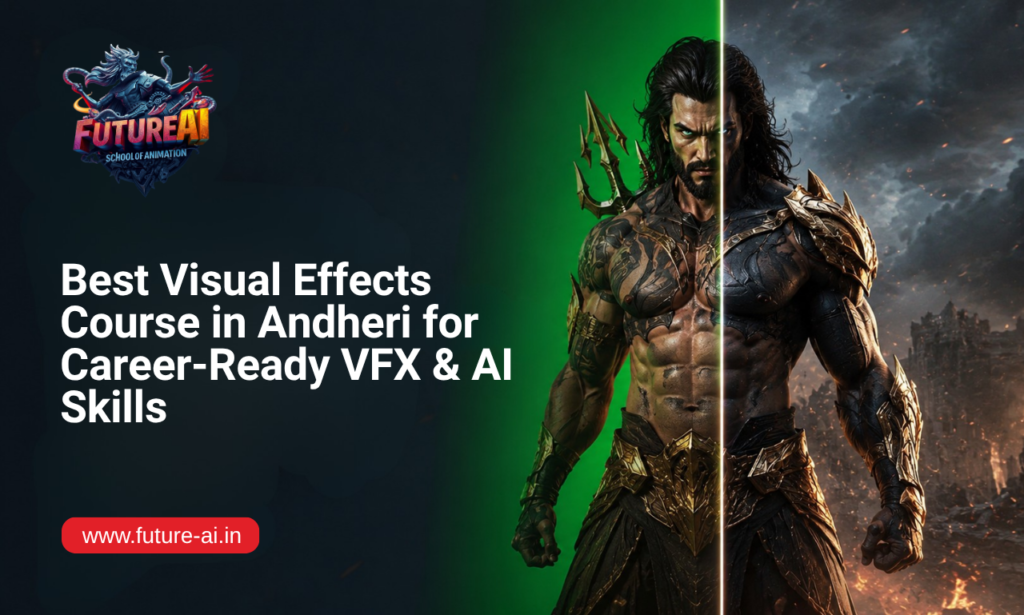
Rotoscoping involves separating people or objects from their backgrounds so that individual elements can be edited independently. It remains an important foundation for many compositing workflows.
Chroma Keying
Green-screen and blue-screen techniques allow backgrounds to be replaced digitally. Students should learn how to create clean keys while handling edges, hair, transparency, colour spill and lighting differences.
Motion Tracking
Tracking helps digital elements follow movement inside recorded footage. It may involve tracking individual objects, surfaces or complete camera movement.
Matchmoving
Matchmoving allows artists to recreate camera movement inside a digital 3D environment. This helps computer-generated objects remain correctly positioned inside live-action shots.
Compositing
Compositing is one of the central skills in visual-effects production. A compositor may combine live-action footage, 3D renders, matte paintings, effects and multiple visual layers into a final shot.
The artist must carefully match:
- Lighting
- Colour
- Perspective
- Depth
- Grain
- Motion
- Focus
Good compositing often goes unnoticed because the final result looks natural.
3D Fundamentals
Students learning VFX can benefit from understanding how three-dimensional assets are created.
Important introductory areas may include:
- Modelling
- Materials
- Texturing
- Lighting
- Cameras
- Animation
- Rendering
Even students who eventually specialise in compositing should understand how 3D departments work.
FX and Simulations
Simulation-based effects can create visually complex events such as:
- Fire
- Smoke
- Water
- Dust
- Debris
- Explosions
- Destruction
- Particles
These workflows are often associated with procedural software such as Houdini.
Post-Production
A VFX artist should understand where visual effects fit within the broader post-production process.
Editing, colour correction, rendering, file management and output preparation help students understand how individual shots become part of a finished production.
Which Software Should VFX Students Learn?
Software is important, but software alone does not create a skilled VFX artist. Students should understand the purpose of each application and how different tools connect inside a production pipeline.
Adobe After Effects
After Effects is widely used for motion graphics, compositing, tracking, masking and digital effects.
It can be especially useful for students working in advertising, social media, motion design and video post-production.
Foundry Nuke
Nuke is a node-based compositing application commonly associated with high-end film and visual-effects workflows.
Students interested in professional compositing can benefit from understanding node-based workflows and shot construction.
Autodesk Maya
Maya is widely associated with 3D modelling, animation, lighting, effects and rendering. It can help students understand how computer-generated assets are created before they are composited into final footage.
Houdini
Houdini is known for procedural workflows and simulations.
It can be particularly useful for artists interested in:
- Fire
- Smoke
- Fluids
- Destruction
- Particles
- Procedural environments
Cinema 4D
Cinema 4D is frequently used for motion design, 3D graphics and visual content.
It can be useful for students interested in combining motion graphics with 3D production.
3ds Max
3ds Max can support modelling, visualisation, animation and rendering workflows depending on the production requirement.
RealFlow
RealFlow has traditionally been used for fluid and dynamics-oriented visual-effects workflows.
Future AI’s VFX Film Making curriculum includes exposure to multiple professional tools and production areas across its different terms.
How Is AI Changing VFX Training?
Artificial intelligence is creating new possibilities for visual-effects artists. AI-assisted tools are increasingly being integrated into creative software to help artists complete repetitive or technically demanding tasks faster.
This does not mean learning traditional VFX is becoming unnecessary. Instead, students now need to understand how AI can support a professional workflow while maintaining human creative control.
AI Can Assist With Tasks Such As
- Object masking
- Rotoscoping
- Asset generation
- Concept development
- Image generation
- Video generation
- Clean-up
- Motion creation
- Background development
- Workflow organisation
- Repetitive production tasks
The most valuable students will not simply know how to enter prompts.
They will understand cinematography, composition, lighting, perspective and compositing well enough to recognise whether AI-generated output actually works.
Why Should VFX Students Learn AI Alongside Traditional Skills?
AI tools can accelerate production, but they do not remove the need for visual judgement. Suppose an AI system generates a digital background. The artist still needs to determine whether the camera angle is correct, whether the lighting matches the actor, whether the perspective looks realistic and whether the final shot supports the story.
This is why students researching a Visual Effects Course in Andheri should look for training that combines AI with professional VFX fundamentals rather than treating AI as a replacement for them. The strongest creative workflow is increasingly becoming:
Human creativity + VFX fundamentals + professional software + AI assistance.
Why Are Practical Projects Important in VFX Training?
VFX cannot be mastered through theory alone. Students need repeated practical experience. Classroom demonstrations may explain how a tool works, but projects teach students how to solve actual production problems.
Through Practical Projects, Students Learn to
- Interpret creative briefs
- Plan shots
- Organise project files
- Meet deadlines
- Correct mistakes
- Handle revisions
- Receive creative feedback
- Combine multiple techniques
- Improve visual quality
- Present completed work professionally
This is one reason students should ask institutes about actual project work before taking admission.
Why Is a VFX Showreel Important?
A showreel is one of the most important career assets for a new VFX artist. It gives studios and recruiters direct evidence of what you can create.
Rather than simply stating that you know Nuke, Houdini or After Effects, your showreel allows an employer to see your practical ability.
Student Showreels Can Include
- Green-screen composites
- Rotoscoping
- Object removal
- Tracking
- Matte painting
- Set extensions
- Motion graphics
- 3D integration
- Simulation shots
- Lighting work
- Before-and-after breakdowns
Quality usually matters more than quantity.
A shorter showreel containing polished work can often create a stronger impression than a long reel filled with unfinished projects.
How Long Does It Take to Learn VFX?
The time required depends on the depth of the program and the student’s chosen specialisation. Short-term courses may focus on one application or one particular skill. More comprehensive career programs may include design fundamentals, filmmaking, compositing, 3D, simulations and portfolio development.
Future AI currently lists its VFX Film Making program at approximately 18 months, divided across four terms. The curriculum progresses through different areas of visual production rather than concentrating on only one software application. Students should always verify the latest timetable, batch schedule and course structure directly with the institute.
How to Choose the Best Visual Effects Course in Andheri
Choosing a VFX institute requires more than comparing fees or looking at a long list of software. Students should evaluate what they will actually be capable of creating when the program ends.
Check the Curriculum
The program should cover a meaningful combination of fundamental and advanced skills.
Look for topics such as:
- Cinematography
- Compositing
- Tracking
- 3D
- Motion graphics
- FX
- Simulations
- Post-production
Check the Practical Training
Ask how frequently students work on projects. VFX becomes easier to understand when techniques are repeatedly applied to actual shots.
Check Mentor Experience
Trainers who understand professional production workflows can explain challenges that may not appear in software tutorials.
Check Software Exposure
Students should gain hands-on familiarity with tools relevant to their preferred specialisation.
Check AI Integration
A modern program should introduce students to the growing role of AI-assisted creative workflows.
Check Showreel Support
Ask whether students receive feedback while building their portfolios and showreels.
Check Production Exposure
Studio-style workflows can teach students how different departments interact during professional projects.
Check Career Guidance
Placement-oriented support may include:
- Resume development
- Interview preparation
- Showreel feedback
- Portfolio review
- Career counselling
- Studio referrals
Is VFX a Good Career in India?
VFX can offer strong career possibilities for students who develop professional-level skills. India has a large entertainment, advertising, streaming, gaming and digital-content ecosystem. Visual-effects professionals can contribute to both domestic and international productions.
However, completing a course does not automatically guarantee career success. Students who progress faster usually combine technical knowledge with consistent practice and strong creative work.
Important Career Strengths Include
- Technical proficiency
- Good observation
- Strong showreel
- Visual judgement
- Problem-solving
- Communication
- Time management
- Ability to accept feedback
- Specialised knowledge
- Continuous learning
The industry rewards people who can produce reliable work, not simply those who know the names of many software applications.
What Career Options Are Available After a VFX Course?
Visual effects is not a single job role. The production process requires specialists with different responsibilities.
VFX Artist
A VFX artist may contribute to different stages of creating or integrating digital effects.
Compositor
Compositors combine visual layers to create finished shots that look consistent and realistic.
Roto Artist
Roto artists create precise masks around subjects or objects to help separate them from their surroundings.
Paint Artist
Paint and clean-up artists remove unwanted visual elements such as wires, rigs, markers or production equipment.
Matchmove Artist
Matchmove artists recreate the movement of live-action cameras so digital assets can be correctly placed in scenes.
Motion Graphics Designer
Motion designers create animated typography, titles, promotional graphics and other visual communication.
FX Artist
FX artists often specialise in simulations such as fire, smoke, particles, liquids and destruction.
3D Generalist
A 3D generalist may handle modelling, texturing, lighting, rendering and other 3D production tasks.
VFX Editor
A VFX editor helps organise and manage effects shots within the wider editorial process.
AI-Assisted VFX Creator
Emerging creative roles increasingly combine conventional VFX knowledge with generative and AI-assisted production techniques.
Where Can VFX Artists Work?
After developing professional skills, VFX artists may explore opportunities across several industries.
Film Production
Movies can require compositing, simulations, environment creation, tracking, digital clean-up and many other visual-effects services.
OTT Platforms
Streaming productions rely heavily on post-production and visual enhancement.
Advertising Agencies
Advertising teams use VFX for product videos, campaign films, commercials and digital content.
Gaming Studios
Game production can involve real-time effects, environments, cinematic sequences and particles.
Television
VFX and motion design can be used for broadcast graphics, promotional content and entertainment programming.
Digital Marketing
Brands increasingly use advanced animation and effects for social media, campaigns and online video.
Virtual Production
Virtual production combines digital environments and filmmaking technology to create new types of production workflows.
What Salary Can a Beginner VFX Artist Expect?
There is no universal salary for VFX professionals. Income depends on factors such as:
- Role
- Location
- Software proficiency
- Portfolio
- Studio
- Specialisation
- Experience
- Project quality
The source material notes broad trainee and junior-level salary estimates around ₹1.8 lakh to ₹4.2 lakh annually, though compensation can vary significantly by role and employer.
Instead of choosing a course only because of salary claims, students should focus on developing high-value skills and a professional showreel.
Does VFX Training Include Placement Support?
Many institutes provide career assistance, but students should understand what that actually means.
Placement assistance may involve:
- Resume creation
- Showreel preparation
- Portfolio reviews
- Mock interviews
- Job-opening information
- Studio references
- Career guidance
Placement assistance should not automatically be interpreted as a guaranteed job.
Future AI describes its approach as 100% placement-focused training, with portfolio development, interview preparation, industry exposure and career guidance forming part of its broader training positioning. Students should confirm current placement processes and eligibility requirements before admission.
Why Choose Future AI for a Visual Effects Course in Andheri?
Future AI – School of Animation is located in Andheri West and focuses on creative career training across animation, VFX and emerging digital technologies.
Students looking for a Visual Effects Course in Andheri may find its learning model relevant because the program combines traditional VFX disciplines with production-oriented training and exposure to new AI-supported workflows.
Structured VFX Curriculum
Future AI’s VFX Film Making program is currently structured across approximately 18 months and four terms.
Students progress through multiple areas including graphics, storytelling, cinematography, 3D, compositing, post-production, motion graphics and simulations.
Studio-Style Learning
Understanding how professionals manage shots, revisions and production pipelines can help students prepare for real working environments.
Future AI highlights live-project and production-workflow exposure within its approach.
Industry Guidance
Future AI identifies Chirag C. Bhuva and Shambhu J. Singh from Raj Studios as mentors connected with its training ecosystem.
Industry guidance can help students understand the difference between simply completing an exercise and delivering a shot suitable for professional production.
AI-Focused Creative Learning
The growing use of artificial intelligence in media production means students increasingly need to understand both conventional software and AI-supported processes.
Future AI’s broader positioning integrates emerging AI technologies with animation and VFX education.
Portfolio Development
Creative employers need to see evidence of skill.
A course that supports students in developing meaningful project work and showreels can help them prepare more effectively for entry-level opportunities.
Location in Andheri West
Andheri is closely connected to Mumbai’s filmmaking, advertising, television and media ecosystem.
For students based in Mumbai, studying in Andheri can provide convenient access to one of the city’s important creative-industry locations.
Visual Effects Course or Animation Course in Andheri: Which Should You Choose?
Students sometimes confuse animation with visual effects because both industries use digital production tools. However, their primary areas of focus are different.
Animation generally focuses more on:
- Character movement
- 3D animation
- Acting
- Storytelling
- Modelling
- Character development
VFX generally focuses more on:
- Compositing
- Live-action integration
- Tracking
- Rotoscoping
- Simulations
- Digital environments
- Post-production
Students interested in both areas can gradually build overlapping skills.
Future AI also provides an Animation Course in Andheri, allowing students to explore other areas of creative production depending on their career goals.
Frequently Asked Questions About Visual Effects Courses in Andheri
1. Which Visual Effects Course in Andheri is suitable after 12th?
Students should look for a program that teaches compositing, tracking, 3D fundamentals, simulations, cinematography, post-production, AI-assisted workflows and showreel development. Future AI currently offers an approximately 18-month VFX Film Making program in Andheri West.
2. Can a complete beginner learn VFX?
Yes. Beginners can start without professional VFX experience. A structured program normally begins with design and visual fundamentals before progressing towards advanced production techniques.
3. Is VFX difficult for beginners?
Some advanced techniques require time and practice, but students can learn gradually. Beginning with basic compositing, masking, editing and tracking makes it easier to understand advanced tools later.
4. Which software should I learn for VFX?
The correct software depends on your desired career role. Popular tools can include After Effects, Nuke, Maya, Houdini, Cinema 4D and 3ds Max. Students should focus on understanding workflows rather than trying to master every application simultaneously.
5. Can Commerce students join a VFX course?
Yes. Students from Commerce, Arts and Science backgrounds can learn visual effects. Previous experience in a technical subject is not generally required to begin.
6. Is an Animation Course in Andheri better than a VFX course?
Neither is automatically better. Animation may suit students interested in characters, movement and 3D storytelling, while VFX may suit students interested in compositing, simulations, live-action footage and digital effects.
7. How long does professional VFX training take?
The duration depends on the course. Short programs may focus on individual tools, while comprehensive career programs may require a year or longer. Future AI currently lists its VFX Film Making course at approximately 18 months.
8. Will AI replace VFX artists?
AI is more likely to transform production workflows than completely replace skilled VFX professionals. Artists still need creative judgement, technical knowledge, storytelling ability and the skill to integrate visual elements realistically.
9. What jobs can I apply for after learning VFX?
Potential roles include compositor, roto artist, paint artist, matchmove artist, motion graphics designer, VFX artist, 3D generalist, FX artist, simulation artist and VFX editor.
10. Does Future AI provide placement support?
Future AI states that its training is placement-focused and includes areas such as portfolio development, studio exposure, interview preparation and career guidance. Students should contact the institute for the latest placement details related to individual batches.
Conclusion: Start Building Professional VFX and AI Skills in Andheri
Visual effects has moved far beyond traditional film effects. Today, VFX plays an important role in films, streaming shows, advertising, gaming, digital campaigns, social media content and emerging virtual-production environments. At the same time, artificial intelligence is becoming increasingly integrated into creative software and professional production workflows.
For students entering this industry, learning only software commands is no longer enough. A strong Visual Effects Course in Andheri should help students understand visual storytelling, cinematography, compositing, tracking, 3D production, simulations, post-production and project execution. AI should complement these fundamentals rather than replace them.
Future AI – School of Animation in Andheri West offers a structured VFX Film Making program that brings together multiple areas of creative production. Its approximately 18-month curriculum introduces students to graphics, cinematography, 3D fundamentals, compositing, motion design, post-production and advanced simulation workflows.
Students can also explore an Animation Course in Andheri and other creative programs if they want to develop wider skills across animation, digital production and AI-assisted media. Ultimately, a successful VFX career depends on what a student can create. Regular practice, professional feedback, a focused showreel, technical understanding and the ability to adapt to new tools can make a major difference.
For students who enjoy filmmaking, visual storytelling, digital creativity and emerging technology, choosing the right Visual Effects Course in Andheri can provide a strong starting point for building career-ready skills in the modern VFX industry.
Contact Future Ai
Future Ai Animation Andheri – Animation & VFX Courses in Andheri, Mumbai
Address: Unit No. 1606, Chandak Unicorn, Dattaji Salvi Marg, Off Veera Desai Rd, Andheri, Mumbai, Maharashtra 400053
Phone: 08879998001
Website: www.future-ai.in
Google Maps: https://maps.app.goo.gl/cLeb9zBsJJEADR9x6