
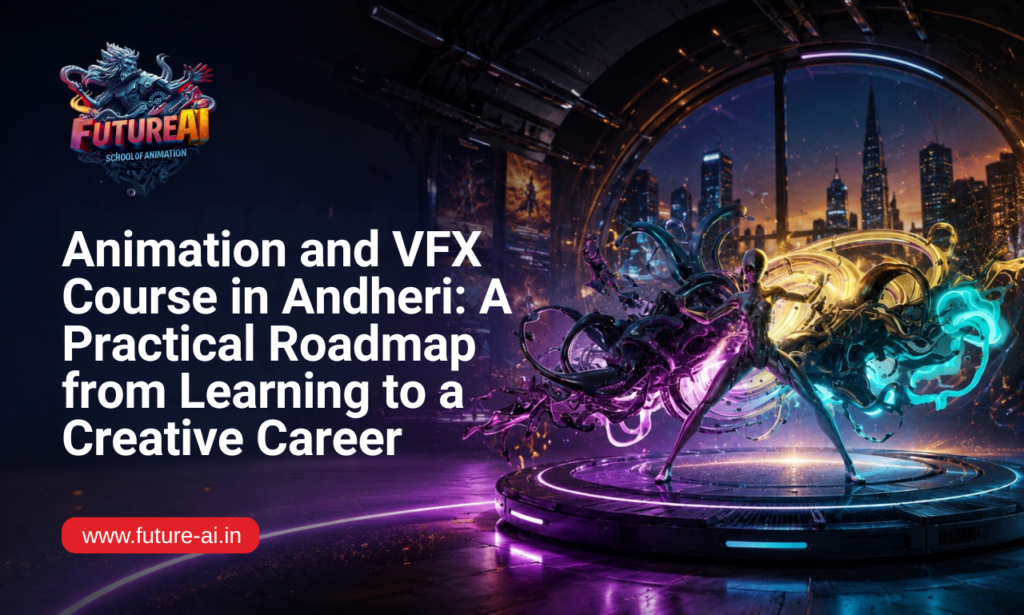
Students who enjoy animated films, visual storytelling, gaming, digital art or cinematic effects often consider joining an Animation Course in Andheri or a VFX Course in Andheri after school or college. These courses can help beginners develop practical skills for films, television, OTT platforms, advertising, gaming, social media and other forms of digital content.
The creative industry, however, does not hire students only because they know how to operate software. Studios look for people who understand design, storytelling, movement, composition, production workflows and professional deadlines. A strong animation and VFX program must therefore combine technical instruction with project experience, feedback, portfolio creation and career preparation.
Future AI School of Animation in Andheri West offers programs covering animation, VFX filmmaking, broadcast design, gaming, Web Design and UX/UI, dynamics and applied creative technologies. Its training model emphasises studio-oriented assignments, green-screen exercises, post-production processes and guidance from professionals associated with Raj Studios.
This guide answers the most common questions students and parents ask before choosing an animation or visual-effects course in Mumbai.
What Is an Animation and VFX Course?
An animation and VFX course is a professional skill-development program that teaches students how to create animated visuals and enhance live-action footage using digital tools.
Animation involves creating the appearance of movement. Artists may animate characters, objects, text, logos, cameras or complete digital environments. The work can be produced through 2D animation, 3D animation, motion graphics, stop motion or real-time technology.
VFX, or visual effects, involves creating imagery that cannot be captured easily during a normal shoot. A VFX artist may replace a green-screen background, remove an unwanted object, create a digital location, add fire or water, track a moving camera or combine several visual layers into one believable shot.
Animation and VFX are closely connected. For example, a fantasy creature may be modelled and animated by a 3D team before being integrated into filmed footage by compositing, tracking and lighting artists.
A complete course may introduce students to:
- Graphic design and digital illustration
- Colour, layout and typography
- Story development and scriptwriting
- Storyboards and animatics
- Animation principles
- 2D and 3D production
- Modelling and sculpting
- Texturing and materials
- Lighting and rendering
- Character rigging
- Motion graphics
- Video and audio editing
- Chroma keying and rotoscopy
- Match-moving and camera tracking
- Compositing and post-production
- Particle and fluid effects
- Portfolio and showreel development
Future AI’s Animation Prime program covers the complete production journey from design and illustration to modelling, character animation, rendering, simulations and portfolio development. Its VFX Film Making program combines visual design, cinematography, compositing, motion graphics, camera tracking and cinematic simulation workflows.
The purpose of professional training is not simply to complete software modules. Students should understand how an idea moves through pre-production, production and post-production before becoming a finished visual.
Why Should Students Choose an Animation and VFX Course in Andheri?
Andheri is one of Mumbai’s most prominent areas for film, television, advertising and digital-content production. Students studying in Andheri West are located close to production houses, post-production facilities, casting agencies, advertising companies and independent creative professionals.
Being close to the media industry does not automatically create employment, but it can give students a better understanding of the professional environment. They may gain exposure to industry discussions, production terminology, studio expectations and creative career paths.
Andheri is also accessible from many parts of Mumbai through local trains, metro routes and road connections. This makes it a practical learning location for students from Jogeshwari, Goregaon, Vile Parle, Santacruz, Bandra, Powai, Malad, Kandivali and nearby suburbs.
Students should still evaluate the quality of the institute rather than selecting a program only because of its location. A useful course should offer:
- A structured curriculum
- Trainers with production knowledge
- Regular practical assignments
- Access to professional software
- Individual project feedback
- Portfolio and showreel guidance
- Exposure to real production stages
- Career and interview preparation
Future AI is situated in Andheri West and states that its students receive experience with VFX shoots, chroma work, camera tracking, match-moving, editing, compositing, motion design and AI-assisted creative tasks.
For students searching locally, an institute that connects classroom learning with studio-style practices can be more valuable than a program based mainly on recorded demonstrations or theoretical lectures.
Which Is the Best Animation and VFX Course in Andheri?
The best animation and VFX course is the one that matches a student’s interests, career plans, available time and preferred area of specialisation.
A student who wants to animate characters requires a different learning emphasis from someone who wants to become a compositor, video editor or simulation artist. Therefore, students should first understand the major career paths within the industry.
Before admission, compare courses based on the following questions:
- Does the curriculum begin with creative fundamentals?
- Are animation principles taught before advanced software?
- Does the course include individual and team projects?
- Will students work on complete scenes rather than isolated exercises?
- Are trainers familiar with current studio workflows?
- Does the institute help students select a specialisation?
- Is portfolio development included in the course?
- Are placement claims clearly explained?
- Can students view genuine project or showreel samples?
- Are batch timings suitable for regular practice?
Future AI offers an 18-month Animation Prime program divided into four terms. Its curriculum begins with graphics, illustration, storytelling and character design before progressing to broadcast design, 3D production, rigging, animation, tracking, simulations and advanced FX.
Its VFX Film Making program runs for approximately 18 months and covers graphics, filmmaking foundations, motion design, compositing, post-production, Cinema 4D and fluid or procedural effects.
Students should request a detailed term-wise syllabus before enrolling. The best course is not defined only by the number of software names displayed in a brochure. What matters is whether students learn to apply those tools to complete, presentable projects.
What Will You Learn in an Animation and VFX Course?
An animation and visual-effects course typically develops three categories of ability: creative thinking, technical execution and professional working habits.
Design and visual communication
Students first need to understand why an image looks appealing or believable. They may study:
- Composition
- Colour theory
- Typography
- Shape language
- Perspective
- Digital illustration
- Character development
- Anatomy basics
- Visual hierarchy
- Design presentation
These skills provide a foundation for every later stage. Even technically accurate work may appear weak when the design, lighting or composition is poorly planned.
Story and pre-production
Before creating a detailed sequence, students learn how to organise an idea. Pre-production subjects may include:
- Concept development
- Scriptwriting
- Story structure
- Storyboarding
- Shot division
- Animatics
- Camera angles
- Photography
- Cinematography
- Production planning
Pre-production helps the artist decide what must appear in each shot, how the camera will move and how the sequence will communicate emotion or information.
2D animation and motion graphics
Students may create title sequences, animated logos, social media videos, promotional content and broadcast graphics. Common topics include:
- Principles of movement
- Timing and spacing
- Keyframes
- Transitions
- Text animation
- Shape animation
- Motion design
- Audio synchronisation
- Video editing
- Colour correction
3D animation production
A 3D pipeline generally includes:
- Object and environment modelling
- Character modelling
- Digital sculpting
- UV preparation
- Texturing
- Materials and shaders
- Lighting
- Rendering
- Rigging
- Character animation
- Camera animation
- Dynamics and simulations
Future AI’s Animation Prime curriculum includes graphic concepts, digital illustration, storytelling, motion graphics, modelling, Maya-based production, rigging, character animation, Arnold rendering, camera tracking, crowd simulation, Cinema 4D, RealFlow and Houdini-related FX learning.
Visual-effects production
A professional VFX Course in Andheri may train students in:
- Green-screen keying
- Rotoscopy
- Digital paint and cleanup
- Wire and object removal
- Matte compositing
- Match-moving
- Camera tracking
- Background replacement
- Colour and lighting integration
- Particle effects
- Fluid simulation
- Node-based compositing
- Final shot delivery
The goal is to make separate elements appear as though they belong within the same scene.
What Is the Eligibility for an Animation and VFX Course in Andheri?
The eligibility criteria depend on the institute and the level of the program. Many professional certificate and diploma courses accept students after the 10th or 12th standard.
Students from arts, commerce and science backgrounds can learn animation and VFX. These fields do not usually require a particular school stream because success is based primarily on practical skills, visual judgement and portfolio quality.
Future AI states that students who have completed the 10th or 12th may enrol in its animation, VFX, gaming and design programs. It also states that beginners do not need an existing technical background.
In addition to academic eligibility, students should consider their personal readiness. Useful qualities include:
- Interest in visual storytelling
- Curiosity about films and technology
- Willingness to practise outside class
- Patience with detailed work
- Ability to accept constructive feedback
- Observation and problem-solving skills
- Discipline to complete projects
- Openness to learning new software
Students do not need to possess professional-level abilities before joining. The purpose of a beginner course is to develop those abilities progressively.
Graduates and working professionals may also enrol when they want to shift into a creative field, develop additional digital-media skills or start offering freelance services.
Before taking admission, students should verify the minimum qualification, documents required, course certificate, batch timings and assessment system.
Can Students Join an Animation and VFX Course After the 10th or 12th?
Yes, students can join suitable animation and VFX courses after either the 10th or the 12th standard.
After the 10th, students may begin learning fundamental creative skills while continuing their formal education. This gives them more time to practise design, drawing, software and storytelling before applying for advanced roles.
After the 12th, students can select animation or VFX as a focused career direction. They may choose a short certificate, an intensive professional course or a longer diploma-style program depending on their goals.
Students from every academic stream can contribute different strengths:
- Arts students may be comfortable with visual expression and communication.
- Commerce students may understand branding, advertising and business presentation.
- Science students may enjoy technical workflows and problem-solving.
The student’s stream does not decide their future role. A commerce student may become an excellent animator, while an arts student may perform well in technical compositing. Continuous practice matters more than labels.
Future AI’s published FAQ confirms that students may join after the 10th or 12th and that previous technical training is not necessary for beginner admission.
Parents should also understand that animation is not limited to drawing cartoons. The industry includes design, modelling, editing, tracking, lighting, simulations, UI design, gaming and many other creative-technical occupations.
Can Beginners Learn Animation and VFX Without Drawing or Technical Skills?
Yes. Beginners can start learning animation and VFX even when they do not have advanced drawing, coding or software experience.
Drawing is valuable, but its importance varies by role. A concept artist or storyboard artist will use drawing more frequently than a compositor, tracking artist or editor. Basic sketching can still help every student improve observation, proportion, posing and composition.
Technical knowledge is also developed gradually. Students are not expected to understand modelling, rendering or node-based compositing before beginning a foundation course.
A beginner-friendly learning path normally starts with:
- Design and observation exercises
- Storytelling and visual planning
- Basic software navigation
- Simple motion exercises
- Small individual projects
- 2D and 3D production fundamentals
- VFX and post-production exercises
- Specialisation-based portfolio work
Future AI describes its beginner animation pathway as starting with drawing, storytelling and design fundamentals before moving into modelling, rigging, lighting and character animation.
What beginners need most is consistency. Animation and VFX often involve repeated corrections. A character movement may require changes to timing and posing, while a composite may need multiple adjustments to colour, edges, shadows and perspective.
Students who are prepared to revise their work generally progress faster than those who expect immediate results.
What Is the Duration of an Animation and VFX Course in Andheri?
Animation and VFX courses may last from a few months to around 18 months or more. The duration depends on whether the program teaches one specialised skill or the complete production pipeline.
A short-term course may focus on:
- Video editing
- Motion graphics
- Cinema 4D
- Houdini
- RealFlow
- Compositing
- Graphic design
- 3D modelling
A comprehensive program needs more time because students must learn foundations, practise multiple tools, complete projects and create a showreel.
Future AI lists its Animation Prime course as an 18-month, four-term program. Its VFX Film Making course is also listed as approximately 18 months across four terms.
Other courses available through the institute include Broadcast Prime, Advanced Gaming with AR, Web Design and UX/UI, and specialised dynamics programs. The institute’s website states that course lengths vary according to the selected program.
Students should consider learning depth rather than choosing only by duration. Finishing a course quickly does not guarantee professional readiness. A student must have enough time to practise, correct mistakes, build projects and develop a consistent portfolio.
Before admission, ask about:
- Total program duration
- Weekly class frequency
- Practical lab hours
- Project deadlines
- Attendance requirements
- Portfolio-development period
- Access to systems outside lecture hours
These details provide a clearer picture than the duration displayed in a course advertisement.
Does the Course Include Live Projects, Green-Screen Shoots and Practical Training?
A strong animation and VFX course should include practical assignments because production skills cannot be developed through theory alone.
Live projects teach students how to interpret a brief, plan tasks, organise assets, manage revisions and present completed work. Students also learn that professional projects require accuracy, file discipline and communication.
Green-screen training is particularly valuable for VFX learners. During a chroma shoot, students can observe how decisions made on set influence post-production.
They may learn how to:
- Light a green screen evenly
- Separate the subject from the background
- Avoid difficult costume colours
- Plan camera movement
- Capture reference footage
- Key the background
- Remove green spill
- Refine hair and edge details
- Track the shot
- Add a digital background
- Match colour and lighting
- Complete the final composite
Future AI states that students participate in green-screen and chroma shoots, camera tracking, match-moving, editing, compositing, motion-design tasks and AI-assisted VFX exercises. It also describes its teaching model as involving real shoots, post-production workflows and client-style assignments.
Practical work may also include short films, motion posters, title sequences, 3D models, character animation, simulation shots and compositing breakdowns.
Students should ask to see completed projects created during previous batches. This helps them evaluate whether “practical training” involves genuine project creation or only trainer-led demonstrations.
Will Students Receive Portfolio, Showreel and Internship Support?
Portfolio development is one of the most important parts of animation and VFX education.
A portfolio shows recruiters what a student can create. It may include still artwork, models, textures, lighting studies, storyboards, animation exercises, motion graphics and compositing breakdowns.
A showreel is a short video containing selected work. It should be tailored to the role the student is targeting.
For example:
- A character-animation reel should highlight movement, acting and body mechanics.
- A modelling reel should show form, topology, details and turntables.
- A compositing reel should include final shots and layer breakdowns.
- An FX reel should demonstrate particles, destruction, smoke, fire or fluid simulations.
- A motion-design reel should present typography, transitions and graphic animation.
Future AI states that students receive professional portfolio and showreel development through production-style assignments. Its Animation Prime syllabus also includes design, broadcast and digital-portfolio stages.
Internship support should be discussed separately. Availability may depend on performance, portfolio readiness, interview selection and current studio openings.
Students should ask:
- Is an internship included or referral-based?
- Which students become eligible?
- Does the institute assist with interview preparation?
- Are opportunities available internally or through partner companies?
- How is student performance evaluated?
Clear answers prevent misunderstandings and help learners focus on the requirements needed to qualify.
Does an Animation and VFX Course in Andheri Provide Placement Assistance?
Yes, career-oriented institutes may provide placement assistance after students complete their training and portfolio requirements.
Placement assistance usually includes a combination of:
- Resume preparation
- Showreel improvement
- Portfolio review
- Mock interviews
- Communication training
- Job-opening information
- Studio introductions
- Recruitment coordination
- Industry networking
- Freelance guidance
Future AI advertises 100% placement-focused training guided by Raj Studios industry experts. Its official website explains that students receive showreel development, interview preparation, studio workflow training, communication support, networking opportunities and job referrals through Raj Studios and partner networks.
This wording should not be confused with an unconditional promise that every student will automatically receive a job at Raj Studios. Employment normally depends on portfolio quality, technical ability, attendance, performance, interview results and vacancies available at the time.
Studios generally assess:
- Quality of execution
- Relevance of the showreel
- Understanding of the chosen role
- Ability to follow feedback
- Professional communication
- File and deadline discipline
- Problem-solving ability
- Willingness to work within a team
Students should request a clear explanation of the placement process during counselling. A transparent institute should explain what support is offered, which criteria students must meet and whether opportunities are provided through Raj Studios, partner networks or external employers.
What Career Opportunities Are Available After Completing an Animation and VFX Course?
Animation and VFX skills can lead to careers across films, OTT platforms, television, gaming, advertising, digital marketing, social media and corporate communication.
Animation roles
Students may work as:
- 2D Animator
- 3D Animator
- Character Animator
- Modelling Artist
- Rigging Artist
- Texturing Artist
- Lighting Artist
- Rendering Artist
- Layout Artist
- Storyboard Artist
- Motion Graphics Designer
VFX roles
Visual-effects specialisations include:
- Compositor
- Rotoscopy Artist
- Paint Artist
- Cleanup Artist
- Match-Moving Artist
- Camera-Tracking Artist
- Matte-Painting Artist
- FX Artist
- Simulation Artist
- VFX Editor
- Junior VFX Coordinator
Post-production and digital-content roles
Students may also explore:
- Video Editor
- Broadcast Designer
- Promo Editor
- Social Media Video Creator
- Post-Production Artist
- Graphic and Motion Designer
- Content Visualiser
Students may work in studios or begin as freelancers. Freelance opportunities include product animation, logo motion, video editing, explainer videos, architectural visualisation, social-media content and 3D asset creation.
Professional growth depends on specialisation. Students should gain broad knowledge during the course but build deeper skills in one or two roles for their final portfolio.
Why Choose Future AI School of Animation?
Future AI School of Animation may suit students looking for production-oriented creative education in Andheri West.
Training shaped by Raj Studios professionals
Future AI states that the institute was founded and mentored by Chirag Chandrakant Bhuva, VFX Producer and Director at Raj Studios, and Shambhu J. Singh, VFX Director at Raj Studios. Its classroom approach is designed around practices used in film, television, OTT and advertising production.
Multiple creative career programs
The institute offers:
- Animation Prime
- VFX Film Making
- Broadcast Prime
- Advanced Gaming with AR
- Web Design and UX/UI
- Dynamics specialisations
- Applied AI and related creative technologies
These programs allow students to explore different roles before selecting a focused direction.
Studio-oriented practical exposure
Future AI highlights green-screen shoots, compositing, editing, camera tracking, match-moving, motion design and FX tasks as part of its production-focused environment.
Portfolio-based learning
Students create portfolios and showreels from project assignments. This is important because employers need evidence of practical skill rather than only a course-completion certificate.
AI-integrated modules
The institute states that its broader learning approach includes generative AI, AI-assisted content creation, machine learning for VFX and computer-vision concepts.
Career and placement preparation
Future AI provides portfolio development, resume support, interview preparation, communication guidance, networking and referrals through Raj Studios and partner networks.
Small-batch attention
The institute lists personalised attention in small batches among the reasons students choose its programs. Smaller learning groups can make it easier for trainers to review individual projects and identify areas for improvement.
Andheri West location
Future AI is located at Unit 1606, Chandak Unicorn, opposite Janki Centre, off Veera Desai Road in Andheri West, Mumbai.
Web Design and UX/UI Course at Future AI
Future AI also provides a Web Design and UX/UI course for students interested in websites, mobile applications and digital-product experiences.
The course is listed as a six-month program divided into two terms. Its curriculum includes web-design basics, multimedia applications, HTML, Bootstrap, Photoshop, CSS, JavaScript and graphic-design tools. The second term introduces user-centred design, mobile and web application design, UX research and problem-solving.
This program may be suitable for students who enjoy visual design but prefer working on websites, app interfaces and digital products rather than film production.
Animation knowledge can also support UX/UI careers. Motion principles help designers create transitions, loading states, micro-interactions and interactive prototypes that communicate actions clearly.
Students uncertain between animation, VFX and UX/UI should compare the everyday work involved in each field:
- Choose animation when you enjoy characters, movement and visual storytelling.
- Choose VFX when you enjoy film shots, compositing and cinematic effects.
- Choose UX/UI when you enjoy solving user problems through websites and applications.
Frequently Asked Questions About Animation and VFX Courses
1. Is animation and VFX a suitable career after the 12th?
Yes. Animation and VFX can be suitable for students interested in films, gaming, advertising, digital art and technology. Students should choose the field after understanding the actual work involved. Career development depends on practice, portfolio quality, specialisation and the ability to complete professional assignments.
2. What are the fees for an Animation Course in Andheri?
Fees differ according to the course duration, curriculum, software, facilities and certification. Students should request the latest written fee structure directly from the institute. They should also ask about registration charges, instalments, examination fees, software access and other possible costs.
3. What are the fees for a VFX Course in Andheri?
VFX course fees vary depending on whether the student selects a short-term specialisation or an extensive filmmaking and post-production program. Programs covering compositing, 3D, tracking and simulations generally require more training time. Students should compare the complete curriculum rather than selecting only on price.
4. Which software is taught in animation and VFX courses?
Common tools include Photoshop, Illustrator, Premiere Pro, After Effects, 3ds Max, Maya, Cinema 4D, Nuke, Arnold, RealFlow and Houdini. Future AI references these tools across its published animation and VFX modules, although the exact software and versions should be confirmed before admission.
5. Is drawing compulsory for joining an animation course?
Professional drawing ability is not compulsory for beginners. Basic drawing and design exercises are usually taught during the foundation stage. Drawing is especially useful for storyboarding, character design and concept art, but roles such as editing, tracking and compositing depend more on technical and visual problem-solving.
6. Can a commerce student become a VFX artist?
Yes. Commerce students can pursue VFX when they meet the institute’s educational eligibility. Academic stream is less important than practical ability. Students must learn the required software, understand visual composition and build a focused showreel for roles such as compositing, tracking, rotoscopy or editing.
7. Is a degree necessary to work in animation and VFX?
Requirements vary by employer. Many creative studios pay close attention to the applicant’s showreel, technical ability and project experience. Formal education can support overall career development, but students should also create a strong portfolio demonstrating the specific role for which they are applying.
8. Can students learn animation and VFX while attending college?
Yes, provided they can manage the schedule and project workload. Students should ask about weekday, weekend or flexible batches. Regular practice is necessary because classroom attendance alone is insufficient for developing modelling, animation, editing or compositing skills.
9. Does Future AI provide placement support?
Future AI states that it provides showreel and portfolio development, resume preparation, interview guidance, studio workflow training, networking and job referrals through Raj Studios and partner networks. Placement outcomes may still depend on student performance, portfolio readiness and available openings.
10. How should students select an animation and VFX institute?
Students should compare the syllabus, trainers, project quality, lab access, batch size, portfolio development and placement process. They should view student work, attend counselling and ask how practical training is delivered. Every important promise regarding internships or placements should be clarified before admission.
Conclusion
Joining an Animation Course in Andheri or VFX Course in Andheri can help students move from creative interest to structured professional training. The right program should develop visual foundations, software skills, production discipline and a role-focused portfolio.
Students should avoid selecting an institute only because it promotes a long list of applications or quick placement promises. They should evaluate how the course is taught, what projects they will complete, how frequently they receive feedback and how the institute prepares them for interviews and studio work.
Future AI School of Animation provides courses in animation, VFX filmmaking, broadcast design, gaming, Web Design and UX/UI, dynamics and emerging creative technologies. Its official information highlights Raj Studios mentorship, green-screen shoots, post-production workflows, portfolio development, AI-assisted learning and structured career support.
The most successful students are generally those who attend consistently, practise beyond class hours, accept corrections and gradually build expertise in a specific department. A polished showreel, clear specialisation and professional attitude can help students present themselves more confidently to studios, agencies and clients.
Future AI gives learners access to tools, projects and industry-oriented guidance, but the student’s own commitment ultimately determines how effectively those opportunities are converted into a creative career.
Contact Future Ai
Address: Unit No. 1606, Chandak Unicorn, Dattaji Salvi Marg, Off Veera Desai Rd, Andheri, Mumbai, Maharashtra 400053
Phone: 08879998001
Website: www.future-ai.in
Google Maps: https://maps.app.goo.gl/k1vxiQusj5DX46C96