
Introduction
Every hand carries a unique story. Long before written records became common, people observed the shape of hands, finger formations, and palm markings to understand human nature, strengths, habits, and personality. Over centuries, this practice evolved into what we know today as Palmistry—a traditional science that focuses on careful observation rather than guesswork.
In today’s digital era, this ancient knowledge is no longer limited to books or classroom learning. Through a Palmistry Course Online, students from around the world can study authentic palmistry with experienced mentors without leaving their homes. Live classes, practical demonstrations, and structured lessons have made learning easier, more interactive, and accessible for beginners.
The growing interest in palmistry is also part of a larger movement toward holistic education. More people are exploring traditional disciplines that help them understand themselves while supporting emotional and spiritual growth. Alongside a Palmistry Course Online, many learners also choose a Reiki Course Online to gain a deeper understanding of energy healing, mindfulness, and overall well-being. Together, these subjects provide different yet complementary perspectives on personal development.
At India Reiki Foundation, we believe that authentic learning should combine traditional wisdom with practical application. Palmistry is taught not as fortune telling but as a disciplined method of observation that encourages thoughtful interpretation, ethical practice, and continuous learning.
Whether your goal is personal growth, expanding your knowledge of holistic sciences, or building a strong foundation for future practice, this guide will help you understand what palmistry is, how professionals study the hand, and what every beginner should learn before moving to advanced techniques.
The Evolution of Palmistry: From Ancient India to Modern Online Learning
Palmistry has a rich history that spans thousands of years and multiple civilizations. Although different cultures contributed to its development, India is widely recognised as one of its earliest and most influential origins.
Ancient Indian scholars documented the study of the human body through Samudrika Shastra, a traditional discipline that examines physical characteristics to understand personality and behavioural tendencies. The hand became one of the most important areas of study because of its unique structure and remarkable variation from one individual to another.
As trade and cultural exchanges expanded, palmistry spread to regions such as China, Persia, Egypt, and Greece. Each civilisation contributed new observations while preserving the central idea that the hand reflects aspects of an individual’s character and natural abilities.
Today, technology has transformed how this knowledge is shared. Students no longer need to travel to specialised centres to begin learning. A structured Palmistry Course Online provides access to experienced instructors, live discussions, recorded lessons, and guided practice from anywhere in the world.
This combination of ancient wisdom and modern education has opened new opportunities for learners interested in holistic sciences.
Why Palmistry Is More Than Fortune Telling
One of the biggest misunderstandings about palmistry is that it exists only to predict the future.
Professional palmistry takes a much broader approach.
Rather than making dramatic predictions, experienced practitioners observe the hand to understand behavioural patterns, personality characteristics, communication styles, emotional tendencies, and natural strengths.
For example, instead of saying that one specific line guarantees a particular life event, a trained palmist studies how different features interact to form a balanced interpretation.
This approach makes palmistry more about observation than prediction.
Professional practice encourages students to ask questions such as:
- How does this person approach challenges?
- What are their natural strengths?
- How do they communicate?
- Are they practical or imaginative?
- What personality traits appear consistently across the hand?
Learning to answer these questions requires patience, careful observation, and structured education—skills that are developed gradually through a quality Palmistry Course Online.
Understanding the Language of the Hands
Just as a doctor studies different parts of the body before making an assessment, a palmist studies every section of the hand before forming an interpretation.
The hand communicates through several interconnected features rather than a single palm line.
Understanding these features is the first major milestone for every beginner.
Palm Shape
The overall structure of the palm creates the foundation of hand analysis.
Professional palmists observe:
- Length
- Width
- Balance
- Proportion
These characteristics help identify general personality tendencies before examining finer details.
Fingers
Each finger contributes different information during observation.
Students learn to study:
- Length
- Shape
- Position
- Flexibility
- Relative proportion
Rather than analysing one finger independently, professionals observe how all fingers work together.
Thumb
The thumb plays a central role in palmistry because it reflects important qualities such as reasoning, determination, adaptability, and self-control.
Its structure often provides valuable context for the overall interpretation.
Skin Texture
Texture can reveal useful observational information.
Students learn to recognise variations while understanding that every characteristic should be interpreted within the context of the complete hand.
Palm Colour
Traditional palmistry also considers overall palm colour and appearance.
These observations are never interpreted alone but contribute additional context to the complete reading.
Flexibility
The flexibility of the hand and fingers is another important observation.
Professional practitioners consider how comfortably the hand moves before combining this information with other characteristics.
The Building Blocks Every Beginner Must Learn
Every Palmistry Course Online begins with a strong foundation. Before attempting full hand readings, students learn several essential concepts that remain important throughout their learning journey.
Hand Types
Traditional palmistry groups hands into different elemental categories.
These classifications help beginners recognise broad personality patterns before moving to more detailed observations.
Mounts
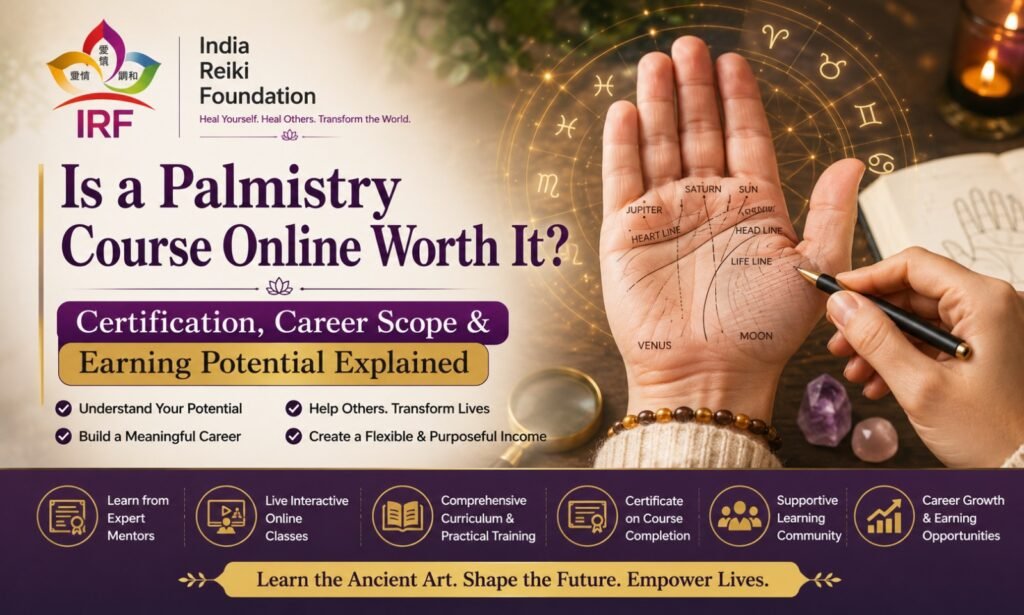
The raised areas beneath the fingers are called Mounts.
Each mount has traditional significance, and students learn how to assess their relative development while avoiding exaggerated conclusions.
Major Palm Lines
Most beginners begin by studying:
- Life Line
- Head Line
- Heart Line
- Fate Line
Instead of memorising isolated meanings, students learn how these lines interact with the overall structure of the hand.
Minor Lines
As learning progresses, additional lines are introduced.
These provide supporting information rather than replacing the major observations.
Finger Types
Professional palmistry studies finger length, shape, spacing, flexibility, and proportion.
These observations contribute significantly to understanding personality and behavioural tendencies.
How Professional Palmists Observe a Hand
One of the biggest differences between beginners and experienced practitioners is how they observe.
Beginners often search immediately for the Life Line or Fate Line.
Professionals follow a much more systematic approach.
A typical observation process includes:
Step 1
Observe the entire hand.
Step 2
Study overall proportions.
Step 3
Compare both hands.
Step 4
Observe fingers and thumb.
Step 5
Study mounts.
Step 6
Analyse major lines.
Step 7
Observe supporting features.
Step 8
Combine all observations before forming conclusions.
This structured workflow helps avoid common beginner mistakes and encourages balanced interpretation.
Skills You Build While Learning Palmistry
Learning palmistry develops practical life skills that extend beyond hand reading itself.
Observation
Students become more attentive to details that others may overlook.
Patience
Palmistry encourages careful study rather than quick conclusions.
Logical Thinking
Students learn to combine multiple observations before reaching balanced interpretations.
Communication
Explaining observations clearly and respectfully becomes an important part of the learning process.
Active Listening
Good palmistry involves understanding people as much as understanding their hands.
Listening carefully helps create meaningful conversations.
Confidence
As students practise regularly, they become more comfortable analysing hands and expressing their observations with clarity.
Why Palmistry and Reiki Complement Each Other
Although palmistry and Reiki are different disciplines, many students choose to study both because they support different aspects of holistic learning.
A Palmistry Course Online focuses on understanding personality, behavioural tendencies, and individual characteristics through careful observation of the hands.
A Reiki Course Online introduces learners to the principles of universal life energy, relaxation, mindfulness, and spiritual well-being through traditional Reiki practices.
Studying these disciplines together allows learners to develop a broader perspective on holistic wellness. While palmistry helps students understand the individual, Reiki encourages practices that promote balance and inner harmony.
At India Reiki Foundation, many learners begin with one discipline and gradually expand their knowledge through complementary courses that support lifelong learning in holistic sciences.
Preparing for Practical Learning
Learning palmistry is similar to learning a musical instrument.
Reading theory provides valuable knowledge, but true understanding develops through observation, practice, discussion, and consistent guidance.
A structured Palmistry Course Online introduces concepts gradually so that students build confidence step by step rather than feeling overwhelmed by information.
The stronger your foundation, the easier it becomes to interpret hands accurately and responsibly as you progress.
From Learning to Mastery – Your Practical Roadmap After Joining a Palmistry Course Online
Learning the fundamentals of palmistry is only the beginning. The real transformation happens when you start applying your knowledge consistently. Every experienced palmist has followed the same path—studying, observing, practising, making mistakes, and gradually building confidence through experience.
A professional Palmistry Course Online is designed to guide students beyond theory. Instead of simply remembering the meanings of palm lines, learners develop the ability to analyse the complete hand, communicate responsibly, and understand the deeper principles behind every observation.
If you’re planning to master palmistry, the following roadmap will help you understand what your learning journey should look like.
Your First 90 Days as a Palmistry Student
Learning palmistry is a step-by-step process. Dividing your journey into manageable stages makes it easier to build confidence and avoid feeling overwhelmed.
Month 1: Building Your Foundation
The first month is dedicated to understanding the language of the hands.
During this phase, your focus should be on learning:
- Basic palmistry terminology
- Different hand shapes
- Finger formations
- Thumb characteristics
- Major palm lines
- Mount locations
- Correct observation techniques
Avoid trying to interpret everything immediately. Instead, spend time becoming familiar with the structure of different hands.
A quality Palmistry Course Online teaches beginners to observe before they interpret.
Month 2: Connecting Observations
Once you’re comfortable identifying individual features, the next step is learning how they relate to one another.
Instead of analysing only the Life Line or Head Line, you’ll begin asking questions such as:
- Does the thumb support the person’s decision-making style?
- Do the fingers match the overall hand type?
- Are the mounts balanced?
- How do the major lines complement one another?
This stage helps students move from isolated observations to complete hand analysis.
Month 3: Developing Practical Confidence
The third month focuses on practice.
Students begin reading multiple hands, discussing observations with mentors, and learning how to explain their interpretations clearly and ethically.
Confidence develops through repetition rather than memorisation.
At India Reiki Foundation, students are encouraged to practise regularly under guidance so they gradually become comfortable analysing different hand structures with accuracy and responsibility.
Daily Practice Habits That Improve Palmistry Skills
Like any traditional discipline, palmistry improves through consistent practice.
Here are a few habits that experienced learners often follow.
Observe at Least One Hand Every Day
Regular observation sharpens your analytical ability.
Each new hand introduces different combinations of:
- Palm shape
- Finger proportions
- Thumb flexibility
- Mount development
- Line formations
Over time, these observations become easier to recognise naturally.
Maintain a Palmistry Journal
Keeping a learning journal is one of the most effective ways to monitor your progress.
Record details such as:
- Date
- General hand structure
- Unique observations
- Questions for your mentor
- Lessons learned
Reviewing older notes helps reinforce concepts and highlights how your understanding has evolved.
Compare Hands Rather Than Memorise Meanings
Instead of trying to remember hundreds of definitions, compare different hands and notice recurring patterns.
This practical approach strengthens your reasoning and helps you interpret the hand as a complete system.
Continue Revising the Fundamentals
Even experienced practitioners revisit the basics regularly.
Strong foundations make advanced interpretation more accurate and reliable.
Mistakes That Slow Down Every Beginner
Every learner faces challenges, but recognising common mistakes early can save time and improve progress.
Looking for Instant Answers
Palmistry is not about finding one marking that explains everything.
Professional interpretation develops by combining multiple observations patiently.
Ignoring Hand Structure
Many beginners focus immediately on palm lines while overlooking the overall hand.
Experienced practitioners always study:
- Palm shape
- Fingers
- Thumb
- Mounts
- Flexibility
before analysing individual lines.
Practising Too Little
Watching videos alone does not build practical skill.
Confidence comes from observing many different hands and discussing interpretations with experienced mentors.
Believing Every Source Online
The internet contains a mixture of authentic teachings and misinformation.
Learning from a structured Palmistry Course Online helps students understand traditional principles without confusion.
Forgetting Ethical Responsibility
Palmistry should guide people with sensitivity and respect.
Avoid making statements that create fear, false certainty, or unrealistic expectations.
Responsible communication is one of the most important qualities of a professional practitioner.
Palmistry vs Astrology vs Numerology vs Reiki
Many beginners wonder which holistic discipline they should learn first. Although these subjects complement one another, each has a unique focus.
| Discipline | Primary Focus | Best For |
|---|---|---|
| Palmistry | Hand analysis, personality traits, behavioural tendencies | Understanding human nature through observation |
| Astrology | Birth chart interpretation based on planetary positions | Exploring life themes and astrological symbolism |
| Numerology | Meaning of numbers and life path analysis | Personal insight through numerical patterns |
| Reiki | Energy healing and relaxation | Supporting emotional balance, mindfulness, and holistic well-being |
A Palmistry Course Online teaches students to understand personality through the structure of the hands, while a Reiki Course Online focuses on working with universal life-force energy to promote relaxation and inner balance.
At India Reiki Foundation, many learners choose to study both disciplines because they complement one another without overlapping. Palmistry develops observation and interpretation skills, whereas Reiki encourages energetic awareness, compassion, and personal healing.
How to Choose the Right Palmistry Course Online
With numerous courses available, selecting the right program is an important decision.
Consider these factors before enrolling.
Experienced Mentors
Learn from instructors who have practical teaching experience and can explain concepts clearly.
Structured Curriculum
The course should progress from beginner concepts to advanced interpretation in a logical sequence.
Live Interactive Classes
Learning becomes more effective when students can ask questions, participate in discussions, and receive immediate feedback.
Practical Demonstrations
Observing real hand examples helps bridge the gap between theory and application.
Continued Learning Support
Choose an institute that encourages ongoing learning instead of ending support after course completion.
Ethical Teaching Approach
Responsible education should emphasise observation, balanced interpretation, and respect for every individual.
Why Learn with India Reiki Foundation?
Choosing the right learning environment can make a significant difference in your educational journey.
At India Reiki Foundation, our goal is to preserve the authenticity of traditional spiritual sciences while making them accessible through modern online education.
Students enrolling in our Palmistry Course Online benefit from:
- Live online interactive classes
- Step-by-step beginner-friendly curriculum
- Practical demonstrations using real examples
- Guidance from experienced mentors
- Ethical approach to palmistry
- Doubt-solving sessions
- A supportive learning community
Many students also continue their journey with a Reiki Course Online, Numerology, Crystal Healing, Pendulum Dowsing, Astrology, and other holistic science programs offered by India Reiki Foundation. This integrated learning pathway allows students to expand their understanding while developing a well-rounded foundation in traditional spiritual education.
Frequently Asked Questions
Is a Palmistry Course Online suitable for complete beginners?
Yes. Most structured courses are designed for beginners and introduce concepts gradually, making them easy to understand even without prior knowledge.
How much time should I practise each week?
Regular practice is more important than long study hours. Consistent observation several times a week helps build confidence and understanding.
Can I learn palmistry alongside my job or studies?
Absolutely. Online learning offers flexibility, allowing students to learn at their own pace while balancing work, education, or family responsibilities.
Is learning Reiki necessary before studying palmistry?
No. Both disciplines can be learned independently. However, many students later choose a Reiki Course Online because it complements palmistry by introducing concepts of energy awareness and holistic well-being.
How long does it take to become confident in hand reading?
The basics can be learned within a structured course, but confidence develops through continuous observation, guided practice, and practical experience.
Does India Reiki Foundation provide live online training?
Yes. India Reiki Foundation offers live interactive online learning with mentor guidance, practical demonstrations, and ongoing student support across multiple holistic disciplines.
Conclusion
Mastering palmistry is not about memorising symbols or making bold predictions—it is about developing the ability to observe, analyse, and understand the uniqueness of every individual. A well-designed Palmistry Course Online gives you the knowledge, but consistent practice transforms that knowledge into skill.
If you’re looking for authentic training that combines traditional wisdom with practical online education, India Reiki Foundation provides a structured learning experience designed for beginners and lifelong learners alike. Along with palmistry, you can also deepen your understanding of holistic wellness through a Reiki Course Online and other complementary disciplines, allowing you to build a broader perspective on personal growth and spiritual learning.
Whether your goal is self-discovery, helping others, or simply exploring an ancient science with curiosity, the journey begins with one decision—to start learning with the right guidance and an open mind.
Start your learning journey with India Reiki Foundation and discover how authentic knowledge, consistent practice, and expert guidance can help you unlock the true potential of palmistry.
India Reiki Foundation | Online Reiki Course & Spiritual Healing Academy
Adress- 502-503, Stanford Plaza, Veera Desai Road, Andheri West, Mumbai, Maharashtra 400065, India
Phone number +91 96254 88550
Website- indiareikifoundation.com
Mail- mail@indiareikifoundation.com