

Introduction:
High-volume manufacturing is no longer defined by speed alone. In today’s industrial environment, success depends on consistency, durability, precision, and uptime. Across India, manufacturers supplying construction, infrastructure, rolling shutter systems, ceiling frameworks, and OEM components are under constant pressure to scale output without increasing rejection rates, downtime, or operating costs.
At the center of this challenge lies a critical decision the quality and capability of roll forming machinery. As production volumes rise, many factories discover that conventional or semi-industrial machines are unable to cope with continuous loads, high speeds, and tight tolerances. This is why experienced manufacturers increasingly partner with a trusted Roll Forming Machine Manufacturer in India that understands real production conditions, not just theoretical machine capacity.
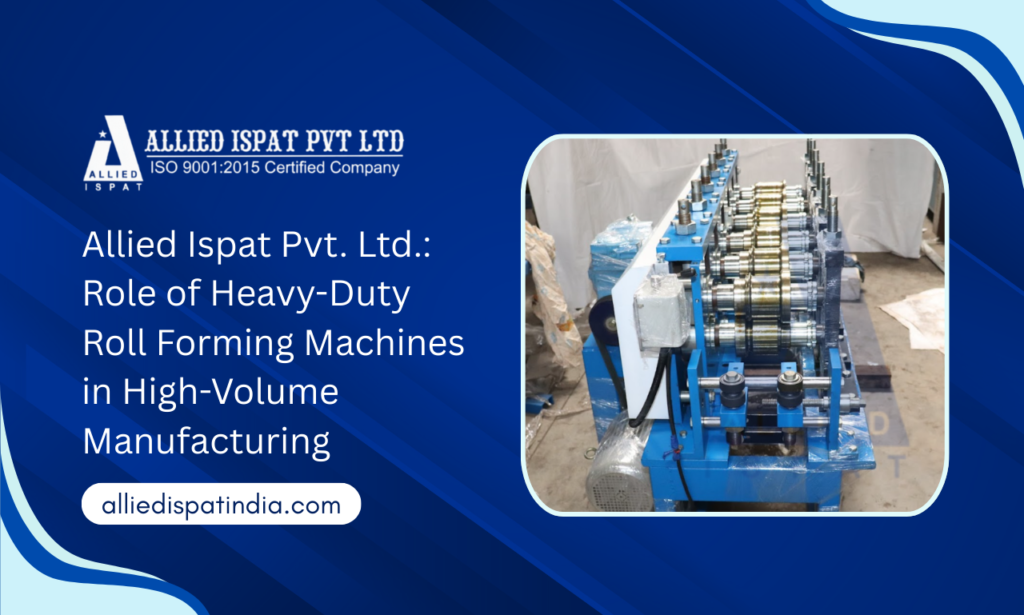
In this context, Heavy-Duty Roll Forming Machines play a decisive role. They are engineered not just to produce profiles, but to sustain long production cycles, heavy material loads, and uninterrupted operations the true demands of high-volume manufacturing. Companies such as Allied Ispat Pvt. Ltd., based in Mumbai, have built their expertise around this exact requirement: delivering machines that perform reliably in large-scale Indian manufacturing environments.
Why High-Volume Manufacturing Demands Heavy-Duty Roll Forming Machines
High-volume manufacturing environments expose machinery to extreme operational stress. Unlike short-run or job-based production, these setups require machines to operate:
- Continuously across multiple shifts
- At high speeds for extended durations
- With minimal tolerance for stoppage or deviation
- Under varying raw material quality and thickness
- With consistent output across lakhs of running meters
In such conditions, machine strength and engineering depth matter more than nominal speed ratings.
Light-duty or standard machines often perform well during initial months but gradually begin to show issues such as vibration, roll misalignment, uneven profile formation, and increasing maintenance frequency. These problems directly affect output quality, labor efficiency, and delivery schedules.
This is why Roll Forming Machines for High-Volume Manufacturing must be designed as industrial assets not workshop tools. Heavy-duty machines are built to absorb stress, maintain alignment, and deliver uniform results even as production scales.
What Is High-Volume Manufacturing & Why Equipment Strength Matters
High-volume manufacturing refers to the continuous production of standardized profiles in large quantities, usually serving regional or national markets. Typical examples include:
- Roofing and cladding sections
- Rolling shutter slats, guides, and bottom bars
- False ceiling and drywall partition channels
- Structural framing profiles
- OEM sheet metal components
In these applications, even minor deviations multiply into major losses.
Why equipment strength directly impacts outcomes:
- Rigid frames prevent deflection at high speed
- Stable roll shafts maintain profile geometry
- Heavy-duty bearings reduce vibration and wear
- Robust drives ensure torque stability under load
Weak equipment introduces variation. Strong equipment controls it.
What Truly Makes a Roll Forming Machine “Heavy-Duty”?
The term “heavy-duty” is often used loosely. In practice, a genuine heavy-duty system is defined by engineering fundamentals, not marketing labels.
1. Structural Frame & Build Quality
A true Heavy Structure Roll Forming Machine uses thick MS plates, reinforced side frames, stress-relieved welding, and precision-machined housings. This construction ensures long-term rigidity and vibration control during continuous operation.
2. Roll Tooling & Forming Accuracy
High-volume output demands roll tooling that can maintain accuracy over millions of meters. Precision-ground, hardened rolls are essential for Precision Roll Forming Technology, ensuring consistent profile dimensions and surface finish.
3. Drive System & Power Transmission
High-speed, continuous production requires oversized motors, industrial gearboxes, and efficient power transmission. These components are critical in High-Speed Roll Forming Machines, where torque stability directly affects profile quality.
4. Automation & Control Systems
An Automatic Roll Forming Machine integrates PLC control, encoder-based speed regulation, synchronized punching or cutting, and safety interlocks. Automation ensures repeatability, reduces operator dependency, and improves overall equipment efficiency.
Together, these elements define true Industrial Roll Forming Machines designed for high-volume production.
Role of Heavy-Duty Roll Forming Machines in High-Volume Production
Speed Consistency Across Long Runs
Heavy-duty machines maintain stable speed even with coil thickness variation, ensuring downstream processes remain synchronized and efficient.
Uniform Output Quality
Rigid structures and precise roll tooling deliver consistent profiles with minimal deviation, reducing rejection and rework.
Reduced Downtime & Maintenance
High-quality components extend service intervals and reduce unplanned breakdowns—critical for factories running 16–24 hours daily.
Cost Efficiency at Scale
Lower scrap rates, reduced labor intervention, and higher throughput significantly reduce cost per unit over time.
For large manufacturers, Heavy-Duty Roll Forming Machines are not a luxury they are a production necessity.
Why Standard Roll Forming Machines Fail in High-Volume Manufacturing
Many manufacturers begin with standard machines to reduce initial capital investment. However, as volumes increase, these machines reveal limitations:
- Frame vibration at higher speeds
- Rapid roll wear and frequent adjustments
- Overheating motors and gearbox failures
- Inconsistent profiles leading to customer complaints
These issues may not appear immediately but compound over time, increasing operational risk and reducing profitability.
How Allied Ispat Pvt. Ltd. Engineers Heavy-Duty Roll Forming Machines
As an experienced Roll Forming Machine Manufacturing Company, Allied Ispat Pvt. Ltd. follows a production-oriented engineering philosophy.
Engineering Approach
Machines are designed to withstand Indian manufacturing conditions power fluctuations, variable raw material quality, and long operating hours.
Custom Roll Forming Capability
Every profile has unique forming requirements. The company offers Custom Roll Forming Machines with optimized roll stages, shaft diameters, automation levels, and optional integrations.
Quality Control & Certification
ISO 9001:2015 certification ensures standardized manufacturing processes, strict inspection protocols, and consistent performance across machines.
Indian Manufacturing Advantage
With manufacturing facilities near Mumbai and Navi Mumbai, Allied Ispat Pvt. Ltd. leverages the Indian manufacturing ecosystem for faster service, easy spares availability, and lower lifecycle costs.
This integrated approach positions the company as a reliable Roll Forming Machine Supplier in India for OEMs and large-scale manufacturers.
Industries That Depend on Heavy-Duty Roll Forming Machines
Construction & Pre-Engineered Buildings
Roofing, decking, and framing profiles require consistent mechanical strength and dimensional accuracy across high volumes.
Infrastructure Development
Infrastructure projects depend on uninterrupted supply of precision-formed components, making machine uptime critical.
Rolling Shutter Manufacturing
Shutter components demand uniform thickness and straightness, best achieved using Cold Roll Forming Machines built for endurance.
Ceiling & Partition Systems
Light-gauge sections require high-speed production without distortion ideal for automated roll forming lines.
Across these sectors, Roll Forming Machines for High-Volume Manufacturing ensure supply reliability and quality consistency.
Manual vs Automatic Heavy-Duty Roll Forming Machines
| Parameter | Manual Heavy-Duty | Automatic Heavy-Duty |
|---|---|---|
| Speed Control | Operator-dependent | PLC-controlled |
| Output Consistency | Moderate | High |
| Labor Requirement | Higher | Lower |
| Downtime Risk | Medium | Low |
| Scalability | Limited | Excellent |
For manufacturers planning long-term growth, automation is no longer optional.
ROI Benefits of Investing in Heavy-Duty Roll Forming Machines
- Lower scrap and rejection rates
- Reduced maintenance frequency
- Higher output per shift
- Improved delivery reliability
- Longer machine life and asset value
Over time, these advantages far outweigh the initial investment.
Why Choose Allied Ispat as Your Roll Forming Machine Manufacturer in India
Manufacturers choose Allied Ispat Pvt. Ltd. because of:
- ISO 9001:2015 certified manufacturing
- Heavy-duty machine structures engineered for Indian factories
- Advanced Sheet Metal Roll Forming expertise
- Custom roll design capability for OEMs
- Proven experience across construction and infrastructure sectors
As a trusted Roll Forming Machine Manufacturer in India, the company supports businesses at every stage of scale.
Frequently Asked Questions (FAQs)
1. What makes a roll forming machine suitable for high-volume manufacturing?
A suitable machine must have a rigid structure, precision roll tooling, heavy-duty drives, and automation capable of continuous operation without quality loss.
2. Are heavy-duty roll forming machines cost-effective?
Yes. Reduced downtime, lower scrap, longer tool life, and higher output significantly improve ROI over time.
3. Can machines be customized for specific profiles?
Yes. Custom roll forming machines are designed based on profile geometry, material thickness, and production speed.
4. Why is automation important in roll forming?
Automation ensures consistent speed control, reduces operator error, improves safety, and supports continuous production.
5. Which industries benefit most from heavy-duty machines?
Construction, infrastructure, rolling shutters, ceiling systems, and OEM manufacturing benefit the most.
6. How does ISO certification benefit buyers?
ISO 9001:2015 certification ensures standardized quality, traceability, and reliability.
7. Is Indian manufacturing an advantage over imported machines?
Yes. Indian manufacturing offers faster service, easier spares availability, and lower lifecycle costs.
Conclusion: Building Scalable Manufacturing with Confidence
High-volume manufacturing demands machines that can perform reliably under constant pressure. Heavy-Duty Roll Forming Machines provide the strength, precision, and stability required for modern industrial production. By combining robust engineering, customization capability, and deep understanding of Indian manufacturing realities, Allied Ispat Pvt. Ltd. enables manufacturers across India to scale operations with confidence.
Ready to plan a high-volume roll forming solution?
Contact Allied Ispat India
Head Office: Allied Ispat Pvt. Ltd.
69, Chotta Sonapur, Maulana Shaukat Ali Road, Mumbai — 400008
Phone: +91 98211 77009
Manufacturing Works:
Plot No. C-17/9, MIDC Taloja, Behind Bank of Baroda, Dist. Raigad — 410208
Phone: +91 87790 51606
Get Directions: https://maps.app.goo.gl/gyEqxBGcw9jLsYm26
Email: info@alliedispatindia.com | sales@alliedispatindia.com
Website: https://alliedispatindia.com
Visit the factory. Discuss your profile. Engineer a roll forming line built for scale.

