

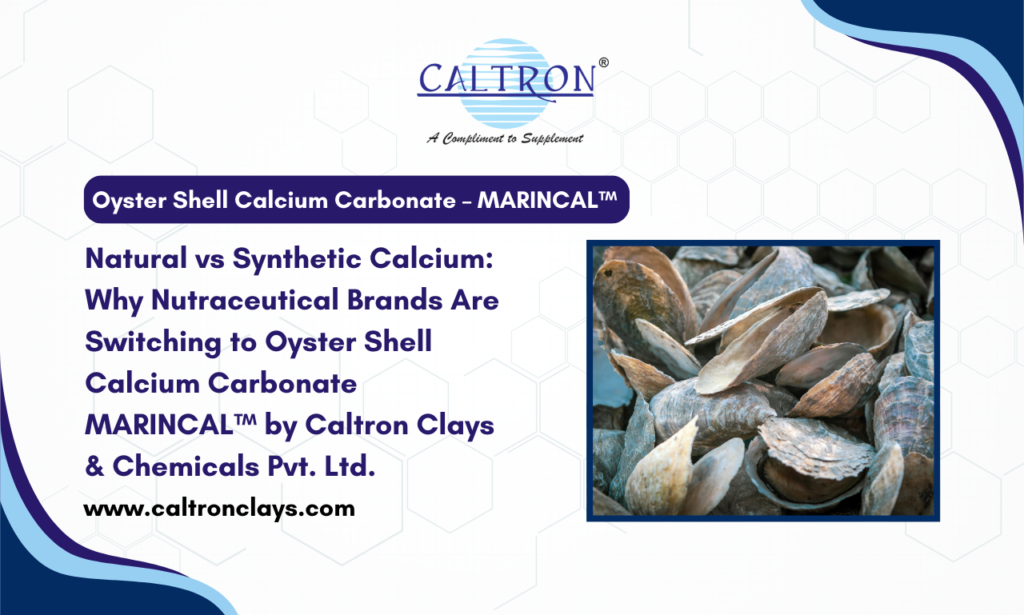
Introduction: The Calcium Debate Is No Longer About Quantity — It’s About Quality
Calcium deficiency continues to impact global populations despite decades of supplementation initiatives. From pediatric bone development concerns to post-menopausal bone density decline and geriatric fracture risks, calcium remains one of the most widely consumed yet critically evaluated minerals in modern nutrition science.
However, today’s nutraceutical landscape has evolved significantly. The key question is no longer:
“How much calcium does this supplement contain?”
Instead, it has become:
“What is the source of this calcium, and how safe, natural, and bio-compatible is it?”
For years, synthetic rock-derived calcium carbonate dominated the supplement industry due to low cost and widespread availability. But increasing scrutiny over heavy metal contamination, geological impurities, bioavailability limitations, sustainability concerns, and clean-label expectations has reshaped sourcing decisions across the pharmaceutical and nutraceutical manufacturing sectors.
This shift has led to a growing preference for marine-derived calcium — particularly Oyster Shell Calcium Carbonate Powder MARINCAL™, manufactured by Caltron Clays & Chemicals Pvt. Ltd..
Recognized as a leading Oyster Shell Calcium Carbonate Powder Manufacturer in India, Caltron supplies pharmaceutical-grade marine calcium to nutraceutical brands, contract manufacturers, and food supplement companies seeking reliable, export-compliant, heavy metal controlled calcium powder solutions.
This comprehensive B2B-focused article explores:
• The scientific differences between synthetic and marine calcium
• Regulatory and impurity concerns
• Market drivers behind the clean-label movement
• Commercial advantages of switching to natural calcium
• Why MARINCAL™ is emerging as a preferred Marine Calcium Supplier solution
The Global Calcium Market Is Under Transformation
Why Calcium Supplementation Is Still Critical
Calcium supports:
• Bone mineralization
• Muscle contraction
• Neuromuscular signaling
• Cardiovascular function
• Hormonal regulation
Despite awareness campaigns, global dietary shifts have reduced natural calcium intake due to:
• Lower dairy consumption
• Plant-based dietary transitions
• Urban processed food dependency
• Lifestyle-induced micronutrient imbalances
The global nutraceutical sector responded with tablets, capsules, effervescents, chewables, fortified beverages, and protein blends. Yet modern consumers and regulatory bodies now demand more than elemental calcium percentage.
They demand:
• Source transparency
• Heavy metal testing documentation
• Clean-label compliance
• Sustainable sourcing
• Long-term safety credibility
This is where marine-derived calcium has begun reshaping procurement strategies.
Understanding Synthetic Calcium Carbonate
Synthetic calcium carbonate is typically derived from limestone mining or chemical precipitation processes. Although chemically identical as CaCO₃, its origin, structure, and processing differ significantly from marine-derived calcium.
1. Rock-Based Mining Process
Traditional calcium carbonate originates from geological limestone deposits. The process involves:
• Mining
• Crushing
• Calcination
• Chemical purification
• Micronization
While industrially efficient, geological sources may carry trace impurities depending on deposit composition.
2. Potential Geological Impurity Risks
Even under regulated purification, rock-derived materials can contain:
• Trace heavy metals
• Environmental contaminants
• Variable mineral composition
As regulatory scrutiny increases in export markets, brands are reassessing raw material origin.
3. Bioavailability Concerns
Synthetic calcium carbonate typically contains ~40% elemental calcium. However, absorption may depend on:
• Gastric acidity
• Particle size distribution
• Co-nutrient presence (Vitamin D3, K2, magnesium)
For elderly populations with reduced stomach acid, absorption efficiency may vary.
4. Commodity Positioning Challenge
While cost-effective, synthetic calcium is increasingly viewed as a commodity ingredient. In premium nutraceutical segments, differentiation through natural sourcing is becoming a competitive advantage.
What Is Marine-Derived Oyster Shell Calcium?
Marine calcium originates from oyster shells formed through biological mineralization processes in marine ecosystems. Unlike geological limestone, oyster shells are biologically structured crystalline calcium matrices.
Key Characteristics of Marine Calcium
• Naturally formed CaCO₃ structure
• Trace magnesium presence
• Biologically layered crystalline matrix
• Marine mineral synergy
This biological origin enhances its positioning as Natural Calcium for Nutraceuticals.
Natural vs Synthetic Calcium: Strategic B2B Comparison
From a formulation, compliance, and branding perspective, the difference extends beyond chemistry.
Source Origin
Synthetic calcium → Mined rock or chemical precipitation
Marine calcium → Oyster shells formed via marine biomineralization
Processing Intensity
Synthetic calcium → Heavy industrial calcination and chemical treatment
Marine calcium → Controlled purification and micronization
Impurity Perception
Rock-derived calcium → Geological deposit variability
Marine calcium → Heavy metal controlled calcium powder under strict testing
Brand Positioning
Synthetic → Commodity supplement segment
Marine → Premium clean-label nutraceutical positioning
Consumer Appeal
Synthetic → Technical ingredient
Marine → Natural, sustainable, marine-sourced mineral
Long-Term Market Value
Synthetic → Cost-driven purchasing
Marine → Value-driven differentiation
Why Nutraceutical Brands Are Switching to MARINCAL™
1. Clean-Label Movement
Consumers prefer recognizable natural sources. “Marine calcium” resonates more positively than “calcium carbonate.”
2. Regulatory Pressure
Export markets increasingly require:
• Heavy metal testing reports
• GMP-compliant manufacturing
• Batch traceability documentation
As a trusted Oyster Shell Calcium Carbonate Powder Supplier in India, Caltron supports international regulatory expectations.
3. Premium Product Positioning
Marine calcium enables brands to:
• Command higher margins
• Differentiate in crowded supplement markets
• Align with sustainability narratives
4. Natural Mineral Synergy
Marine calcium contains trace minerals such as magnesium, enhancing formulation storytelling without making exaggerated claims.
5. Long-Term Safety Perception
Natural sourcing strengthens consumer trust for lifelong supplementation products.
Oysto Teratta vs Meta-Calciota: Strategic Raw Material Options
Marine calcium production may utilize different oyster shell species.
Oysto Teratta
• Higher CaCO₃ assay
• Fibrous flaky structure
• Approx. 1.5% natural magnesium
• Premium grade
• Limited availability
Ideal for high-end tablet and capsule formulations.
Meta-Calciota
• More abundant
• Economical sourcing
• Slightly lower assay
• Suitable for cost-sensitive formulations
Caltron Clays & Chemicals Pvt. Ltd. ensures stable global sourcing, positioning itself as a reliable Oyster Shell Calcium Powder Bulk Supplier for consistent supply.
MARINCAL™ Applications Across Industries
MARINCAL™ is engineered for diverse dosage formats:
Tablets
Optimized compressibility and uniform particle size.
Capsules
Compatible with gelatin and vegetarian capsules.
Softgels
Blended with Vitamin D3 & K2 systems.
Pediatric Suspensions
Used in liquid calcium formulations.
Chewables
Ideal for flavored nutraceutical supplements.
Functional Foods
Fortified beverages, protein powders, nutrition blends.
Cosmetic Formulations
Mineral-enriched skincare and personal care systems.
As a leading Oyster Shell Calcium Carbonate Powder Manufacturer in India, Caltron supports high-volume pharmaceutical and nutraceutical manufacturing globally.
Quality & Purification Standards Behind MARINCAL™
The MARINCAL™ production process includes:
• Careful raw shell selection
• Multi-stage cleaning
• Controlled thermal treatment
• Precision micronization
• Pharmaceutical grade heavy metal testing
• Batch-level documentation
Caltron Clays & Chemicals Pvt. Ltd. operates as a pharmaceutical-grade marine calcium specialist, ensuring export-grade compliance and scalable production.
The Future of Marine Calcium (2026 and Beyond)
Market indicators suggest continued growth in:
• Clean-label supplements
• Aging population-driven calcium demand
• Premium nutraceutical categories
• Regulatory impurity audits
• Sustainable sourcing mandates
Marine-derived calcium is no longer a niche alternative — it represents a structural evolution in raw material sourcing.
Brands investing today in marine calcium solutions like MARINCAL™ are future-proofing their formulation strategy.
Frequently Asked Questions
Is oyster shell calcium better than synthetic calcium?
Oyster shell calcium is marine-derived and contains trace minerals. Many nutraceutical brands prefer it for clean-label positioning and premium differentiation.
Is marine calcium suitable for long-term supplementation?
Pharmaceutical-grade marine calcium processed under strict quality control is widely used in long-term formulations.
What industries use oyster shell calcium carbonate?
It is used in nutraceutical manufacturing, pharmaceutical raw materials, functional foods, and cosmetic applications.
Is MARINCAL™ suitable for tablets and capsules?
Yes. MARINCAL™ is engineered for compression, encapsulation, suspension, and chewable formats.
Conclusion: A Strategic Shift Toward Marine Calcium
The debate between synthetic and natural calcium has moved beyond elemental percentages. Today, sourcing integrity, impurity control, regulatory compliance, and clean-label positioning determine long-term brand success.
Oyster Shell Calcium Carbonate Powder MARINCAL™ offers:
• Pharmaceutical-grade purity
• Heavy metal controlled calcium powder profile
• Bulk manufacturing scalability
• Export documentation support
• Premium brand differentiation
As a recognized Marine Calcium Supplier and Oyster Shell Calcium Carbonate Powder Manufacturer in India, Caltron Clays & Chemicals Pvt. Ltd. empowers nutraceutical brands with compliant, scalable, and future-ready marine calcium solutions.
For bulk supply, export inquiries, or technical specifications of MARINCAL™, connect with:
Natural sourcing. Pharmaceutical precision. Marine mineral excellence.
Connect with Caltron Clays & Chemicals Pvt. Ltd.
Website: https://caltronclays.com
Office: Office №211, 2nd Floor, Orbit Premises, Next to Sheetal Banquets, Opp. Inox Plaza, Mindspace, Off New Link Road, Chincholi Bunder, Malad West, Mumbai, Maharashtra 400064, India
Email: marketing@caltronclays.com | sales@caltronclays.com
Call: +91 70214 37453 / +91 22 2876 4864 / +91 22 3571 9844
Google Maps: https://maps.app.goo.gl/jCuz1ZCf1iAhzZiH7

