

Introduction: Why Egg Shell Membrane Is Creating New Possibilities in Skincare Formulation
The search for differentiated cosmetic ingredients is reshaping modern skincare development. Cosmetic manufacturers and R&D teams are increasingly evaluating raw materials not only for their individual functions, but also for their natural origin, composition, versatility, formulation compatibility and potential to support premium product concepts.
Egg shell membrane is gaining attention within this evolving ingredient landscape.
Hidden beneath the hard outer shell of a hen egg is a thin biological membrane with a composition that is fundamentally different from the mineral-rich eggshell. This naturally occurring membrane contains components including Collagen Types I, V and X, elastin, hyaluronic acid and essential amino acids.
This combination makes egg shell membrane an interesting raw material for cosmetic formulations designed around firmness, elasticity, hydration, skin conditioning and visible signs of aging.
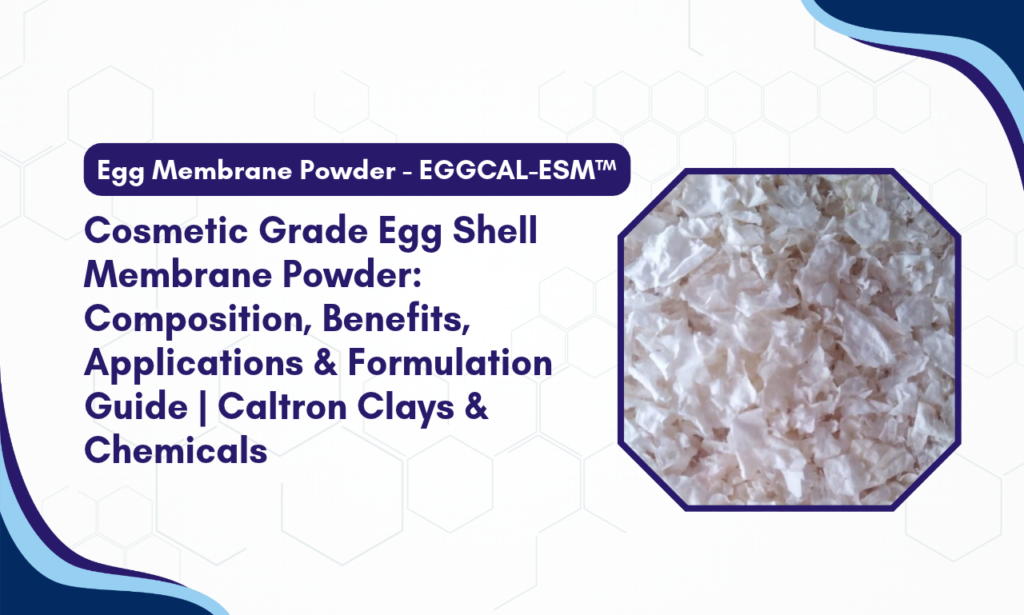
Cosmetic Grade Egg Membrane Powder provides formulators with an opportunity to explore this naturally derived material in specialized skincare development. EGGCAL-ESM™ from Caltron Clays & Chemicals is a premium cosmetic-grade Egg Shell Membrane derived from the natural inner membrane of hen eggshells.
For companies looking for an Egg Membrane Powder Manufacturer in India, however, ingredient selection should go beyond the natural-origin story. Commercial buyers need to consider quality consistency, ingredient identity, physical characteristics, microbiological quality, documentation, formulation compatibility and dependable supply.
This comprehensive guide explores what egg shell membrane powder is, what makes its composition distinctive, where it can be used, what formulators should evaluate and how B2B buyers can approach supplier selection.
Egg Shell Membrane Powder: Understanding the Ingredient Behind the Innovation
Egg shell membrane is the thin biological layer found on the inner side of a hen eggshell. It lies between the hard shell and the contents of the egg.
Although it is closely associated with the eggshell, the membrane and the shell are not the same material.
The hard eggshell is primarily mineral-based, while the membrane is an organic biological structure containing naturally occurring proteins and other components.
This difference is particularly relevant when selecting Cosmetic Raw Material Manufacturer in India
Eggshell Powder vs Egg Membrane Powder
A simple distinction can help manufacturers understand the categories:
Eggshell powder is primarily associated with the mineral structure of the shell.
Egg membrane powder is associated with the biological membrane and its naturally occurring components.
Therefore, these materials should not be considered interchangeable simply because they originate from the same egg.
EGGCAL-ESM™ is specifically derived from the natural inner membrane of hen eggshells and is positioned as a cosmetic-grade ingredient for formulation development.
For professional procurement teams, cosmetic-grade material should be evaluated through suitable quality and technical criteria, including identity, purity, physical properties, microbiological quality, batch consistency and supporting documentation.
What Makes Egg Membrane a Distinctive Cosmetic Raw Material?
Modern cosmetic development increasingly favors ingredients with a meaningful technical story.
Formulators may look for raw materials that combine:
- Natural origin
- Distinctive composition
- Multifunctional potential
- Formulation flexibility
- Product differentiation
- Consistent quality
- Traceable sourcing
Egg membrane fits this direction because of its naturally occurring combination of collagen, elastin, hyaluronic acid and amino acids.
Rather than viewing it as a single-purpose ingredient, cosmetic R&D teams can investigate how it fits into broader formulation strategies.
For example, a premium facial serum may be designed around hydration, firmness, elasticity and conditioning. Egg membrane can be evaluated as one component within such a system, alongside other suitable cosmetic ingredients.
The important point is that ingredient potential and finished-product performance are not the same. The final cosmetic result depends on the complete formulation, processing conditions, ingredient interactions, packaging and appropriate testing.
Inside the Natural Composition of Egg Shell Membrane
The composition of egg shell membrane is one of its most interesting characteristics for cosmetic R&D.
EGGCAL-ESM™ is naturally rich in:
- Collagen Types I, V and X
- Elastin
- Hyaluronic acid
- Essential amino acids
Each component contributes to the ingredient’s overall formulation story.
Collagen Types I, V and X: A Formulation-Relevant Protein Profile
Collagen is widely associated with the structural characteristics of skin and frequently appears in discussions surrounding firmness, elasticity and age-focused skincare.
The presence of Collagen Types I, V and X in EGGCAL-ESM™ makes the ingredient relevant to cosmetic concepts focused on the appearance of:
- Firmness
- Elasticity
- Mature-looking skin
- Visible signs of aging
- Skin vitality
However, formulators should distinguish between the natural composition of a raw material and a claim about a finished cosmetic.
The presence of collagen does not automatically establish a specific consumer outcome. Finished products should be evaluated through appropriate formulation and performance testing.
Elastin: Supporting Firming and Elasticity Concepts
Elastin is another naturally occurring component of egg shell membrane.
Because elasticity is a key consideration in firming and age-focused skincare, elastin adds to the ingredient’s relevance for these product categories.
Egg membrane may therefore be investigated in formulations such as:
- Firming serums
- Facial creams
- Targeted treatments
- Premium skincare
- Mature-skin products
Its role should be evaluated within the complete formulation rather than treated as an isolated function.
Hyaluronic Acid: Connecting Egg Membrane With Hydration
Hyaluronic acid is strongly associated with hydration-focused skincare.
Its natural presence within egg shell membrane contributes to the ingredient’s broader multifunctional composition.
This makes egg membrane interesting for formulations where hydration is combined with other cosmetic objectives such as:
- Skin conditioning
- Firmness
- Elasticity
- Age-focused care
- Skin comfort
Formulators should consider its behavior alongside the complete humectant, emollient and conditioning system.
Essential Amino Acids: Completing the Natural Profile
Egg shell membrane also contains essential amino acids and other naturally occurring components.
For R&D teams, these contribute to the ingredient’s broader biological profile.
The combination of multiple naturally occurring components makes egg membrane different from a conventional single-component cosmetic raw material and gives manufacturers another ingredient platform to investigate.
Cosmetic Benefits of Egg Shell Membrane Powder
The potential benefits of egg membrane are best considered according to the cosmetic objectives of the formulation.
1. An Interesting Ingredient for Age-Focused Skincare
Age-focused skincare often combines ingredients selected for hydration, conditioning, firmness and the appearance of mature skin.
Because egg membrane is naturally associated with collagen and elastin, it can be evaluated in:
- Anti-aging creams
- Facial serums
- Firming treatments
- Premium skincare
- Specialized facial products
Finished-product claims should always be based on appropriate evidence.
2. Supporting Firmness-Oriented Formulation Concepts
Firmness is an important objective for many premium skincare products.
The collagen- and elastin-associated composition of egg membrane gives formulators a reason to investigate it within firming formulations.
It can be combined with suitable moisturizing and conditioning ingredients as part of a broader formulation strategy.
3. Supporting Elasticity-Focused Skincare
Elasticity is closely related to the development of firming and mature-skin product concepts.
Egg membrane can be explored in formulations designed around the appearance of elasticity and skin suppleness.
Potential formats include serums, creams and specialized facial treatments.
4. Hydration-Focused Formulation Potential
Hydration is fundamental to modern facial skincare.
The naturally occurring hyaluronic acid associated with egg membrane makes it relevant to products where hydration is an important formulation objective.
Possible formats include:
- Hydrating serums
- Moisturizers
- Facial creams
- Masks
- Specialized treatments
The final hydration performance depends on the complete formulation system.
5. Skin-Conditioning and Barrier-Supportive Concepts
Skin conditioning and barrier-focused skincare are increasingly important in cosmetic product development.
Egg membrane can be investigated in formulations designed around hydration, conditioning and barrier-supportive cosmetic positioning.
Such positioning should remain within appropriate cosmetic boundaries and should not imply treatment of a medical condition.
6. A Multi-Component Ingredient for Product Differentiation
The combination of collagen, elastin, hyaluronic acid and amino acids gives egg membrane a distinctive ingredient story.
This can be useful for brands seeking differentiated formulations that combine:
Natural Origin + Multifunctional Composition + Premium Skincare Positioning
Cosmetic Applications of Egg Membrane Powder
A raw material’s commercial potential becomes more apparent when its potential use across different product formats is considered.
Cosmetic Grade Egg Membrane Powder can be explored across multiple skincare applications, subject to appropriate formulation compatibility and performance testing.
Anti-Aging Creams: Building Comprehensive Facial-Care Concepts
Anti-aging creams frequently combine moisturization, conditioning and ingredients selected for mature-skin care.
Egg membrane can be evaluated in these systems because of its naturally occurring collagen, elastin and hyaluronic acid profile.
During development, formulators should examine compatibility with:
- Emulsifiers
- Preservatives
- Oil and water phases
- Texture modifiers
- Other cosmetic actives
The finished product should be assessed for stability, appearance, sensory properties and overall performance.
Firming Serums: Lightweight Formats for Premium Skincare
Serums provide an attractive format for brands developing concentrated skincare concepts.
Egg membrane can be investigated in serum systems designed around firmness, elasticity and hydration.
Because serum formulations can be sensitive to physical changes, manufacturers should assess:
- Powder dispersion
- Incorporation method
- Viscosity
- Texture
- Sensory profile
- Stability
The most suitable processing method should be established through formulation trials.
Under-Eye Treatments: Specialized Formulation Requirements
The under-eye area requires careful formulation because products are intended for use around delicate skin.
Egg membrane can be explored in:
- Eye creams
- Eye gels
- Targeted treatments
- Hydration-focused eye products
Manufacturers should pay particular attention to formulation compatibility, preservation, sensory characteristics and suitability for the intended application.
Repair-Oriented Creams: Conditioning and Comfort
Egg membrane may be investigated in richer cream formulations designed around moisturization, conditioning and barrier-supportive cosmetic positioning.
These concepts can be relevant to specialized facial-care ranges.
However, terminology such as “repair” should be used carefully so that it refers to cosmetic conditioning or appearance rather than medical treatment.
Hydrating Skincare: Beyond Basic Moisturization
Modern hydration products frequently combine moisturization with additional cosmetic objectives.
Egg membrane can be evaluated in:
- Hydrating serums
- Facial moisturizers
- Skin-conditioning creams
- Hydration masks
- Specialized facial treatments
Its naturally occurring composition can complement other humectants, emollients and conditioning ingredients.
Facial Masks: An Opportunity for Differentiated Product Concepts
Facial masks provide brands with flexibility to develop specialized ingredient combinations.
Egg membrane can be explored in different mask formats depending on the desired texture, application method and formulation objective.
For premium brands, its distinctive natural origin may also contribute to an interesting ingredient story.
Why Egg Membrane Aligns With Emerging Cosmetic Ingredient Trends
The growing interest in egg membrane is not occurring in isolation. It reflects several broader shifts within the cosmetic industry.
Naturally Derived Ingredients With a Stronger Technical Story
Natural-origin ingredients continue to attract attention, but manufacturers are becoming more sophisticated in how they evaluate them.
Professional buyers increasingly consider:
- Identity
- Purity
- Consistency
- Traceability
- Formulation behavior
- Documentation
- Quality systems
Egg membrane provides a combination of natural origin and distinctive composition that can be evaluated against these criteria.
Bio-Based Beauty
The movement toward bio-based cosmetic development is encouraging R&D teams to explore naturally occurring biological materials.
Egg membrane is an example of a biological-origin ingredient that offers a different route to ingredient innovation.
Multifunctional Skincare
Modern products often target multiple cosmetic objectives within a single formulation.
For example:
Hydration + Firmness + Elasticity + Conditioning
Egg membrane’s multi-component profile makes it relevant to this formulation philosophy.
Premium and Differentiated Formulations
Premium brands often seek unusual ingredients that can help distinguish a product from conventional formulations.
Egg membrane offers an interesting combination of natural origin and composition that can contribute to differentiated skincare development.
Formulation Guide: What Should R&D Teams Check?
Selecting Cosmetic Grade Egg Membrane Powder is only the beginning.
The ingredient should be assessed from laboratory development through pilot-scale production.
Ingredient Compatibility
Formulators should investigate compatibility with:
- Emulsifiers
- Preservatives
- Humectants
- Emollients
- Surfactants
- Botanical extracts
- Cosmetic actives
- Film-formers
- Conditioning agents
Laboratory trials can help identify potential changes in appearance, texture, viscosity or stability.
Powder Dispersion and Incorporation
As a powdered ingredient, egg membrane should be evaluated for how effectively it can be incorporated into the selected formula.
Important considerations include:
- Dispersion
- Agglomeration
- Mixing efficiency
- Uniformity
- Addition sequence
The best incorporation method may differ between creams, serums, masks and other product formats.
Solubility and Dispersibility
Manufacturers should establish how the powder behaves in the selected formulation system.
Complete solubility should not be assumed.
The appropriate method should be determined through laboratory trials and supplier technical guidance.
pH Compatibility
The finished product’s pH should be considered during formulation development.
Rather than using an assumed generic range, manufacturers should establish suitable conditions through compatibility and stability studies.
Processing Conditions
Mixing and processing conditions should be evaluated during laboratory and pilot-scale trials.
Commercial manufacturing parameters should be finalized only after appropriate formulation testing.
Preservation and Microbiological Control
Because egg membrane is a biological-origin material, microbiological quality requires appropriate attention.
The preservation system should be evaluated based on the complete finished formulation.
Formula Stability
Depending on the product, stability studies may evaluate:
- Appearance
- Colour
- Odour
- Texture
- pH
- Viscosity
- Dispersion
- Phase stability
- Microbiological quality
The exact protocol should depend on the product type and target market.
Sensory Evaluation
Technical stability alone does not guarantee commercial success.
Manufacturers should also evaluate:
- Texture
- Spreadability
- Skin feel
- Odour
- Appearance
Packaging Compatibility
The finished formulation should be evaluated with the intended packaging system.
This can help identify potential interactions between the formula and packaging components.
Quality Checklist for Buying Egg Membrane Powder
For B2B procurement teams, selecting the right raw material requires systematic evaluation.
Identity
Confirm that the material corresponds to the intended egg shell membrane ingredient.
Purity
Review the supplier’s current specification and establish suitable requirements for the intended application.
Appearance
Evaluate colour, texture and physical appearance against the agreed specification.
Particle Characteristics
Confirm that the physical characteristics are suitable for the formulation and processing method.
Moisture
Review moisture information because it may influence handling, storage and microbiological considerations.
Microbiological Quality
Appropriate microbiological information is particularly important for biological-origin cosmetic ingredients.
Heavy Metals and Relevant Contaminants
Depending on the target market and internal requirements, manufacturers may evaluate relevant contaminants.
Batch Consistency
Commercial production depends on repeatable raw-material characteristics.
Traceability
Source and batch information can support internal quality systems and supply-chain management.
Technical Documentation
Depending on the product and market, buyers may request:
- Product Specification Sheet
- Certificate of Analysis
- Technical Data
- Microbiological Information
- Safety Documentation, where applicable
- Batch-related quality information
The required documentation should be confirmed with the supplier.
How to Select an Egg Membrane Powder Manufacturer in India
Choosing an Egg Membrane Powder Manufacturer in India is a strategic B2B sourcing decision.
A manufacturer should be evaluated based on the systems supporting the ingredient—not simply the ingredient itself.
Manufacturing Capability
Assess the manufacturer’s processing and quality-control capabilities.
Raw-Material Control
Understand how the source material is obtained, controlled and processed.
Quality Systems
Review testing procedures and batch-release controls.
Batch Consistency
Determine how the manufacturer maintains consistency between production batches.
Technical Documentation
Review product specifications and relevant technical information.
Technical Support
Consider the supplier’s ability to support ingredient evaluation and formulation discussions.
Packaging
Ensure that packaging is appropriate for storage, handling and transportation.
Commercial Supply
Assess the ability to support ongoing procurement requirements.
Documentation for Target Markets
Discuss market-specific documentation requirements where applicable.
Long-Term Partnership
The strongest supplier relationships should support both R&D development and commercial manufacturing.
How to Choose an Egg Membrane Powder Supplier in India
An Egg Membrane Powder Supplier in India should be evaluated as a potential long-term sourcing partner.
B2B buyers should look for:
Consistent Raw-Material Quality
The product should maintain agreed characteristics across batches.
Transparent Documentation
R&D and quality teams should have access to appropriate product and batch information.
Reliable Supply Capability
The supplier should be able to support recurring commercial requirements.
Technical Communication
Clear communication is particularly valuable when working with a specialized ingredient.
Suitable Packaging
Packaging should align with storage and handling requirements.
Commercial Coordination
Efficient coordination can simplify procurement planning.
Export Support Where Applicable
Businesses supplying international markets should discuss applicable documentation and commercial requirements directly with the supplier.
The goal should be to build a relationship that supports quality, formulation development and long-term sourcing.
EGGCAL-ESM™ by Caltron Clays & Chemicals: Natural Composition for Modern Skincare
A Specialized Egg Shell Membrane Ingredient for Cosmetic R&D
EGGCAL-ESM™ is a premium cosmetic-grade Egg Shell Membrane derived from the natural inner membrane of hen eggshells.
Its naturally occurring composition includes:
Collagen Types I, V & X
Elastin
Hyaluronic Acid
Essential Amino Acids
This composition makes EGGCAL-ESM™ relevant to cosmetic development concepts focused on:
- Firmness
- Elasticity
- Hydration
- Visible signs of aging
- Skin conditioning
- Specialized facial care
Potential Application Areas
Firming Serums
For formulations developed around firmness and elasticity.
Anti-Aging Skincare
For products designed around visible signs of aging and mature-skin care.
Under-Eye Treatments
For specialized hydration and conditioning concepts.
Repair-Oriented Creams
For cosmetic moisturization, conditioning and barrier-supportive positioning.
Hydrating Formulations
For creams, serums, masks and facial treatments.
Premium Facial Care
For brands exploring differentiated naturally derived ingredients.
As a Cosmetic Raw Material Manufacturer in India, Caltron Clays & Chemicals provides specialized raw-material solutions for cosmetic and pharmaceutical applications.
For businesses searching for a Cosmetic Raw Material Supplier in India, factors such as ingredient quality, consistency, technical information, documentation, formulation suitability and commercial support should remain central to supplier evaluation.
Who Can Explore Egg Membrane Powder?
Egg membrane powder can be relevant to several B2B stakeholders.
Skincare Manufacturers
Established manufacturers can investigate the ingredient for anti-aging, firming, hydration and specialized facial-care formulations.
Cosmetic Brands
Brands can explore it when developing differentiated premium skincare concepts.
Contract Manufacturers
Contract manufacturers can evaluate it for clients seeking specialized skincare formulations.
Private-Label Manufacturers
Private-label companies can investigate it for differentiated cosmetic product ranges.
Cosmetic R&D Teams
R&D professionals can assess the ingredient during screening, formulation trials, compatibility testing and stability studies.
Cosmetic Formulators
Formulators can investigate its behavior across different bases and supporting ingredients.
Ingredient Distributors
Distributors can consider it as a specialized addition to their cosmetic raw-material portfolios.
Personal-Care Developers
Product-development teams can explore the ingredient where natural-origin positioning and multifunctional formulation are important.
Frequently Asked Questions About Egg Membrane Powder
1. What is Egg Membrane Powder?
Egg Membrane Powder is derived from the natural inner membrane of hen eggshells and is naturally associated with collagen, elastin, hyaluronic acid and amino acids. Caltron Clays & Chemicals offers EGGCAL-ESM™ for cosmetic formulation applications.
2. What is Egg Membrane Powder used for in cosmetics?
It can be evaluated in anti-aging, firming, hydrating, under-eye and specialized skincare formulations. Caltron Clays & Chemicals’ EGGCAL-ESM™ is developed as a cosmetic-grade raw material for these applications.
3. What does Egg Shell Membrane naturally contain?
Egg Shell Membrane is naturally associated with Collagen Types I, V and X, elastin, hyaluronic acid and essential amino acids. Caltron Clays & Chemicals offers EGGCAL-ESM™ based on this naturally occurring composition.
4. Is Egg Membrane Powder suitable for anti-aging skincare?
It can be considered for formulations focused on visible signs of aging, firmness and elasticity. Caltron Clays & Chemicals’ EGGCAL-ESM™ can be evaluated in specialized anti-aging skincare concepts.
5. Can Egg Membrane Powder be used in creams and serums?
Yes. Manufacturers can evaluate it in firming serums, anti-aging creams, hydrating products and specialized treatments. Caltron Clays & Chemicals provides EGGCAL-ESM™ for cosmetic formulation development.
6. What are the cosmetic benefits of Egg Shell Membrane?
Its naturally occurring composition makes it relevant to formulations focused on firmness, elasticity, hydration and skin conditioning. Caltron Clays & Chemicals’ EGGCAL-ESM™ is developed for cosmetic application evaluation.
7. How do I choose an Egg Membrane Powder Manufacturer in India?
Evaluate manufacturing capabilities, quality systems, batch consistency, documentation, technical support and supply reliability. Caltron Clays & Chemicals offers EGGCAL-ESM™ for cosmetic manufacturers and formulators.
8. How do I choose an Egg Membrane Powder Supplier in India?
B2B buyers should assess specifications, documentation, consistency, technical support, packaging and supply capabilities. Caltron Clays & Chemicals supports businesses seeking specialized egg membrane raw materials.
9. Is Egg Membrane Powder suitable for premium skincare?
It can be explored for premium skincare because of its distinctive natural origin and multi-component composition. Caltron Clays & Chemicals offers EGGCAL-ESM™ for specialized cosmetic formulation development.
10. What is EGGCAL-ESM™?
EGGCAL-ESM™ is a premium cosmetic-grade Egg Shell Membrane derived from the natural inner membrane of hen eggshells. Caltron Clays & Chemicals offers it for firming, anti-aging, hydration and specialized skincare formulation concepts.
Conclusion: Exploring a Distinctive Ingredient for Next-Generation Skincare
The evolution of cosmetic formulation is creating new opportunities for ingredients that combine natural origin, distinctive composition and multifunctional potential. Egg shell membrane is an interesting ingredient category for manufacturers looking to explore new possibilities in specialized skincare.
Its naturally occurring association with Collagen Types I, V and X, elastin, hyaluronic acid and essential amino acids gives formulators a distinctive ingredient profile to investigate across firmness, elasticity, hydration, conditioning and age-focused formulations.
But the strongest formulation decisions are based on more than ingredient storytelling.
Before commercial adoption, manufacturers should evaluate identity, purity, physical characteristics, microbiological quality, batch consistency, traceability, technical documentation, formulation compatibility and stability.
Explore EGGCAL-ESM™ for Your Next Formulation
EGGCAL-ESM™ by Caltron Clays & Chemicals brings naturally derived egg shell membrane into modern cosmetic formulation development.
It can be explored across:
Firming Serums | Anti-Aging Creams | Under-Eye Treatments | Hydrating Skincare | Repair-Oriented Creams | Specialized Facial Care
As an Egg Membrane Powder Manufacturer in India and Egg Membrane Powder Supplier in India, Caltron Clays & Chemicals supports cosmetic manufacturers, formulators, R&D teams, brands and product developers seeking specialized cosmetic raw-material solutions.
Looking for a Distinctive Ingredient for Your Next Skincare Concept?
Explore EGGCAL-ESM™ by Caltron Clays & Chemicals and evaluate the potential of natural egg shell membrane for your cosmetic formulation development.
Caltron Clays & Chemicals Pvt Ltd
Address: Suite# 1901-1904, Level-19, 9 Business Bay, Off Link Road, Mindspace, Malad West, Mumbai 400064
Phone No.: 022 3571 9844 | +91 70214 37453 | +91 22 2876 4864
Website: https://caltronclays.com
Email: marketing@caltronclays.com | sales@caltronclays.com
Google Maps: https://maps.app.goo.gl/n2TeYQcnXnS4aMio9

