

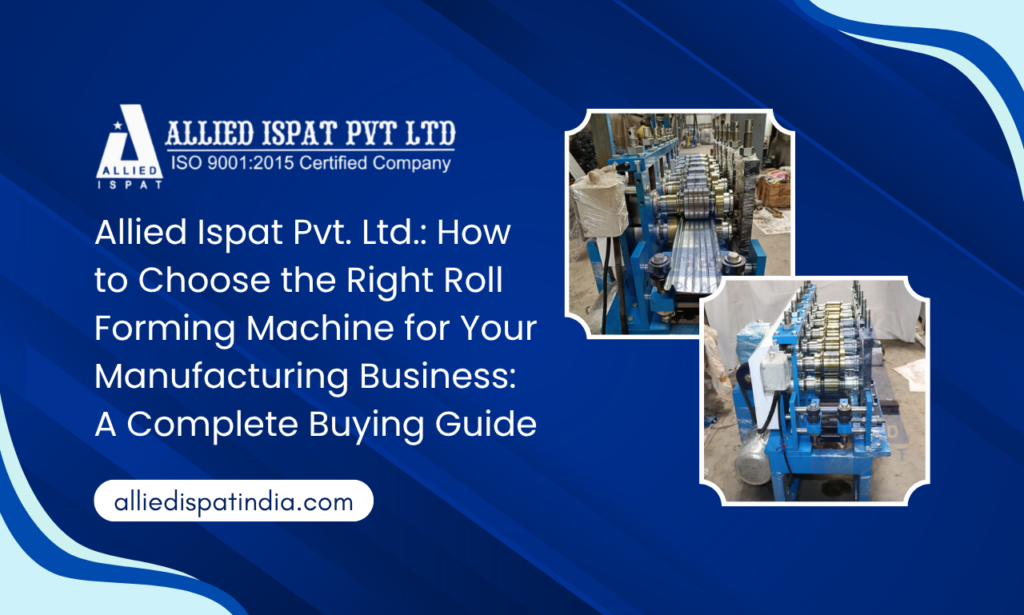
Introduction
Manufacturing efficiency depends on selecting equipment that can consistently produce the required products without creating unnecessary operational expenses. For businesses involved in steel fabrication, rolling shutter manufacturing, false ceiling profiles, and industrial metal components, a roll forming machine is an important part of the production process. Choosing the right equipment can improve manufacturing consistency, support better material utilization, and help businesses respond to changing market demands.
However, buying industrial machinery requires more than comparing technical brochures and purchase prices. Manufacturers must consider steel thickness, material strength, profile dimensions, automation capabilities, production speed, tooling accuracy, and long-term maintenance requirements. A machine that performs well for one application may not be suitable for another.
Working with a reliable Roll Forming Machine Manufacturer in India helps businesses understand these technical differences and identify machinery that matches their manufacturing requirements. A properly designed Cold Roll Forming Machine can support continuous metal profile production while maintaining dimensional accuracy and operational efficiency.
Allied Ispat Pvt. Ltd., part of the Malik Group of Companies, offers industrial roll forming machinery for different metal fabrication applications. Businesses searching for a Roll Forming Machine Manufacturer in Mumbai can explore its machinery solutions for manufacturing steel profiles and construction-related components.
This guide explains the essential considerations for selecting a roll forming machine, comparing available configurations, understanding machinery costs, and evaluating long-term investment value.
What Is a Roll Forming Machine and How Does It Work?
A roll forming machine is industrial equipment that transforms flat metal strips into finished profiles through a sequence of forming rollers. Instead of bending the material into its final shape in one operation, the machine gradually changes its geometry as the strip moves through multiple roller stations. This progressive forming method is commonly used to manufacture metal channels, shutter sections, framing profiles, and other components that require repeatable cross-sectional shapes.
A Cold Roll Forming Machine generally operates at room temperature, using controlled mechanical pressure to shape the metal without intentionally heating it. The process is particularly useful for continuous production of long metal sections with consistent profiles.
How the Roll Forming Process Works
- Coil Loading: A suitable metal coil is placed on a decoiler or feeding arrangement.
- Strip Feeding: The material enters the machine through guides that help maintain alignment.
- Progressive Bending: A series of roller stations gradually forms the required cross-sectional shape.
- Profile Control: Tooling geometry and alignment help maintain the intended profile dimensions.
- Length Cutting: A suitable cutting mechanism separates the formed sections into specified lengths.
- Product Inspection: Finished profiles are checked for dimensions, surface condition, and general quality.
The process can support repeatable manufacturing, particularly where businesses need to produce the same steel section in large quantities. Actual output depends on the machine design, profile complexity, material properties, and operating conditions.
Allied Ispat Pvt. Ltd., a Roll Forming Machine Supplier in India, offers machinery configurations for businesses manufacturing different steel profiles and industrial components.
Why Is Choosing the Right Roll Forming Machine Important for Manufacturers?
Selecting the right machinery has a direct influence on production quality, operating efficiency, and manufacturing costs. A machine that is not compatible with the intended steel thickness or profile design may require frequent adjustments, produce inconsistent dimensions, or create avoidable material waste. These issues can affect delivery schedules and increase the overall cost of production.
An experienced Roll Forming Machine Manufacturer in India can help manufacturers evaluate equipment according to the products they intend to produce, rather than relying on general performance claims.
Benefits of Selecting the Right Machinery
- Dimensional Consistency: Properly designed forming rollers help maintain uniform profile geometry.
- Efficient Material Usage: Accurate forming and cutting can reduce unnecessary scrap.
- Production Reliability: Suitable equipment supports planned manufacturing operations.
- Lower Avoidable Downtime: Durable components and preventive maintenance help limit interruptions.
- Improved Product Quality: Correct machine settings support consistent finished profiles.
- Business Scalability: Appropriate machinery capacity helps accommodate future production requirements.
Manufacturers should also consider the machine’s operating environment, expected working hours, and availability of trained operators. These practical factors influence equipment performance after installation.
When evaluating a Roll Forming Machine Manufacturer in Mumbai, businesses should prioritize machine suitability, engineering quality, and total ownership costs over purchase price alone.
What Factors Should You Consider Before Buying a Roll Forming Machine?
A successful machinery purchase begins with a detailed understanding of the intended manufacturing application. Before requesting quotations, businesses should identify the steel profiles they plan to produce, the materials they will use, and the output required from the production line. These details influence the number of forming stations, roller design, cutting mechanism, and automation requirements.
A professional Roll Forming Machine Supplier in India should be able to discuss how the proposed equipment configuration relates to these production requirements.
Six Factors Every Machinery Buyer Should Evaluate
- Finished Profile Specifications: Confirm dimensions, bend angles, tolerances, and required section lengths.
- Material Characteristics: Identify steel grade, thickness, strip width, strength, and coating type.
- Production Capacity: Estimate realistic daily output and expected operating shifts.
- Tooling Quality: Evaluate roller design, alignment arrangements, and manufacturing precision.
- Automation Requirements: Consider programmable controls, cutting systems, and operator involvement.
- Maintenance Accessibility: Check whether important machine components can be inspected and serviced conveniently.
Manufacturers should also consider future product requirements. Purchasing machinery without accounting for possible expansion may result in additional equipment investments sooner than expected.
A well-configured Cold Roll Forming Machine should provide an appropriate balance between technical capability, operational practicality, and investment cost.
How Do You Select a Roll Forming Machine Based on Material Type and Thickness?
Steel specifications are fundamental to roll forming machine selection. Material thickness, yield strength, strip width, and coating type influence the forming force required and the design of the tooling. Two steel coils with similar dimensions may behave differently during forming if their mechanical properties are not the same.
Consulting a Roll Forming Machine Manufacturer in India can help buyers understand whether the proposed equipment is compatible with their intended material range and profile specifications.
Important Material Considerations
- Galvanized Steel: Roller surfaces and handling arrangements should help protect the zinc coating.
- Cold Rolled Steel: Forming equipment must accommodate the material’s strength and dimensional specifications.
- Pre-Painted Steel: Suitable tooling and material handling help reduce the risk of surface damage.
- Thickness Range: The machine should be designed for the required minimum and maximum thickness.
- Strip Width: The feeding arrangement and tooling must accommodate the intended input dimensions.
- Material Consistency: Stable steel properties support repeatable profile formation.
Manufacturers should provide detailed coil specifications before confirming a machinery order. These may include thickness tolerances, steel grade, coating details, and relevant mechanical properties.
Businesses working with a Roll Forming Machine Manufacturer in Mumbai should also share finished profile drawings to help establish suitable tooling and equipment requirements.
Manual vs Semi-Automatic vs Fully Automatic Roll Forming Machines: Which Is Better?
Automation influences how a roll forming machine is operated, monitored, and integrated into a manufacturing workflow. The right level depends on production volume, labour availability, investment capacity, and the complexity of the products being manufactured. Higher automation may improve repeatability and reduce manual involvement, but it can also increase initial costs and maintenance requirements.
A Cold Roll Forming Machine can incorporate different operating arrangements depending on the intended application and machine design.
Comparison of Roll Forming Machine Types
| Factor | Manual | Semi-Automatic | Fully Automatic |
|---|---|---|---|
| Operation | Greater manual involvement | Combination of manual and automated functions | More functions automated |
| Production Volume | Generally lower | Moderate | Suitable for higher-volume requirements |
| Labour Involvement | Higher | Moderate | Lower for automated tasks |
| Initial Cost | Generally lower | Moderate | Generally higher |
| Consistency | More operator-dependent | Improved repeatability | High repeatability when correctly configured |
| Maintenance | Relatively straightforward | Moderate complexity | More advanced control systems |
| Suitable Business | Small fabrication units | Growing manufacturers | High-volume manufacturing operations |
How to Choose the Right Automation Level
- Manual Equipment: Consider for limited production volumes and simpler operating requirements.
- Semi-Automatic Equipment: Suitable when selected automated functions can improve productivity.
- Fully Automatic Equipment: Consider for repetitive production where automation provides measurable operational benefits.
- Workforce Skills: Evaluate whether operators can manage the proposed control system.
- Production Flexibility: Consider the frequency of profile or material changes.
- Financial Planning: Compare automation investment against realistic output and labour requirements.
Automation should be selected according to manufacturing needs rather than treated as an automatic guarantee of higher profitability.
Allied Ispat Pvt. Ltd., a Roll Forming Machine Supplier in India, provides machinery solutions with configurable operating and automation features for different industrial applications.
How Do Production Speed, Precision, and Machine Capacity Affect Manufacturing Efficiency?
Manufacturers often compare roll forming machines based on their stated production speeds. However, maximum operating speed does not necessarily represent the amount of acceptable finished material produced during a working shift. Profile complexity, steel thickness, cutting arrangements, setup time, and maintenance interruptions can all influence actual output.
When evaluating a Roll Forming Machine Manufacturer in Mumbai, buyers should focus on achievable production performance for their specific product rather than relying only on general machine specifications.
Factors That Influence Production Performance
- Forming Speed: Must be appropriate for the material and profile geometry.
- Dimensional Precision: Finished sections should meet specified tolerances.
- Cutting Accuracy: Length consistency helps reduce rework and rejected products.
- Material Feeding: Stable strip movement supports continuous production.
- Machine Stability: Proper construction helps maintain tooling alignment.
- Operational Availability: Maintenance and setup requirements affect usable production time.
Manufacturers should also assess whether the proposed machine can maintain acceptable product quality throughout extended production runs.
A dependable Roll Forming Machine Manufacturer in India should help buyers understand the relationship between production speed, finished profile accuracy, and practical equipment capacity.
Which Features Make a Roll Forming Machine Efficient, Durable, and Reliable?
A roll forming machine must withstand repeated mechanical loads while maintaining the alignment required for accurate profile manufacturing. Its long-term performance depends on several interconnected components, including the machine frame, roller stations, drive system, cutting arrangement, and controls.
A professional Roll Forming Machine Supplier in India should explain how these features support the intended application and which maintenance requirements apply to the selected configuration.
Six Features to Prioritize
- Rigid Machine Frame: Supports stability during repetitive forming operations.
- Precision Roller Stations: Help maintain the required cross-sectional profile.
- Suitable Drive System: Provides controlled movement through the forming process.
- Programmable Controls: Can simplify selected operating adjustments and production settings.
- Reliable Cutting System: Supports accurate cutting according to the required product length.
- Accessible Components: Make routine inspections and preventive maintenance more manageable.
The suitability of each feature depends on the machine’s intended workload. A heavy-duty configuration may be necessary for certain applications, while other products can be manufactured using simpler equipment.
Allied Ispat Pvt. Ltd. focuses on robust construction, precision tooling, and customizable machinery designs for industrial steel profile manufacturing.
How Can Custom Roll Forming Machines Support Different Manufacturing Applications?
Different industries require steel sections with different shapes, thicknesses, dimensions, and performance characteristics. A machine designed for one profile cannot automatically manufacture every other profile without suitable tooling or modifications. Custom roll forming machinery addresses these requirements by matching the equipment configuration to the intended product.
Working with an experienced Roll Forming Machine Manufacturer in India allows manufacturers to explore application-specific tooling and machinery arrangements.
Applications of Customized Roll Forming Machinery
- Rolling Shutter Manufacturing: Production of selected shutter profiles and related steel sections.
- False Ceiling Systems: Manufacturing of metal channels and framing profiles.
- Drywall Partition Systems: Production of selected studs, tracks, and supporting components.
- Construction Products: Forming of metal sections for building and infrastructure applications.
- Industrial Components: Manufacturing repeatable profiles for fabrication requirements.
- Specialized Steel Sections: Production of custom shapes using appropriately engineered tooling.
Manufacturers should provide approved drawings, material specifications, and tolerance requirements before finalizing a custom machine.
Allied Ispat Pvt. Ltd. offers customized Cold Roll Forming Machine configurations that can be developed around specific profile designs and material processing requirements.
What Mistakes Should Manufacturers Avoid When Buying a Roll Forming Machine?
Purchasing industrial machinery without adequate technical evaluation can create problems that become apparent only after production begins. An unsuitable machine may struggle with the intended material, fail to achieve required tolerances, or require additional investment to meet production expectations.
Businesses comparing a Roll Forming Machine Manufacturer in Mumbai should review technical and commercial details carefully before selecting equipment.
Six Common Mistakes to Avoid
- Buying Based Only on Price: Lower upfront costs do not always mean lower long-term expenses.
- Ignoring Steel Specifications: Incorrect material assumptions can affect forming performance.
- Overlooking Profile Complexity: Tooling requirements depend on the geometry of the finished section.
- Assuming Maximum Speed Equals Actual Output: Production interruptions and quality requirements affect usable capacity.
- Neglecting Maintenance Planning: Servicing accessibility and component requirements influence operating costs.
- Failing to Confirm Supply Details: Buyers should verify tooling, accessories, controls, and applicable support arrangements.
Manufacturers should also establish clear acceptance criteria for finished profiles and machine performance.
A careful purchasing process reduces the risk of specification mismatches and helps businesses make more informed investment decisions.
How Much Does a Roll Forming Machine Cost in India?
Roll forming machine prices vary considerably because equipment is often configured around particular manufacturing requirements. The cost of a basic machine for a relatively simple profile may differ from that of an automated production line designed for complex sections or demanding materials.
A Roll Forming Machine Supplier in India can prepare a more relevant quotation when the buyer provides detailed profile drawings, material specifications, and expected production capacity.
Factors That Influence Machine Pricing
- Machine Construction: Frame design, structural components, and drive arrangements affect cost.
- Number of Roller Stations: More complex forming requirements may involve additional tooling.
- Automation Features: Control systems and automated functions influence the investment.
- Material Processing Range: Steel thickness and strength requirements affect equipment design.
- Cutting Technology: Different cutting arrangements have different engineering and cost implications.
- Additional Services: Transportation, installation, commissioning, and training may influence the final project value.
Manufacturers should compare quotations using equivalent technical specifications and confirm which components and services are included.
A realistic machinery budget should account for installation, operation, maintenance, and potential future tooling requirements—not just the initial purchase price.
How Can Manufacturers Evaluate the ROI of a Roll Forming Machine?
Return on investment is an important consideration when purchasing production machinery. Manufacturers should assess whether the equipment can generate sufficient financial value through increased output, reduced material waste, better labour utilization, or improved operating efficiency.
A properly selected Cold Roll Forming Machine can contribute to these objectives, but actual returns depend on order volumes, machine utilization, product pricing, and operating expenses.
Important Factors in ROI Calculation
- Capital Investment: Include equipment, tooling, transportation, and setup expenses.
- Production Output: Estimate realistic finished product quantities.
- Material Savings: Evaluate possible reductions in scrap and rework.
- Labour Expenses: Consider staffing requirements and the impact of automation.
- Maintenance Costs: Include routine servicing and anticipated component replacement.
- Operating Utilization: Assess the number of productive hours available throughout the year.
A basic calculation for simple payback is:
Simple Payback Period = Initial Investment ÷ Annual Net Cash Benefit
For example, a machinery investment of ₹24 lakh generating an additional annual net cash benefit of ₹8 lakh would have an illustrative simple payback period of three years.
This calculation is an example only. Actual investment decisions should also consider financing, taxes, equipment life, and changing production conditions.
Why Choose Allied Ispat Pvt. Ltd. for Roll Forming Machines in India?
Manufacturers selecting industrial equipment benefit from working with a company that understands steel products and their production requirements. Allied Ispat Pvt. Ltd., part of the Malik Group of Companies, operates in the steel products sector and offers machinery solutions for different metal profile manufacturing applications.
Businesses searching for a Roll Forming Machine Manufacturer in Mumbai can consider Allied Ispat Pvt. Ltd. for equipment focused on precision engineering, durable construction, and customizable production requirements.
Key Features of Allied Ispat Machinery Solutions
- Industrial Engineering Focus: Machinery designed for steel profile manufacturing applications.
- Durable Construction: Robust structures suited to repetitive industrial operations.
- Precision Tooling: Forming arrangements developed to support consistent profile geometry.
- Custom Configurations: Machine designs based on specific profile and material requirements.
- Automation Options: Suitable control and cutting arrangements for selected applications.
- Manufacturing Experience: Understanding of steel sections, rolling shutter components, and construction-related profiles.
Manufacturers should discuss their intended products, steel specifications, and production targets to identify an appropriate equipment configuration.
As a Roll Forming Machine Supplier in India, Allied Ispat Pvt. Ltd. provides machinery options for businesses seeking reliable metal forming solutions aligned with their manufacturing needs.
What Questions Should You Ask a Roll Forming Machine Manufacturer Before Buying?
Before finalizing a purchase, manufacturers should clarify the technical capabilities and commercial conditions associated with the proposed equipment. A detailed discussion helps establish whether the machine can meet the required profile specifications and production expectations.
When contacting a Roll Forming Machine Manufacturer in India, buyers should prepare a structured list of questions supported by product drawings and material details.
Questions to Ask Before Placing an Order
- Material Compatibility: Which steel grades, thicknesses, and strip widths can the machine process?
- Finished Profile Tolerances: What dimensional accuracy can be expected?
- Production Capacity: What realistic operating output is suitable for the intended application?
- Tooling Design: Is the tooling specifically developed for the required profile?
- Automation Scope: Which controls, cutting arrangements, and operating functions are included?
- Commercial Terms: What are the delivery conditions, warranty provisions, and available technical support arrangements?
Manufacturers should also clarify how the machine will be tested and which acceptance criteria will apply.
Clear documentation and realistic expectations support better purchasing decisions and reduce the likelihood of disagreements after delivery.
Discover Allied Ispat Pvt. Ltd.’s Premium Steel Products for Modern Industries
Allied Ispat Pvt. Ltd., part of the Malik Group of Companies, offers a diverse range of steel products for construction, infrastructure, and industrial manufacturing. From durable rolling shutter components to quality trading coils and precision-engineered ceiling profiles, the company focuses on delivering dependable solutions that meet evolving industry requirements.
Rolling Shutter Parts – Strength and Precision Behind Every Shutter
As a Rolling Shutter Parts Manufacturer in India, Allied Ispat Pvt. Ltd. provides guide channels, bottom sections, springs, brackets, and other essential shutter components. Designed for durability, dimensional consistency, and reliable functionality, these products support rolling shutter systems used in warehouses, commercial establishments, factories, and industrial facilities.
Trading Coils – The Foundation of High-Performance Steel Manufacturing
Allied Ispat Pvt. Ltd., a Trading Coil Manufacturer in India, supplies galvanized (GI), cold rolled (CR), and colour-coated steel coils for various manufacturing applications. These steel materials support roll forming, fabrication, roofing, construction, and industrial component production, helping businesses select suitable raw materials for consistent manufacturing performance.
POP Parts – Precision-Engineered Profiles for Stronger Interior Frameworks
As a POP Parts Manufacturer in India, Allied Ispat Pvt. Ltd. offers galvanized steel profiles for false ceiling and partition applications. Its range includes ceiling sections, intermediate channels, perimeter channels, and other framing components designed to support accurate installation, structural stability, and dependable performance in residential and commercial interiors.
From raw steel materials to finished construction components, Allied Ispat Pvt. Ltd. supports industrial progress with quality-focused steel solutions.
Frequently Asked Questions (FAQs)
1. What is a roll forming machine used for?
A roll forming machine converts flat metal strips into consistent profiles through progressive bending. Allied Ispat Pvt. Ltd. offers machinery solutions for manufacturing steel channels, rolling shutter sections, and other industrial metal components.
2. Which is the best Roll Forming Machine Manufacturer in India?
The best manufacturer depends on machinery quality, customization capabilities, application suitability, and commercial requirements. Allied Ispat Pvt. Ltd. is a Roll Forming Machine Manufacturer in India offering machinery configurations for industrial steel profile manufacturing.
3. What is the price of a roll forming machine in India?
Prices vary according to machine size, tooling complexity, automation, material capacity, and cutting arrangements. Allied Ispat Pvt. Ltd. offers application-specific machinery options, with pricing determined by the required specifications.
4. What is the difference between cold roll forming and hot roll forming?
Cold roll forming shapes metal at approximately room temperature, while hot forming involves elevated material temperatures. Allied Ispat Pvt. Ltd. provides cold roll forming machinery for suitable industrial steel profile applications.
5. How do I choose the right roll forming machine?
Consider profile dimensions, steel thickness, material strength, production targets, tooling, and automation. Allied Ispat Pvt. Ltd. offers customizable machinery configurations for businesses with different metal fabrication requirements.
6. What are the benefits of an automatic roll forming machine?
Automatic machines can improve repeatability, reduce manual involvement, and support efficient production workflows. Allied Ispat Pvt. Ltd. offers machinery with suitable automation options for industrial manufacturing applications.
7. Can one roll forming machine produce different profiles?
Some machines can manufacture multiple profiles when equipped with appropriate tooling or specialized configurations. Allied Ispat Pvt. Ltd. provides customized machinery solutions, subject to the technical compatibility of each profile.
8. Which materials are suitable for roll forming machines?
Suitable machines may process galvanized steel, cold rolled steel, and pre-painted steel within their specified capabilities. Allied Ispat Pvt. Ltd. offers configurations based on the material characteristics and intended product.
9. How much maintenance does a roll forming machine require?
Maintenance depends on machine design, usage, and operating conditions. Allied Ispat Pvt. Ltd. emphasizes durable machinery, while routine lubrication, roller inspection, and alignment checks remain important for reliable operation.
10. Where can I find a Roll Forming Machine Manufacturer in Mumbai?
Allied Ispat Pvt. Ltd. is a Roll Forming Machine Manufacturer in Mumbai offering machinery solutions for steel profile production. Manufacturers can discuss their product drawings, material specifications, and automation requirements with the company.
Conclusion: Invest in the Right Roll Forming Machine for Long-Term Manufacturing Growth
Selecting the right roll forming machine requires a careful balance of technical performance, operational requirements, and investment planning. Manufacturers should evaluate the intended steel profiles, material compatibility, tooling accuracy, automation level, production capacity, and maintenance needs before making a purchase.
A suitable Cold Roll Forming Machine can help businesses produce consistent steel profiles while supporting efficient material utilization and dependable production workflows. However, long-term results depend on proper machine selection, skilled operation, preventive maintenance, and realistic production planning.
Partnering with an experienced Roll Forming Machine Manufacturer in India can help manufacturers understand available equipment configurations and select machinery aligned with their business requirements. Companies searching for a Roll Forming Machine Manufacturer in Mumbai can explore Allied Ispat Pvt. Ltd.’s industrial machinery solutions.
Build a More Efficient Manufacturing Future with Allied Ispat Pvt. Ltd.
Discuss your production requirements and explore roll forming machinery designed for precision, durability, and industrial applications.
Engineered for Performance. Delivered with Precision.
Contact Allied Ispat Pvt. Ltd.
Allied Ispat Mumbai Central
Address: Shop 69, Maulana Shaukat Ali Road, Chhota Sonapur, Siddharth Nagar, Mumbai Central, Mumbai, Maharashtra 400008
Phone: 098211 77009
Get Directions: https://maps.app.goo.gl/gyEqxBGcw9jLsYm26
Allied Ispat Works:
Plot no. C-17 9, MIDC Road behind Bank of Baroda Bank Taloja Panvel, Maharashtra 410208 India
Get Directions: https://maps.app.goo.gl/6ujLCuHpQLu1Uy3r8
Phone: 087790 51606
Email: info@alliedispatindia.com | sales@alliedispatindia.com
Website: www.alliedispatindia.com

