

Introduction
A manufacturing line can only perform as consistently as the raw material supplied to it. In steel processing, the trading coil is often the starting point for roll forming, profiling, stamping, cutting, fabrication, roofing and panel production. If the selected coil does not match the production requirement, problems can begin before the first finished component leaves the machine.
Incorrect coil width can create additional slitting work. An unsuitable thickness can affect forming and product requirements. Poor surface consistency may become visible after fabrication, while the wrong coating can be unsuitable for the environment in which the finished product will be installed.
For these reasons, selecting a Trading Coil Manufacturer in India should not be treated as a simple price comparison. Procurement teams need to evaluate material type, thickness, width, coating, finish, slitting requirements, machine compatibility and supplier consistency.
Companies looking for a Galvanized Coil Manufacturer in India should take the same detailed approach. The objective is to source galvanized steel that fits the manufacturing process rather than adapting the entire process around an unsuitable coil.
Allied Ispat Pvt. Ltd., part of the Malik Group of Companies, offers galvanized and color-coated coils for industrial and infrastructure applications. The current range includes GI Coil, GI Slit Coil, PPGI Coil, PPGI Slit Coil, GL Coil and multiple color-coated options. Customized widths and thicknesses are also available to suit different production requirements.
This guide explains the major factors industrial buyers should consider before selecting trading coils for manufacturing.
What Is a Trading Coil?
A trading coil is flat steel supplied in continuous coiled form for further industrial processing.
Rather than purchasing a finished profile, panel or component, the manufacturer purchases coil material and converts it according to its own production specifications.
Trading coils may undergo processes such as:
- Roll forming
- Slitting
- Stamping
- Cutting
- Profiling
- Bending
- Sheet conversion
- Fabrication
The material can be supplied with different coatings, surface finishes, widths and thicknesses depending on its intended use.
For example, a company producing roof panels may prioritize both corrosion resistance and appearance. A roll forming company manufacturing concealed sections may focus more heavily on dimensions, consistency and machine compatibility.
This is why a professional Trading Coil Manufacturer in India should be assessed not only on the availability of steel but also on the ability to supply material that suits downstream production.
Why Does Choosing the Right Trading Coil Matter?
Trading-coil specifications influence several areas of manufacturing.
The right coil can help support:
- Consistent material feeding
- Efficient roll forming
- Predictable production
- Appropriate surface appearance
- Better material utilization
- Reduced secondary processing
- Repeatable finished products
An unsuitable coil may require additional preparation before production can begin.
For example, purchasing a wider coil than the machine requires may mean arranging a separate slitting operation. Selecting an unsuitable surface finish may create problems for a product that remains visible after fabrication.
For B2B buyers, coil procurement should therefore connect purchasing decisions with actual factory requirements.
1. Start by Understanding the Final Product
The finished product should determine the coil specification.
Before selecting GI, PPGI, GL or another material, ask:
What are we manufacturing from this coil?
Potential applications include:
- Roofing sheets
- Cladding
- Industrial panels
- Roll-formed profiles
- Fabricated components
- Appliance parts
- Construction products
- Automotive-related components
- Infrastructure products
The official trading-coil information from Allied Ispat Pvt. Ltd. identifies automotive, construction, appliances, roofing and paneling among applications for color-coated coil solutions.
A roofing manufacturer, for example, may place greater importance on surface finish and color. A producer of industrial roll-formed profiles may prioritize thickness, strip width and forming compatibility.
Instead of starting with available stock, start with the product specification and work backwards toward the appropriate raw material.
2. Choose the Correct Coil Material
One of the most important decisions is determining which type of coil suits the application.
GI Coil
GI Coil refers to galvanized steel coil.
The steel receives a zinc-based protective coating that helps protect the underlying steel against corrosion. Galvanized material is widely used in construction, fabrication and industrial component manufacturing.
Allied Ispat Pvt. Ltd. currently lists GI Coil as well as GI Slit Coil options in its product portfolio.
When selecting a Galvanized Coil Manufacturer in India, buyers should clarify:
- Application
- Thickness
- Width
- Slit requirement
- Production process
- Surface requirement
- Environmental exposure
This information makes it easier to source material suited to the actual manufacturing operation.
PPGI Coil
PPGI refers to pre-painted galvanized steel.
It combines galvanized steel with a painted surface, making it useful where both protection and visual appearance are important.
PPGI can be considered for products such as:
- Roofing
- Wall panels
- Cladding
- Appliances
- Architectural elements
- Visible fabricated components
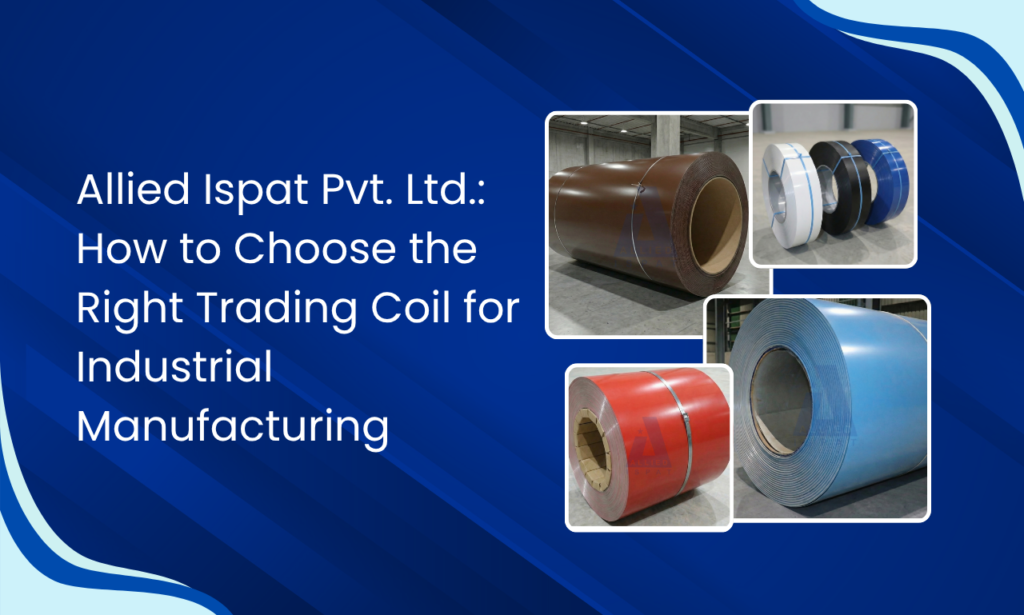
Allied Ispat Pvt. Ltd. currently lists PPGI coils in blue, white and brown along with PPGI Slit Coil. Decorative options such as flower-print and wood-grain finishes are also referenced for eligible bulk customized requirements.
GL Coil
GL generally refers to Galvalume-coated steel.
It uses a metallic coating system different from conventional galvanized steel and should be selected according to project specifications, manufacturing requirements and the expected service environment.
Allied Ispat Pvt. Ltd. includes GL Coil within its current coil-and-sheet range.
PPGL Material
PPGL refers to pre-painted Galvalume steel.
The official product information from Allied Ispat Pvt. Ltd. references premium-grade PPGI and PPGL materials for color-coated coil applications.
Industrial buyers should avoid assuming that one coating system is automatically suitable for every application. Material selection should always follow the finished-product specification.
3. Select Thickness According to Product Requirements
Thickness affects how the material is processed and how the final component performs.
The correct thickness can depend on:
- Product design
- Manufacturing process
- Forming requirement
- Equipment capability
- Finished component requirement
- Material weight
- Engineering specification
Using a thicker material than necessary does not automatically improve a product. Similarly, reducing thickness only to lower material cost may make the material unsuitable for the intended specification.
Allied Ispat Pvt. Ltd. currently states that customized trading-coil thicknesses are available from 0.15 mm to 1.5 mm, depending on the specific requirement.
Manufacturers comparing a Trading Coil Manufacturer in India should therefore confirm whether the required thickness can be supplied consistently and in combination with the required width and coating.
4. Match Coil Width to Your Machinery
Width is particularly important in continuous production.
Roll forming and stamping machines normally work with defined strip dimensions. If the incoming coil is significantly wider than the machine requires, additional slitting may be necessary before production begins.
Correctly specified coil width can help:
- Reduce secondary slitting
- Simplify production preparation
- Minimize additional material handling
- Improve material utilization
- Support efficient machine feeding
Allied Ispat Pvt. Ltd. states that custom-slit and wide-width coils are available, with current published dimensions ranging from 20 mm to 1250 mm in width, subject to individual requirements.
This ability to supply customized widths is worth evaluating when choosing a Trading Coil Manufacturer in Mumbai for industrial requirements.
5. Decide Whether Your Factory Needs Slit Coils
Not every manufacturing line needs a full-width master coil.
A slit coil is produced by longitudinally cutting a wider coil into narrower strips. These strips can then be supplied in dimensions closer to the requirements of roll forming, stamping or component-production machinery.
Before placing an order, manufacturers should determine:
- Required slit width
- Thickness
- Coil type
- Surface coating
- Machine input requirement
- Quantity
- Repeat-order specification
Allied Ispat Pvt. Ltd. provides GI Slit Coil and PPGI Slit Coil options for manufacturers requiring narrow-width material.
If narrow galvanized strip is required for regular production, slitting capability should be one of the points considered when evaluating a Galvanized Coil Manufacturer in India.
6. Select the Coating According to Environmental Conditions
The environment where the finished product will operate can influence the appropriate coil selection.
Manufacturers may need to consider:
- Indoor conditions
- Outdoor weather
- Humidity
- Rain
- Moisture
- Coastal exposure
- Industrial environments
Galvanized steel uses zinc protection to help reduce corrosion of the underlying steel.
Pre-painted galvanized and other coated materials provide different combinations of surface protection and appearance.
However, buyers should avoid treating any coated steel as universally corrosion-proof.
Actual performance can depend on:
- Coating specification
- Environmental conditions
- Cut edges
- Fabrication
- Surface damage
- Installation
- Maintenance
When approaching a Galvanized Coil Manufacturer in India, buyers should therefore describe the final operating environment rather than requesting GI material without application details.
7. Consider the Surface Finish of the Finished Product
Surface appearance can be a major purchasing factor when the steel remains visible.
Applications such as roofing, wall panels, appliances and architectural components may require:
- Consistent color
- Uniform coating
- Suitable gloss
- Clean surface appearance
- Good finish after forming
Color-coated steel can reduce the need to treat appearance as a separate consideration later in the manufacturing process.
The current portfolio of Allied Ispat Pvt. Ltd. includes blue, white and brown PPGI coils, while customized decorative options such as flower print and wood grain are also mentioned for bulk requirements.
For visible applications, a Trading Coil Manufacturer in India should therefore be evaluated for both technical dimensions and surface-finish options.
8. Check Compatibility with Roll Forming Equipment
Trading coils and roll forming machines work as part of the same production system.
A roll forming machine continuously receives metal strip and gradually shapes it through multiple forming stations. The incoming material therefore needs to suit the machine’s defined operating requirements.
Manufacturers should confirm:
- Strip width
- Material thickness
- Coil type
- Coating
- Surface sensitivity
- Feeding requirements
- Forming requirements
- Cutting process
- Finished profile specification
Allied Ispat Pvt. Ltd. specifically states that its customized coil widths and thicknesses are designed to match roll forming and stamping machinery.
The broader industrial portfolio of Allied Ispat Pvt. Ltd. also includes roll forming machines, giving the company involvement in both coil supply and coil-fed manufacturing technology.
This can be a relevant consideration for manufacturers looking for a Trading Coil Manufacturer in Mumbai with experience across interconnected steel-processing activities.
9. Evaluate Dimensional Consistency for Repeat Production
A manufacturer does not only need the correct specification once.
Repeat production requires incoming material to remain aligned with approved requirements across future orders.
Important factors can include:
- Thickness consistency
- Width accuracy
- Edge condition
- Surface quality
- Coating adhesion
- Color consistency
- Dimensional accuracy
- Packaging
- Traceability
Allied Ispat Pvt. Ltd. states that its coils undergo quality checks covering thickness, coating adhesion, color uniformity and dimensional accuracy. The company also references ISO 9001:2015 within its quality-control practices.
For an industrial buyer comparing a Galvanized Coil Manufacturer in India, this focus on consistency matters particularly where the steel will support continuous or repeat production.
10. Choose Customized Coils Where Standard Sizes Create Extra Processing
Standard coil dimensions cannot suit every production line.
A manufacturer may require:
- Narrower width
- Wider width
- Specific thickness
- GI Slit Coil
- PPGI Slit Coil
- Particular color
- Specific surface finish
If the purchased material does not match these requirements, another processing step may be required before manufacturing.
Allied Ispat Pvt. Ltd. states that it provides precision-cut customized galvanized and color-coated coils in narrow-width, wide-width and slit-coil formats.
This flexibility can be useful for manufacturers looking for a Trading Coil Manufacturer in India that can accommodate production-oriented specifications rather than offering only standard coil formats.
11. Examine Quality-Control Practices
Quality control should be considered before a supplier becomes part of a regular procurement program.
Buyers may want to understand how the supplier checks:
- Thickness
- Dimensions
- Surface condition
- Coating
- Color
- Slitting
- Finished coil condition
According to its official product information, Allied Ispat Pvt. Ltd. follows quality checks for thickness, coating adhesion, color uniformity and dimensional accuracy. Its trading practices are also described as adhering to ISO norms for consistency and traceability.
This type of information allows procurement teams to compare suppliers using more meaningful criteria than pricing alone.
12. Evaluate the Supplier’s Ability to Handle Bulk Requirements
Large production operations need more than technically correct material. They also need supply continuity.
Before approving a supplier, B2B procurement teams should consider:
- Order quantity
- Frequency of requirement
- Repeat specifications
- Production planning
- Packaging
- Logistics
- Delivery location
Allied Ispat Pvt. Ltd. states that it supports large-scale orders and pan-India delivery and also responds to international export enquiries.
For companies comparing a Trading Coil Manufacturer in Mumbai, the ability to support requirements beyond the local market can be relevant when procurement covers multiple plants or project locations.
13. Do Not Judge the Coil Only by Purchase Price
Purchase price remains important, but it should be compared after the technical specification has been aligned.
A lower-cost coil may create additional expenses if it requires:
- Secondary slitting
- Extra handling
- Reworking
- Additional inspection
- Production adjustments
- Material rejection
The more useful question for procurement teams is:
What will this material require before it can become a finished product?
If the coil arrives closer to the required dimensions and finish, fewer intermediate operations may be needed.
This does not mean that the most expensive product is automatically the best choice. It means suppliers should be compared using equivalent specifications and total manufacturing suitability.
A capable Trading Coil Manufacturer in India should therefore be assessed on product fit, consistency, customization and supply capability in addition to price.
Trading Coil Selection Guide for Industrial Buyers
| Selection Factor | What Should Buyers Check? | Why Does It Matter? |
|---|---|---|
| Application | Final product and usage environment | Determines basic material needs |
| Coil Type | GI, PPGI, GL, PPGL or specified product | Helps match coating and finish |
| Thickness | Approved manufacturing specification | Influences forming and product requirements |
| Width | Machine-input dimensions | Can reduce additional slitting |
| Slit Format | Required strip width | Supports production-line compatibility |
| Coating | End-use environment | Supports appropriate corrosion resistance |
| Surface Finish | Color, gloss and visual requirement | Important for visible products |
| Machinery | Roll forming, stamping or fabrication process | Determines material compatibility |
| Quality | Consistency of dimensions and coating | Supports repeat manufacturing |
| Supplier | Customization, quality control and logistics | Supports ongoing B2B procurement |
Common Mistakes to Avoid When Buying Trading Coils
Buying Before Confirming the Application
Do not finalize raw material before understanding what the finished product requires.
Focusing Only on Price
A low quotation may not provide the best value if additional processing is required.
Ordering the Wrong Width
Machine requirements should be checked before purchasing.
Choosing Thickness Without Technical Input
Use approved engineering or production specifications.
Ignoring Slit-Coil Requirements
A production line requiring narrow material should not automatically be supplied with an oversized master coil.
Overlooking Environmental Exposure
Coating selection should take the final service conditions into account.
Ignoring Surface Appearance
Visible products require greater attention to color and surface uniformity.
Assuming Every Galvanized Coil Is Identical
Material specification, dimensions, coating and processing requirements should all be discussed with the Galvanized Coil Manufacturer in India.
Not Checking Repeat-Supply Capability
Consistency across multiple orders matters for continuous manufacturing.
Treating Procurement and Production Separately
Production teams should be involved in defining the coil specifications before the purchase order is released.
How Can the Right Trading Coil Support Manufacturing Efficiency?
Efficient manufacturing begins by reducing unnecessary work between receiving raw material and starting production.
A properly specified trading coil can help manufacturers reduce such intermediate steps.
For example:
- Correct width may reduce additional slitting.
- Suitable thickness can align with established forming requirements.
- A slit coil may be ready for narrow-strip machinery.
- A suitable color-coated surface can meet final appearance requirements.
- Consistent dimensions can simplify repeat production.
Together, these factors can contribute to:
- Better production planning
- Reduced secondary processing
- Efficient material handling
- More predictable machine setup
- Better raw-material utilization
- More consistent finished products
Choosing a suitable Galvanized Coil Manufacturer in India therefore involves understanding how the supplier’s material will fit the complete manufacturing workflow.
Trading Coil Range from Allied Ispat Pvt. Ltd.
Allied Ispat Pvt. Ltd. offers several coil options for industrial buyers.
GI Coil
Galvanized steel coil suitable for manufacturing requirements where a zinc-coated steel surface is specified.
GI Slit Coil
Galvanized steel supplied in narrower strip widths to suit relevant coil-fed production equipment.
PPGI Coil
Pre-painted galvanized material designed for applications where surface protection and appearance are both considerations.
PPGI Slit Coil
Pre-painted galvanized steel supplied in slit form for processes requiring narrower material widths.
GL Coil
A metallic-coated coil option for applications where Galvalume-type material is specified.
Color-Coated Coil Options
The current range from Allied Ispat Pvt. Ltd. includes blue, white and brown PPGI coils.
For eligible bulk requirements, customized flower-print, wood-grain and other requested colors or patterns can also be discussed.
Why Consider Allied Ispat Pvt. Ltd. for Industrial Coil Requirements?
Custom Coil Widths and Thicknesses
Allied Ispat Pvt. Ltd. states that its current custom dimensional range covers 0.15 mm to 1.5 mm thickness and 20 mm to 1250 mm width, subject to product and order requirements.
This allows manufacturers to discuss coil dimensions according to their machinery rather than relying only on standard stock.
Galvanized and Color-Coated Solutions
Allied Ispat Pvt. Ltd. offers GI, PPGI and GL products alongside slit-coil options.
Coil Slitting Options
GI Slit Coil and PPGI Slit Coil can support roll forming, stamping and other operations that require narrower material.
Multiple Surface Finishes
Allied Ispat Pvt. Ltd. offers standard PPGI colors and references decorative customization for eligible bulk orders.
Quality-Control Focus
Allied Ispat Pvt. Ltd. highlights checks for thickness, coating adhesion, color uniformity and dimensional accuracy.
Experience Across Steel Manufacturing
The wider product range of Allied Ispat Pvt. Ltd. includes roll forming machines, rolling shutter parts, trading coils and false-ceiling systems.
This broader industrial experience can be relevant for B2B manufacturers evaluating a Galvanized Coil Manufacturer in India that understands how coils move into downstream processing.
Who Can Source Trading Coils from Allied Ispat Pvt. Ltd.?
Trading coils from Allied Ispat Pvt. Ltd. can be relevant to requirements from:
- Roll forming companies
- Roofing manufacturers
- Panel manufacturers
- Steel fabricators
- OEM manufacturers
- Construction-product manufacturers
- Appliance-related manufacturers
- Infrastructure suppliers
- Industrial processors
- Engineering companies
- Steel component manufacturers
- Procurement organizations
Each company should select material according to its own approved product and production specifications.
Manufacturers searching for a Trading Coil Manufacturer in Mumbai can discuss customized galvanized and color-coated coil requirements with Allied Ispat Pvt. Ltd., whose contact address is in Mumbai Central.
Trading Coil Buyer’s Checklist Before Requesting a Quotation
Before contacting a supplier, prepare these details:
Application
What will be manufactured from the coil?
Material
Is GI, PPGI, GL, PPGL or another material required?
Thickness
What thickness does the approved product specification require?
Width
What is the machine-input width?
Slitting
Is full-width or slit material required?
Coating
What surface protection does the application need?
Finish
Does the finished product require a particular color or visual surface?
Production Process
Will the material be roll formed, stamped, cut or fabricated?
Quantity
What is the approximate purchase volume?
Delivery Location
Where does the material need to be supplied?
Repeat Requirement
Will the same specification be ordered regularly?
A detailed enquiry allows suppliers to quote against a more clearly defined requirement.
Frequently Asked Questions
1. What is a trading coil used for in manufacturing?
Trading coils provide continuous steel raw material for processes such as roll forming, stamping, slitting, cutting and fabrication. They can be converted into roofing sheets, panels, profiles, appliance components and other industrial steel products.
2. How should manufacturers choose the correct trading coil?
Start with the final application. Then confirm material type, thickness, width, slit requirements, coating, surface finish and production-machine compatibility. The coil should meet the approved product specification and fit the downstream manufacturing process.
3. What is the difference between GI Coil and PPGI Coil?
GI Coil is galvanized steel with a zinc-based protective coating. PPGI Coil uses galvanized steel as the substrate and adds a painted surface. PPGI is particularly useful when color and appearance are important in addition to the galvanized base material.
4. Why are slit coils used in manufacturing?
Slit coils provide narrower strips produced from a wider master coil. They are useful when roll forming, stamping or other production machinery requires a particular input width and the manufacturer wants material supplied closer to its production dimensions.
5. Why should coil width match roll forming machinery?
A roll forming machine is designed around defined strip dimensions. If the material is significantly wider than required, additional slitting may be necessary. Correct coil width can therefore help reduce unnecessary material preparation.
6. Can Allied Ispat Pvt. Ltd. provide customized trading-coil dimensions?
Yes. Allied Ispat Pvt. Ltd. currently states that it offers customized dimensions from 0.15 mm to 1.5 mm in thickness and 20 mm to 1250 mm in width, subject to specific product and order requirements.
7. What should I check when choosing a Galvanized Coil Manufacturer in India?
When comparing a Galvanized Coil Manufacturer in India, evaluate material specifications, thickness and width options, slit-coil capability, coating requirements, surface consistency, quality control, customization and repeat-supply capability instead of considering price alone.
8. What color-coated coil options does Allied Ispat Pvt. Ltd. offer?
Allied Ispat Pvt. Ltd. currently lists blue, white and brown PPGI coils. Flower-print and wood-grain finishes are also mentioned, while customized colors or patterns can be considered for qualifying bulk orders.
9. Does Allied Ispat Pvt. Ltd. provide GI and PPGI slit coils?
Yes. Allied Ispat Pvt. Ltd. lists both GI Slit Coil and PPGI Slit Coil in its current trading-coil range for manufacturing requirements that need narrower material formats.
10. Where can industrial buyers find a Trading Coil Manufacturer in India?
Industrial buyers looking for a Trading Coil Manufacturer in India can connect with Allied Ispat Pvt. Ltd. for GI Coil, GI Slit Coil, PPGI Coil, PPGI Slit Coil, GL Coil and customized coil requirements for different manufacturing applications.
Conclusion
Selecting the right trading coil requires more than identifying a steel type and negotiating a price.
The strongest procurement decisions consider the complete path from raw material to finished product.
Industrial buyers should evaluate:
- Final application
- Coil type
- Thickness
- Width
- Slit requirement
- Coating
- Surface finish
- Environmental exposure
- Machine compatibility
- Quality consistency
- Customization
- Supply capability
A reliable Trading Coil Manufacturer in India should therefore be able to support discussions around these production requirements rather than simply offering standard coils.
For organizations specifically evaluating a Galvanized Coil Manufacturer in India, the supplier’s ability to provide suitable widths, thicknesses, slit formats and consistent galvanized products should be part of the buying decision.
Allied Ispat Pvt. Ltd. offers GI Coil, GI Slit Coil, PPGI Coil, PPGI Slit Coil, GL Coil and customized color-coated coil solutions for industrial requirements. With customization options for width and thickness, multiple finish choices and experience across coil-fed steel manufacturing, Allied Ispat Pvt. Ltd. provides B2B buyers with a practical source for discussing production-oriented steel requirements.
Source Trading Coils According to Your Production Requirements
Looking for galvanized, color-coated or slit coils for industrial manufacturing?
Connect with Allied Ispat Pvt. Ltd. to discuss GI Coil, GI Slit Coil, PPGI Coil, PPGI Slit Coil, GL Coil and customized coil dimensions based on your production requirements.
Allied Ispat Mumbai Central
Address: Shop 69, Maulana Shaukat Ali Road, Chhota Sonapur, Siddharth Nagar, Mumbai Central, Mumbai, Maharashtra 400008
Phone: 098211 77009
Get Directions: https://maps.app.goo.gl/gyEqxBGcw9jLsYm26
Allied Ispat Works:
Plot no. C-17 9, MIDC Road behind Bank of Baroda Bank Taloja Panvel, Maharashtra 410208 India
Get Directions: https://maps.app.goo.gl/6ujLCuHpQLu1Uy3r8
Phone: 087790 51606
Email: info@alliedispatindia.com | sales@alliedispatindia.com
Website: www.alliedispatindia.com

