

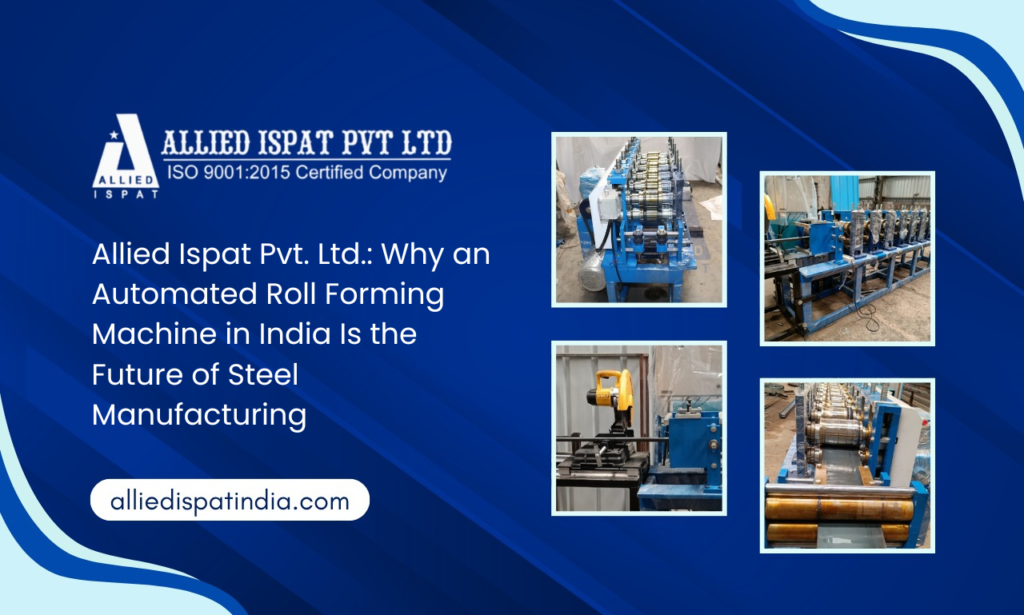
Introduction
The Indian manufacturing industry is rapidly evolving as businesses adopt advanced technologies to meet increasing market demands. With significant investments in infrastructure, industrial construction, renewable energy, warehousing, transportation, and commercial development, the need for precision-engineered steel products has never been higher.
Today’s manufacturers are expected to produce thousands of identical steel profiles while maintaining strict quality standards, minimizing production costs, and meeting shorter delivery schedules. Traditional fabrication methods involving multiple machines and manual processes often struggle to achieve these goals efficiently.
This growing demand for productivity and precision has made the Automated Roll Forming Machine in India one of the most valuable investments for steel manufacturers.
Unlike conventional manufacturing methods, automated roll forming transforms a flat steel coil into a finished profile through a continuous, synchronized production process. Every stage—from coil feeding and profile shaping to hydraulic cutting—is carefully controlled through intelligent automation, ensuring speed, repeatability, and exceptional accuracy.
Whether manufacturing roofing sheets, C-channels, Z-purlins, cable trays, solar mounting structures, warehouse rack systems, or rolling shutter profiles, automated roll forming delivers outstanding production efficiency while reducing manual effort and material wastage.
As a leading Roll Forming Machine Manufacturer in India, Allied Ispat Pvt. Ltd. provides customized roll forming solutions that help manufacturers increase productivity, improve product quality, and achieve sustainable business growth. With precision engineering, durable machine construction, and advanced automation, Allied Ispat has become a trusted partner for businesses across diverse industrial sectors.
This guide explores everything you need to know about automated roll forming technology—from its working principles and machine components to its industrial applications and long-term business benefits.
Understanding an Automated Roll Forming Machine
An automated roll forming machine is a specialized industrial system designed to continuously convert flat metal strips into accurately shaped steel profiles.
Instead of cutting, bending, and welding materials separately, the roll forming process shapes the metal progressively through multiple sets of precision-engineered rollers. Each roller station performs a small portion of the forming operation until the desired profile is achieved.
This gradual forming process offers several important advantages:
- High dimensional precision
- Smooth profile formation
- Consistent product quality
- Better structural strength
- Faster manufacturing speeds
Automation further enhances the system by integrating feeding, profile measurement, hydraulic cutting, and production monitoring into a single continuous manufacturing line.
The result is uninterrupted production capable of manufacturing thousands of identical steel sections with remarkable efficiency.
Key Components of an Automated Roll Forming Machine
The efficiency of a roll forming machine depends on how well its individual systems work together. Every component plays an important role in maintaining production accuracy and reliability.
1. Decoiler System
Production starts with the decoiler, which supports the steel coil and releases the material smoothly into the production line.
A properly designed decoiler ensures:
- Stable coil rotation
- Controlled material tension
- Smooth feeding
- Reduced material deformation
Consistent coil feeding is essential for maintaining profile accuracy throughout production.
2. Entry Guide and Feeding System
Before entering the forming section, the steel strip passes through guide rollers that position the material accurately.
The feeding system ensures:
- Proper strip alignment
- Uniform feeding speed
- Reduced material deviation
- Improved production consistency
Accurate feeding minimizes defects and helps maintain profile precision.
3. Roll Forming Stations
The roll forming section is where the actual profile is created.
Multiple roller stations gradually shape the steel strip into the desired configuration.
Rather than forcing the material into shape, each station performs a controlled bending operation that reduces stress on the steel while preserving its strength.
The number of forming stations depends on:
- Profile complexity
- Material thickness
- Product design
- Production requirements
Well-designed roller tooling ensures smooth profile formation and long machine life.
4. PLC Control Panel
Automation is controlled through a Programmable Logic Controller (PLC).
The operator can easily configure important production settings, including:
- Profile length
- Machine speed
- Production quantity
- Cutting intervals
- Batch production
The PLC synchronizes all machine operations, allowing consistent production with minimal manual intervention.
5. Hydraulic Cutting Unit
After the profile reaches the programmed length, the hydraulic cutting system performs an accurate cut.
Unlike conventional cutting methods, hydraulic cutting operates in synchronization with the roll forming line, allowing production to continue without unnecessary delays.
Benefits include:
- Clean cuts
- Consistent lengths
- Reduced production interruptions
- Better finishing quality
6. Product Receiving Table
After cutting, finished products move to the receiving table where they are collected for inspection, stacking, packaging, or transportation.
Organized product handling reduces damage and improves overall workflow within the production facility.
Step-by-Step Working Process of an Automated Roll Forming Machine
Although highly automated, the production process follows a logical sequence that ensures maximum efficiency and product consistency.
Step 1: Steel Coil Loading
A coil of steel is mounted onto the decoiler.
Depending on production requirements, the machine can process materials such as:
- Galvanized Steel (GI)
- Mild Steel (MS)
- Cold Rolled Steel (CR)
- Stainless Steel
- Pre-painted Steel
- Colour-Coated Steel
- Aluminium
Step 2: Material Feeding
The steel strip is guided into the production line through precision feeding rollers.
Proper feeding ensures the material remains centered throughout the forming process.
Step 3: Progressive Profile Formation
As the material passes through successive roller stations, it is gradually formed into the required profile.
This method provides:
- Excellent profile symmetry
- Accurate dimensions
- Smooth bends
- Superior structural integrity
- Minimal internal stress
Step 4: Intelligent Process Control
The PLC continuously monitors machine performance and synchronizes feeding, forming, measuring, and cutting operations.
Automation allows manufacturers to maintain high production speeds while ensuring repeatable quality.
Step 5: Precision Hydraulic Cutting
When the programmed length is reached, the hydraulic cutting system separates the profile accurately.
Because cutting is synchronized with production, manufacturers experience minimal interruptions and higher output.
Step 6: Product Collection
Finished profiles are transferred to the output section for quality inspection and packaging before dispatch.
The continuous workflow helps manufacturers maximize production efficiency while reducing manual handling.
Applications of Automated Roll Forming Machines
The versatility of roll forming technology allows manufacturers to produce a wide range of steel products across multiple industries.
Common applications include:
- Roofing Sheets
- Wall Cladding Panels
- Rolling Shutter Slats
- Solar Mounting Rails
- Cable Trays
- C-Channels
- Z-Purlins
- Drywall Profiles
- Ceiling Channels
- Door Frames
- Window Reinforcement Sections
- Warehouse Rack Components
- Industrial Structural Profiles
- Custom Steel Sections
By changing roller tooling, manufacturers can efficiently switch between different profile designs without replacing the complete machine.
Types of Roll Forming Machines
Manufacturers select roll forming machines according to production volume, investment capacity, and automation requirements.
Manual Roll Forming Machine
Manual systems are best suited for low-volume production where operators perform several production tasks manually.
Ideal for:
- Small workshops
- Prototype manufacturing
- Limited production runs
Semi-Automatic Roll Forming Machine
Semi-automatic machines combine manual supervision with automated forming functions.
Benefits include:
- Better productivity
- Improved consistency
- Moderate investment
- Reduced operator workload
These machines are suitable for medium-scale manufacturers.
Fully Automatic Roll Forming Machine
Fully automatic machines provide complete production automation.
Features include:
- PLC-controlled operation
- Automatic feeding
- Continuous roll forming
- Hydraulic cutting
- Digital production monitoring
These systems are ideal for manufacturers seeking maximum productivity and long-term operational efficiency.
Why Manufacturers Are Switching to Automated Roll Forming
Across India, manufacturers are upgrading their production facilities to remain competitive.
An automated roll forming machine offers several business advantages:
- Higher production capacity
- Faster manufacturing
- Superior dimensional accuracy
- Reduced material wastage
- Lower labour dependency
- Better production planning
- Consistent product quality
- Improved operational safety
- Excellent return on investment
Automation enables businesses to respond quickly to changing market demands while maintaining high manufacturing standards.
Why Choose Allied Ispat Pvt. Ltd.?
Investing in advanced machinery requires a trusted manufacturing partner with proven engineering expertise.
Allied Ispat Pvt. Ltd. has earned its reputation as a reliable Roll Forming Machine Manufacturer in India by delivering innovative, customized, and durable roll forming solutions tailored to each customer’s production needs.
The company offers:
- Fully Automatic Roll Forming Machines
- Semi-Automatic Roll Forming Machines
- Custom Roll Forming Production Lines
- Precision Roller Tooling
- Heavy-Duty Machine Construction
- PLC Automation Systems
- Hydraulic Cutting Technology
- Installation & Commissioning
- Operator Training
- Comprehensive After-Sales Support
By focusing on quality, customization, and long-term customer satisfaction, Allied Ispat helps manufacturers improve productivity, reduce operating costs, and build future-ready production facilities.
How an Automated Roll Forming Machine Improves Manufacturing Performance
For every steel manufacturer, productivity and quality go hand in hand. Increasing production is valuable only when every finished profile meets the required specifications. This is why businesses across construction, infrastructure, renewable energy, warehousing, and industrial fabrication are replacing conventional production methods with automated roll forming technology.
An Automated Roll Forming Machine in India is designed to simplify complex manufacturing operations by combining material feeding, profile forming, length measurement, and cutting into one continuous process. This integrated workflow minimizes delays, improves consistency, and allows manufacturers to produce large volumes without sacrificing precision.
Whether you’re manufacturing roofing sheets, cable trays, rolling shutter slats, solar mounting structures, or customized steel sections, automation delivers measurable improvements across every stage of production.
Continuous Production Without Interruptions
Traditional fabrication often involves multiple standalone machines for cutting, bending, punching, and shaping. Each operation requires material handling, manual adjustments, and additional labour, slowing down production.
An automated roll forming machine eliminates these interruptions by creating a continuous production line where the steel strip moves seamlessly from one stage to the next.
The advantages of uninterrupted production include:
- Faster manufacturing cycles
- Higher daily production output
- Improved machine utilization
- Reduced idle time
- Quicker order completion
For manufacturers handling large commercial projects or bulk industrial orders, continuous production becomes a significant competitive advantage.
Improved Manufacturing Speed
Meeting customer deadlines has become increasingly important in today’s competitive market.
Automated roll forming machines are designed for high-speed production while maintaining profile accuracy throughout the manufacturing process.
Because feeding, forming, and cutting are synchronized automatically, manufacturers can produce steel profiles much faster than with conventional fabrication methods.
Higher production speed helps businesses:
- Deliver projects on time
- Increase monthly production capacity
- Reduce manufacturing backlogs
- Respond quickly to urgent customer requirements
- Improve overall operational efficiency
Greater speed enables manufacturers to serve more customers without compromising quality.
Exceptional Precision in Every Profile
Precision is one of the defining strengths of roll forming technology.
Each roller station gradually shapes the material using carefully engineered tooling, ensuring that the final product matches the required dimensions with remarkable consistency.
This progressive forming process offers several benefits:
- Uniform profile geometry
- Accurate bend angles
- Consistent thickness distribution
- Excellent edge quality
- Reliable structural performance
Accurate steel profiles reduce installation problems and improve the overall quality of finished projects.
Uniform Quality Across Large Production Runs
One of the biggest challenges in manual manufacturing is maintaining consistency over thousands of components.
Even experienced operators may introduce slight variations during production, resulting in quality differences between batches.
Automated roll forming solves this challenge by maintaining identical production settings throughout the manufacturing cycle.
Manufacturers benefit from:
- Repeatable production quality
- Consistent profile dimensions
- Improved product appearance
- Fewer rejected components
- Greater customer confidence
This consistency is particularly valuable for industries where precision installation is essential.
Reduced Material Waste and Better Resource Utilization
Every kilogram of wasted steel increases manufacturing costs.
Automated roll forming machines maximize material utilization through accurate feeding systems, precision roll tooling, and synchronized cutting technology.
As a result, manufacturers experience:
- Lower scrap generation
- Accurate finished lengths
- Reduced trimming losses
- Better utilization of raw materials
- Improved production yield
Over time, these efficiencies contribute to substantial cost savings and stronger profit margins.
Lower Operating Costs
Automation helps businesses optimize multiple aspects of production, leading to lower operating expenses over the long term.
Cost savings are achieved through:
- Reduced labour requirements
- Less material wastage
- Lower rejection rates
- Improved machine efficiency
- Reduced rework
- Faster production cycles
Although the initial investment may be higher than traditional equipment, automated roll forming typically delivers a stronger return on investment through improved productivity and lower production costs.
Smarter Production with PLC Automation
At the core of every modern roll forming machine is a Programmable Logic Controller (PLC) that manages the complete production process.
Rather than manually controlling each operation, the PLC coordinates every stage automatically after production settings are entered.
Operators can easily configure:
- Product length
- Production quantity
- Line speed
- Cutting intervals
- Batch production
- Machine synchronization
The PLC continuously monitors machine performance, ensuring smooth operation and reducing the possibility of production errors.
This intelligent automation simplifies operation while improving manufacturing reliability.
Hydraulic Cutting Ensures Clean and Accurate Finishing
The final stage of production has a major impact on the quality of the finished product.
Modern hydraulic cutting systems work in perfect synchronization with the roll forming process to produce clean, accurate cuts without interrupting production.
Benefits include:
- Precise profile lengths
- Smooth cutting edges
- Consistent product dimensions
- Faster production flow
- Reduced finishing work
- Better overall product quality
High-quality cutting minimizes waste and improves the appearance of finished steel profiles.
Excellent Surface Finish
Many roll-formed products are manufactured using galvanized, pre-painted, or colour-coated steel, where preserving the surface coating is essential.
Automated roll forming protects the material by using precision-machined rollers and carefully controlled production speeds.
This helps prevent:
- Surface scratches
- Coating damage
- Dents
- Material distortion
The result is a finished product that maintains both its structural performance and visual appeal.
Enhanced Safety in Manufacturing Facilities
Modern manufacturing places great importance on operator safety.
Automated roll forming reduces unnecessary manual handling by automating material movement and production operations.
Today’s machines incorporate several safety features, including:
- Emergency stop controls
- Safety guards
- Protective covers
- Stable feeding mechanisms
- Electrical safety systems
While automation creates a safer working environment, regular maintenance and proper operator training remain essential for safe and efficient machine operation.
Flexible Manufacturing for Different Product Profiles
Manufacturers rarely produce just one type of steel profile.
As customer demands evolve, businesses require machinery capable of producing multiple products with minimal disruption.
By changing roller tooling and adjusting machine settings, automated roll forming machines can manufacture:
- Roofing Sheets
- Rolling Shutter Profiles
- Cable Trays
- Solar Mounting Channels
- Ceiling Channels
- C-Channels
- Z-Purlins
- Door Frames
- Window Reinforcement Sections
- Custom Structural Profiles
This flexibility allows manufacturers to expand into new markets without investing in entirely new production systems.
Why Customized Roll Forming Machines Offer Greater Value
Every manufacturing facility operates under different production requirements. Factors such as material thickness, product design, production targets, and available factory space influence the ideal machine configuration.
Instead of offering standard equipment, experienced manufacturers develop customized solutions based on:
- Product profile drawings
- Steel grade and thickness
- Coil width
- Required production speed
- Punching and cutting requirements
- Plant layout
- Future expansion plans
A customized roll forming machine ensures better productivity, smoother operations, and maximum return on investment.
As an experienced Roll Forming Machine Manufacturer in India, Allied Ispat Pvt. Ltd. designs advanced roll forming solutions that combine precision engineering, intelligent PLC automation, durable construction, and customized machine configurations. Every machine is built to help manufacturers improve productivity, maintain consistent quality, and achieve long-term operational success.
Industries Driving the Demand for Automated Roll Forming Machines in India
The demand for precision steel profiles is increasing across almost every major industry in India. Large-scale infrastructure projects, industrial expansion, renewable energy installations, commercial construction, and warehouse development have created a growing need for fast, accurate, and cost-effective manufacturing solutions.
An Automated Roll Forming Machine in India has become the preferred choice for manufacturers because it delivers consistent quality, high production speed, and the flexibility to produce a wide variety of steel profiles. Unlike conventional fabrication, automated roll forming minimizes manual intervention while ensuring every component meets exact design specifications.
Let’s explore how different industries benefit from this advanced manufacturing technology.
Construction and Infrastructure
Construction remains one of the largest consumers of roll-formed steel products. Modern buildings require lightweight yet durable steel components that can be installed quickly while maintaining structural integrity.
Automated roll forming machines manufacture products such as:
- Ceiling Channels
- Drywall Studs
- Partition Tracks
- Roofing Profiles
- Wall Cladding Sections
- Structural Framing Components
- Window Reinforcement Profiles
Because every profile is manufactured with identical dimensions, contractors spend less time making adjustments during installation. This improves construction efficiency and reduces overall project costs.
As India’s infrastructure sector continues to expand, the demand for precision roll-formed components is expected to grow even further.
Roofing and Cladding Manufacturing
Industrial buildings, factories, warehouses, shopping centres, and commercial complexes all require durable roofing and wall cladding systems.
Roll forming technology allows manufacturers to produce long, continuous roofing profiles with exceptional accuracy and surface quality.
Common products include:
- Corrugated Roofing Sheets
- Trapezoidal Roofing Profiles
- Standing Seam Panels
- Deck Sheets
- Wall Cladding Profiles
Continuous production ensures uniform dimensions across every sheet, making installation faster and reducing material wastage at project sites.
Rolling Shutter Manufacturing
The rolling shutter industry depends heavily on precision manufacturing because every component must fit together perfectly.
Automated roll forming machines manufacture:
- Shutter Slats
- Bottom Rails
- Guide Channels
- Side Profiles
- Reinforcement Sections
Automation provides several advantages for shutter manufacturers:
- Faster production
- Smooth profile finishing
- Excellent dimensional accuracy
- Consistent product quality
- Lower rejection rates
These benefits help manufacturers handle large production volumes while maintaining high quality standards.
Solar Mounting Structure Industry
India’s renewable energy sector has created significant opportunities for manufacturers producing solar mounting structures.
Solar projects require accurately formed steel channels capable of supporting solar panels under varying environmental conditions.
Roll forming machines are commonly used to manufacture:
- Solar Mounting Rails
- C-Channels
- Support Members
- Structural Brackets
- Customized Solar Profiles
Because solar installations involve thousands of identical components, automated production ensures faster manufacturing and easier on-site assembly.
Cable Tray and Electrical Support Systems
Commercial buildings, manufacturing plants, hospitals, airports, and data centres require efficient cable management systems.
Roll forming technology enables manufacturers to produce:
- Cable Trays
- Ladder Trays
- Raceway Systems
- Electrical Support Channels
- Mounting Brackets
High dimensional accuracy improves installation efficiency while maintaining the strength required for heavy cable loads.
Warehouse and Storage Solutions
The expansion of logistics, retail, and e-commerce has increased demand for advanced warehousing systems.
Storage equipment manufacturers rely on roll forming machines to produce:
- Rack Uprights
- Beam Sections
- Shelving Profiles
- Storage Frames
- Industrial Racking Components
Precision manufacturing ensures these products offer excellent load-bearing capacity and easy assembly.
Automotive and Engineering Applications
Automotive manufacturers require steel components that combine strength, durability, and precise engineering.
Roll forming technology is used to manufacture:
- Structural Reinforcement Profiles
- Chassis Components
- Support Channels
- Protective Sections
- Engineering Profiles
The repeatability of automated production helps manufacturers meet strict automotive quality standards.
Furniture and Modular Interior Systems
Steel furniture manufacturers increasingly use roll-formed profiles because they provide durability, strength, and an attractive finish.
Applications include:
- Office Furniture Frames
- Modular Workstations
- Storage Cabinets
- Display Shelves
- Industrial Furniture Components
Automation helps produce visually consistent profiles while minimizing finishing requirements.
Automated Roll Forming vs Traditional Fabrication
Although conventional fabrication methods remain useful for low-volume custom work, they often require multiple machines and several manual operations.
Roll forming combines these operations into one streamlined production process, delivering higher productivity and more consistent quality.
| Comparison | Traditional Fabrication | Automated Roll Forming |
|---|---|---|
| Manufacturing Process | Multiple separate operations | Continuous automated production |
| Production Speed | Moderate | High-Speed Manufacturing |
| Labour Requirement | High | Significantly Lower |
| Product Consistency | Depends on operator skill | Highly Repeatable |
| Material Utilization | Higher Scrap | Optimized Material Usage |
| Production Capacity | Limited | Suitable for Mass Production |
| Dimensional Accuracy | Moderate | Excellent Precision |
| Cost Efficiency | Higher operating cost | Better Long-Term ROI |
For manufacturers producing standard steel profiles in large quantities, automated roll forming offers substantial operational advantages over traditional fabrication.
How Automation Supports Long-Term Business Growth
Investing in advanced machinery is not only about increasing today’s production—it is also about preparing your business for tomorrow’s opportunities.
Automation enables manufacturers to expand operations without compromising quality or increasing labour costs significantly.
Increased Production Capacity
Continuous production allows businesses to manufacture more products within the same working hours.
This enables manufacturers to:
- Accept larger contracts
- Meet tight project deadlines
- Expand into new markets
- Improve annual production output
Higher production capacity creates greater revenue opportunities.
Improved Profitability
Automation improves efficiency throughout the manufacturing process.
Businesses experience savings through:
- Reduced material wastage
- Lower labour costs
- Better machine utilization
- Fewer rejected products
- Reduced production downtime
These improvements strengthen profitability while increasing operational stability.
Stronger Customer Confidence
Customers value manufacturers who consistently deliver high-quality products on time.
Automated roll forming ensures every production batch maintains the same quality standards, helping businesses build long-term relationships and secure repeat orders.
Product Diversification
Modern roll forming machines can manufacture multiple steel profiles simply by changing roller tooling.
Manufacturers can diversify into sectors such as:
- Infrastructure
- Renewable Energy
- Warehousing
- Industrial Fabrication
- Commercial Construction
- Electrical Support Systems
This flexibility allows businesses to respond quickly to changing market demands.
Choosing the Right Roll Forming Machine
Selecting the right machine requires careful planning because it directly affects production efficiency and future business growth.
Manufacturers should evaluate the following factors before investing.
Production Requirements
Understand your requirements regarding:
- Product Design
- Material Type
- Material Thickness
- Coil Width
- Production Volume
- Future Expansion
A machine designed specifically for your products will deliver better long-term performance.
Machine Engineering Quality
Look for machines that offer:
- Heavy-Duty Fabricated Frames
- Precision Roller Tooling
- Hardened Shafts
- Reliable Gearboxes
- Premium Hydraulic Components
- Industrial-Grade Electrical Systems
Strong engineering ensures durability and consistent production.
Automation Features
Modern machines should include:
- PLC Control System
- Touchscreen HMI
- Automatic Length Control
- Digital Production Monitoring
- Hydraulic Cutting
- Fault Detection System
These features simplify operation while improving productivity.
Technical Support
After-sales service is equally important when investing in industrial machinery.
Choose a manufacturer that provides:
- Installation Support
- Machine Commissioning
- Operator Training
- Spare Parts Availability
- Preventive Maintenance
- Technical Assistance
Reliable support minimizes downtime and ensures long-term operational success.
Why Allied Ispat Pvt. Ltd. Is the Right Manufacturing Partner
Choosing a reliable machine manufacturer is essential for achieving consistent production and maximum return on investment.
Allied Ispat Pvt. Ltd. has become a preferred Roll Forming Machine Manufacturer in India by delivering customized, high-performance roll forming solutions tailored to the needs of modern manufacturers.
The company provides:
- Fully Automatic Roll Forming Machines
- Semi-Automatic Roll Forming Machines
- Customized Roll Forming Production Lines
- Precision Roller Tooling
- PLC-Based Automation Systems
- Hydraulic Cutting Technology
- Machine Installation & Commissioning
- Operator Training
- Comprehensive After-Sales Support
With a commitment to innovation, engineering excellence, and customer satisfaction, Allied Ispat helps manufacturers modernize production, improve efficiency, and stay competitive in an evolving industrial landscape.
The Future of Automated Roll Forming Machines in India
Manufacturing is entering a new phase where automation, precision engineering, and digital intelligence are shaping the future of industrial production. Businesses are no longer investing in machinery solely to increase output—they are looking for solutions that improve efficiency, reduce operating costs, ensure consistent quality, and support long-term scalability.
An Automated Roll Forming Machine in India perfectly aligns with these evolving manufacturing goals. By combining intelligent automation with precision roll forming technology, these machines help manufacturers stay competitive in industries where speed, accuracy, and reliability are critical.
As India’s construction, renewable energy, logistics, automotive, and infrastructure sectors continue to expand, the adoption of advanced roll forming technology is expected to accelerate significantly.
Smart Manufacturing Is Redefining Steel Production
The concept of smart manufacturing has transformed the way factories operate. Instead of relying solely on manual supervision, modern production facilities use digital systems to monitor machine performance, optimize workflows, and improve decision-making.
Today’s automated roll forming machines are designed to integrate seamlessly into smart manufacturing environments.
Advanced capabilities include:
- Digital production monitoring
- Real-time performance tracking
- Automated production reports
- Machine diagnostics
- Error detection systems
- Production analytics
- Remote monitoring capabilities
These intelligent features allow manufacturers to identify production bottlenecks quickly and improve operational efficiency before problems affect output.
The result is greater productivity with better control over every stage of manufacturing.
Industry 4.0 and Intelligent Automation
Industry 4.0 is driving the next generation of manufacturing by connecting machines, software, and production data.
Modern roll forming machines equipped with PLC-based automation and digital controls enable manufacturers to streamline operations while improving production accuracy.
Industry 4.0 technologies support:
- Automated machine synchronization
- Digital quality monitoring
- Production data collection
- Smart maintenance scheduling
- Performance optimization
- Improved resource management
As factories become more connected, manufacturers gain better visibility into production performance and can make informed operational decisions.
Predictive Maintenance Minimizes Downtime
Machine downtime remains one of the biggest challenges in industrial manufacturing. Unexpected failures not only delay production but also increase maintenance expenses and reduce customer satisfaction.
Predictive maintenance helps manufacturers avoid these issues by monitoring machine performance and identifying potential problems before they become serious.
Important components that require regular monitoring include:
- Roll forming stations
- Bearings
- Hydraulic cylinders
- Gearboxes
- Electric motors
- Drive chains
- PLC and electrical systems
Implementing predictive maintenance provides several benefits:
- Reduced unexpected breakdowns
- Longer equipment lifespan
- Improved production reliability
- Lower maintenance costs
- Better spare parts planning
A proactive maintenance strategy ensures uninterrupted production while protecting valuable manufacturing assets.
Data-Driven Decision Making
One of the biggest advantages of automation is the ability to collect and analyse production data.
Modern roll forming machines provide valuable operational information that helps businesses improve efficiency and optimize manufacturing performance.
Manufacturers can monitor:
- Daily production output
- Machine utilization
- Production speed
- Material consumption
- Product rejection rates
- Shift performance
- Equipment operating hours
This information allows management teams to make informed decisions regarding production planning, maintenance scheduling, workforce allocation, and process improvement.
Data-driven manufacturing ultimately leads to better profitability and higher customer satisfaction.
Sustainable Manufacturing for the Future
Sustainability has become an important priority for manufacturers worldwide. Companies are expected to reduce waste, improve energy efficiency, and make responsible use of natural resources while maintaining high production standards.
Automated roll forming supports sustainable manufacturing by:
- Reducing raw material waste
- Improving material utilization
- Minimizing rejected products
- Lowering energy consumption through optimized operations
- Reducing unnecessary rework
Efficient manufacturing not only benefits the environment but also helps businesses lower production costs and improve operational performance.
Production Flexibility for Multiple Industries
Customer demands are constantly evolving, and manufacturers must adapt quickly to remain competitive.
One of the biggest advantages of automated roll forming is its flexibility. By replacing roller tooling and adjusting production parameters, businesses can manufacture a wide variety of steel profiles on the same production platform.
Applications include:
- Roofing Sheets
- Wall Cladding Profiles
- Rolling Shutter Components
- Solar Mounting Structures
- Cable Tray Systems
- C-Channels
- Z-Purlins
- Ceiling Channels
- Warehouse Rack Sections
- Industrial Structural Profiles
This flexibility enables manufacturers to expand into new markets without investing in multiple dedicated production lines.
Why the Right Manufacturing Partner Matters
Purchasing a roll forming machine is a significant investment, but the long-term success of that investment depends largely on the expertise and support of the machine manufacturer.
A trusted manufacturer provides more than just machinery—they offer engineering consultation, customization, technical support, and ongoing service that help businesses maximize productivity.
When evaluating a roll forming machine manufacturer, consider:
- Industry experience
- Engineering expertise
- Custom machine design capabilities
- Manufacturing quality standards
- Availability of spare parts
- Installation and commissioning support
- Operator training
- Responsive after-sales service
Choosing the right partner ensures reliable machine performance for years to come.
Why Allied Ispat Pvt. Ltd. Is a Preferred Roll Forming Machine Manufacturer in India
With years of experience in steel processing equipment, Allied Ispat Pvt. Ltd. has established itself as a trusted name in the roll forming industry. The company combines technical expertise with innovative engineering to deliver customized solutions that meet the unique production requirements of every customer.
Customized Engineering Solutions
Every manufacturing business has different production goals.
Allied Ispat designs machines based on:
- Product profile
- Material specifications
- Coil dimensions
- Material thickness
- Production capacity
- Factory layout
- Future expansion requirements
This customer-focused approach ensures maximum productivity and long-term operational efficiency.
Precision Engineering and Reliable Performance
Every machine is manufactured using high-quality components and advanced engineering techniques to ensure dependable performance.
Key highlights include:
- Heavy-duty machine frames
- Precision roller tooling
- Hardened shafts
- PLC-controlled automation
- Hydraulic cutting systems
- Industrial-grade electrical components
- Robust transmission systems
These features contribute to superior profile accuracy, long service life, and reduced maintenance requirements.
Complete After-Sales Support
Allied Ispat believes that customer relationships continue long after machine installation.
The company provides:
- Technical consultation
- Machine installation
- Commissioning assistance
- Operator training
- Preventive maintenance guidance
- Spare parts availability
- Dedicated technical support
This comprehensive service ensures customers achieve maximum performance from their investment.
Frequently Asked Questions (FAQs)
1. What is an Automated Roll Forming Machine?
An automated roll forming machine is a continuous production system that converts flat metal coils into accurately shaped steel profiles using multiple roll forming stations, PLC automation, and hydraulic cutting technology.
2. Which industries benefit from roll forming technology?
Roll forming machines are widely used in construction, infrastructure, roofing, rolling shutters, solar energy, warehousing, cable tray manufacturing, automotive engineering, and industrial fabrication.
3. Why is automated roll forming better than conventional fabrication?
Automated roll forming provides higher production speed, superior dimensional accuracy, consistent product quality, lower material waste, reduced labour dependency, and better long-term cost efficiency.
4. Can roll forming machines produce customized profiles?
Yes. By designing customized roller tooling, manufacturers can produce a wide range of standard and specialized steel profiles according to customer requirements.
5. Which materials can be processed?
Most roll forming machines are capable of processing:
- Mild Steel (MS)
- Galvanized Steel (GI)
- Cold Rolled Steel (CR)
- Stainless Steel
- Colour-Coated Steel
- Pre-Painted Steel
- Aluminium
6. What is the role of PLC automation?
PLC automation controls machine speed, profile length, production quantity, hydraulic cutting, and synchronization between production stages, improving accuracy and reducing manual errors.
7. How does automated roll forming reduce production costs?
Automation improves material utilization, minimizes product rejection, reduces labour costs, shortens production cycles, and increases machine efficiency, leading to lower overall manufacturing costs.
8. Is preventive maintenance important?
Yes. Regular inspection and preventive maintenance improve machine reliability, extend equipment life, reduce downtime, and ensure consistent production quality.
9. Why should manufacturers choose Allied Ispat Pvt. Ltd.?
Allied Ispat offers customized roll forming machines, precision engineering, robust machine construction, advanced PLC automation, hydraulic cutting systems, complete installation support, operator training, and dependable after-sales service, making it a preferred partner for manufacturers across India.
10. Is investing in an Automated Roll Forming Machine a long-term business decision?
Absolutely. Businesses that invest in automation gain higher production capacity, improved product quality, lower operating costs, greater manufacturing flexibility, and stronger competitiveness in the rapidly evolving steel industry.
Conclusion
As manufacturing continues to evolve, automation has become the key to improving efficiency, maintaining product quality, and achieving sustainable business growth. An Automated Roll Forming Machine in India enables manufacturers to streamline production, reduce operational costs, improve material utilization, and consistently deliver precision-engineered steel profiles.
However, the success of any automation project depends not only on the technology but also on the expertise of the machinery manufacturer. Partnering with an experienced company ensures that every machine is designed, installed, and supported to meet your production goals.
Allied Ispat Pvt. Ltd. stands at the forefront of this transformation by delivering innovative, customized, and reliable roll forming solutions for industries across India. With advanced PLC automation, precision roller tooling, heavy-duty machine construction, and exceptional after-sales support, Allied Ispat empowers businesses to enhance productivity and prepare for the future of smart manufacturing.
Whether you are expanding an existing production line or establishing a new manufacturing facility, investing in a high-performance roll forming machine from Allied Ispat is a strategic step toward greater efficiency, higher profitability, and long-term industrial success.
Get Started with Allied Ispat Pvt. Ltd.
Looking for a dependable Roll Forming Machine Manufacturer in India? Allied Ispat Pvt. Ltd. offers customized automated roll forming solutions designed to match your exact production requirements.
Contact our experts today to discuss your project, explore machine customization options, and discover how our advanced roll forming technology can help your business achieve higher productivity, superior quality, and sustainable growth.
Allied Ispat Works:
Plot no. C-17 9, MIDC Road behind Bank of Baroda Bank Taloja Panvel, Maharashtra 410208 India
Get Directions: https://maps.app.goo.gl/6ujLCuHpǪLu1Uy3r8
Phone: 087790 51606
Email: info@alliedispatindia.com | sales@alliedispatindia.com
Website: www.alliedispatindia.com